Passage Study
Remembering the Journey: Unbelief at the Edge of Promise
Deuteronomy 1:1–1:46
Deuteronomy 1:1–46 opens Moses’ final instruction by retelling Israel’s failure at Kadesh. The Lord had set the land before them, yet fear and distrust turned a short journey into a generation of wandering. The passage warns against unbelief while directing readers to Jesus, whose faithful obedience and saving grace create a people who trust God’s promise and enter His rest.
- In this study
- 46 verses · 5 movements
Deuteronomy 1
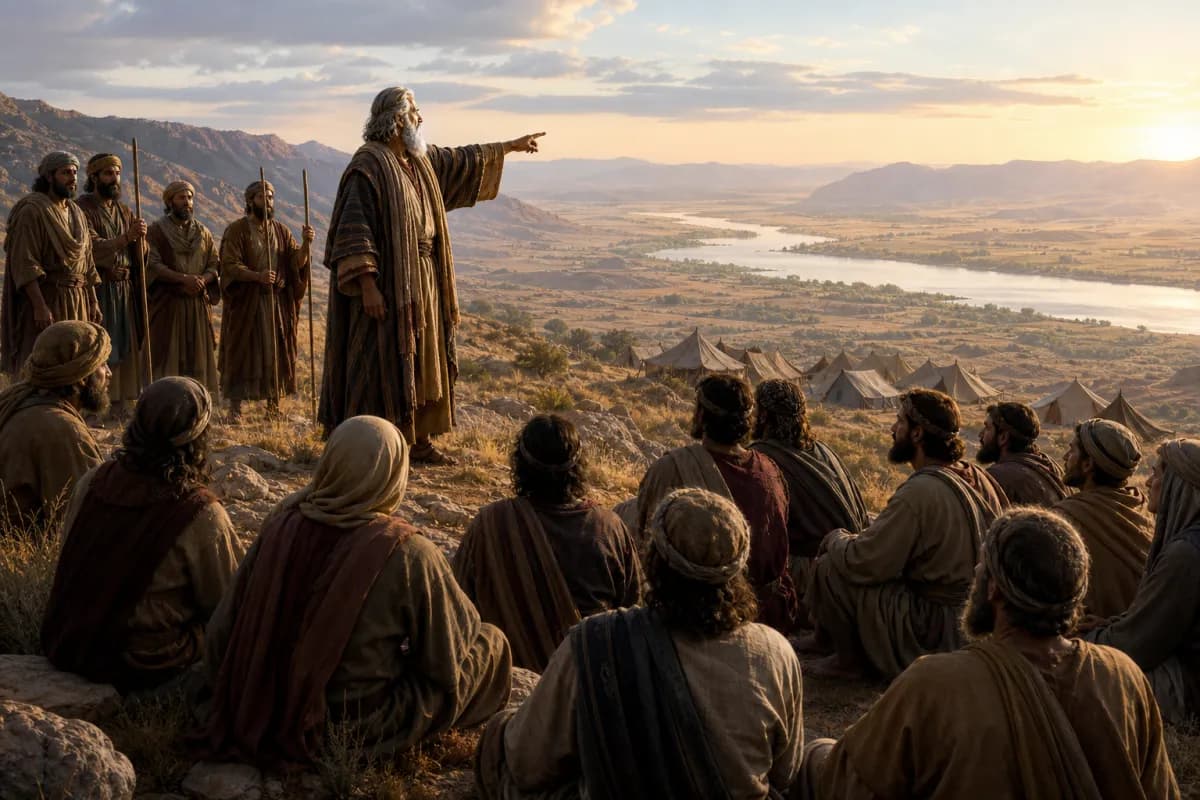
1:1These are the words which Moses spoke to all Israel beyond the Jordan in the wilderness, in the Arabah opposite Suf, between Paran, Tophel, Laban, Hazeroth, and Dizahab.
1:2It is eleven days’ journey from Horeb by the way of Mount Seir to Kadesh Barnea.
1:3In the fortieth year, in the eleventh month, on the first day of the month, Moses spoke to the children of Israel according to all that the LORD had given him in commandment to them,
1:4after he had struck Sihon the king of the Amorites who lived in Heshbon, and Og the king of Bashan who lived in Ashtaroth, at Edrei.
1:5Beyond the Jordan, in the land of Moab, Moses began to declare this law, saying,
1:6“The LORD our God spoke to us in Horeb, saying, ‘You have lived long enough at this mountain.
1:7Turn, and take your journey, and go to the hill country of the Amorites and to all the places near there: in the Arabah, in the hill country, in the lowland, in the South, by the seashore, in the land of the Canaanites, and in Lebanon as far as the great river, the river Euphrates.
1:8Behold, I have set the land before you. Go in and possess the land which the LORD swore to your fathers—to Abraham, to Isaac, and to Jacob—to give to them and to their offspring after them.’”
1:9I spoke to you at that time, saying, “I am not able to bear you myself alone.
1:10The LORD your God has multiplied you, and behold, you are today as the stars of the sky for multitude.
1:11May the LORD, the God of your fathers, make you a thousand times as many as you are and bless you, as he has promised you!
1:12How can I myself alone bear your problems, your burdens, and your strife?
1:13Take wise men of understanding who are respected among your tribes, and I will make them heads over you.”
1:14You answered me, and said, “The thing which you have spoken is good to do.”
1:15So I took the heads of your tribes, wise and respected men, and made them heads over you, captains of thousands, captains of hundreds, captains of fifties, captains of tens, and officers, according to your tribes.
1:16I commanded your judges at that time, saying, “Hear cases between your brothers and judge righteously between a man and his brother, and the foreigner who is living with him.
1:17You shall not show partiality in judgment; you shall hear the small and the great alike. You shall not be afraid of the face of man, for the judgment is God’s. The case that is too hard for you, you shall bring to me, and I will hear it.”
1:18I commanded you at that time all the things which you should do.
1:19We traveled from Horeb and went through all that great and terrible wilderness which you saw, by the way to the hill country of the Amorites, as the LORD our God commanded us; and we came to Kadesh Barnea.
1:20I said to you, “You have come to the hill country of the Amorites, which the LORD our God gives to us.
1:21Behold, the LORD your God has set the land before you. Go up, take possession, as the LORD the God of your fathers has spoken to you. Don’t be afraid, neither be dismayed.”
1:22You came near to me, everyone of you, and said, “Let’s send men before us, that they may search the land for us, and bring back to us word of the way by which we must go up, and the cities to which we shall come.”
1:23The thing pleased me well. I took twelve of your men, one man for every tribe.
1:24They turned and went up into the hill country, and came to the valley of Eshcol, and spied it out.
1:25They took some of the fruit of the land in their hands and brought it down to us, and brought us word again, and said, “It is a good land which the LORD our God gives to us.”
1:26Yet you wouldn’t go up, but rebelled against the commandment of the LORD your God.
1:27You murmured in your tents, and said, “Because the LORD hated us, he has brought us out of the land of Egypt, to deliver us into the hand of the Amorites to destroy us.
1:28Where are we going up? Our brothers have made our heart melt, saying, ‘The people are greater and taller than we. The cities are great and fortified up to the sky. Moreover we have seen the sons of the Anakim there!’”
1:29Then I said to you, “Don’t be terrified. Don’t be afraid of them.
1:30The LORD your God, who goes before you, he will fight for you, according to all that he did for you in Egypt before your eyes,
1:31and in the wilderness where you have seen how that the LORD your God carried you, as a man carries his son, in all the way that you went, until you came to this place.”
1:32Yet in this thing you didn’t believe the LORD your God,
1:33who went before you on the way, to seek out a place for you to pitch your tents in: in fire by night, to show you by what way you should go, and in the cloud by day.
1:34The LORD heard the voice of your words and was angry, and swore, saying,
1:35“Surely not one of these men of this evil generation shall see the good land which I swore to give to your fathers,
1:36except Caleb the son of Jephunneh. He shall see it. I will give the land that he has trodden on to him and to his children, because he has wholly followed the LORD.”
1:37Also the LORD was angry with me for your sakes, saying, “You also shall not go in there.
1:38Joshua the son of Nun, who stands before you, shall go in there. Encourage him, for he shall cause Israel to inherit it.
1:39Moreover your little ones, whom you said would be captured or killed, your children, who today have no knowledge of good or evil, shall go in there. I will give it to them, and they shall possess it.
1:40But as for you, turn, and take your journey into the wilderness by the way to the Red Sea.”
1:41Then you answered and said to me, “We have sinned against the LORD. We will go up and fight, according to all that the LORD our God commanded us.” Every man of you put on his weapons of war, and presumed to go up into the hill country.
1:42The LORD said to me, “Tell them, ‘Don’t go up and don’t fight; for I am not among you, lest you be struck before your enemies.’”
1:43So I spoke to you, and you didn’t listen; but you rebelled against the commandment of the LORD, and were presumptuous, and went up into the hill country.
1:44The Amorites, who lived in that hill country, came out against you and chased you as bees do, and beat you down in Seir, even to Hormah.
1:45You returned and wept before the LORD, but the LORD didn’t listen to your voice, nor turn his ear to you.
1:46So you stayed in Kadesh many days, according to the days that you remained.
CONTEXTUAL OVERVIEW
Deuteronomy is spoken on the plains of Moab as a new generation prepares to enter the land. Moses begins not by flattering them but by remembering their parents’ pivotal failure. The journey from Horeb should have moved toward inheritance, but Kadesh became the place where fear contradicted God’s promise.
The story holds two failures together. Israel first refuses to go because it sees enemies as stronger than God; after judgment is announced, it tries to go in its own strength despite God’s warning. Both fear-driven retreat and self-willed advance reject trustful dependence on the Lord.
HISTORICAL AND LITERARY CONTEXT
The chapter retells events recorded in Numbers 10–14, but Moses preaches the history for a new audience. His concern is covenant memory: the people must understand why a generation died in the wilderness and what it means now to listen and obey.
Moses also remembers the appointment of judges, showing that life in the promised land requires just communal order, not merely military success. The God who gives the land is the God who hears difficult cases and commands leaders to judge without partiality.
SECTION-BY-SECTION ANALYSIS
- The good land · Deuteronomy 1:25The land’s goodness is not disputed; the crisis is whether Israel will believe the God who promised it.
- The complaint · Deuteronomy 1:31Israel’s claim that God hates them reverses the meaning of the exodus and reveals how unbelief distorts God’s character.
- The second attempt · Deuteronomy 1:6Obedience cannot be replaced by spiritual bravado; entering without God’s command is as faithless as refusing His command.
CHRIST IN THIS PASSAGE
The New Testament explicitly treats the wilderness rebellion as a warning to believers. Israel heard God’s good news but did not enter because the word was not received with faith. Jesus, by contrast, is the faithful Son who obeys the Father in the wilderness and leads His people into the deeper rest of reconciliation with God.
Christ’s mission does not reduce the warning to a lesson in confidence. He bears the judgment sin deserves, forgives unbelieving hearts, and gives the Holy Spirit so His people can persevere in faith. Through Him, the promise of God’s presence is no longer a reason for presumption but the ground of humble obedience.
REFLECTION
Fear often speaks with religious vocabulary while quietly accusing God of withholding good. Deuteronomy invites an honest examination of the stories we tell ourselves when obedience seems costly: do they magnify the obstacle or the God who has promised to be with us?
Jesus calls His people neither to paralysis nor to self-directed heroics. He calls them to hear His word, repent when they have resisted it, and take the next faithful step in dependence on His presence. That trust becomes a public witness to His saving mission.
Original Hebrew Word Study
Deuteronomy 1:43
שָׁמַע
shema · H8085
Usually translated: to hear and obey
Shema means to hear with responsive obedience. Israel heard Moses’ warning but did not obey it, showing that hearing God’s word must become trustful action.
Follow the Scripture trail
Remembering the Journey: Unbelief at the Edge of Promise in the larger story
The connection: Israel’s failure at Kadesh shows that God’s promised inheritance cannot be received through fear or self-reliance. Jesus, the faithful Son, bears the consequences of unbelief and leads a redeemed people to trust God’s word, enter His rest, and serve His mission among the nations.
Respond to the passage
Name the place where fear has made God’s promise seem less trustworthy than the obstacle. Bring that unbelief to Jesus, ask for mercy and help, and obey the word He has actually given rather than retreating or rushing ahead on your own terms.
- How does Israel reinterpret God’s rescue when fear takes over at Kadesh?
- Why is the later attempt to fight without God not genuine repentance?
- How does Jesus’ faithfulness in the wilderness give hope to people who have failed to trust?
Prayer
Father, forgive the ways fear has made me doubt Your goodness. Thank You for Jesus, the faithful Son who brings me near and gives help in weakness. Teach me to hear Your word, repent quickly, and walk in humble trust wherever You lead. Amen.