Passage Study
What the Lord Requires: Fear, Love, and Justice
Deuteronomy 10:1–10:22
Deuteronomy 10:1–22 joins the renewal of the tablets after Israel’s rebellion to Moses’ call for wholehearted covenant life. The God who forgives and carries His people requires reverent love, calls them to care for the vulnerable, and reminds them that they were once strangers. Jesus fulfills this holy love and forms a people whose worship becomes mercy and justice in His mission.
- In this study
- 22 verses · 5 movements
Deuteronomy 10
10:1At that time the LORD said to me, “Cut two stone tablets like the first, and come up to me onto the mountain, and make an ark of wood.
10:2I will write on the tablets the words that were on the first tablets which you broke, and you shall put them in the ark.”
10:3So I made an ark of acacia wood, and cut two stone tablets like the first, and went up onto the mountain, having the two tablets in my hand.
10:4He wrote on the tablets, according to the first writing, the ten commandments, which the LORD spoke to you on the mountain out of the middle of the fire in the day of the assembly; and the LORD gave them to me.
10:5I turned and came down from the mountain, and put the tablets in the ark which I had made; and there they are as the LORD commanded me.
10:6(The children of Israel traveled from Beeroth Bene Jaakan to Moserah. There Aaron died, and there he was buried; and Eleazar his son ministered in the priest’s office in his place.
10:7From there they traveled to Gudgodah; and from Gudgodah to Jotbathah, a land of brooks of water.
10:8At that time the LORD set apart the tribe of Levi to bear the ark of the LORD’s covenant, to stand before the LORD to minister to him, and to bless in his name, to this day.
10:9Therefore Levi has no portion nor inheritance with his brothers; the LORD is his inheritance, according as the LORD your God spoke to him.)
10:10I stayed on the mountain, as at the first time, forty days and forty nights; and the LORD listened to me that time also. The LORD would not destroy you.
10:11The LORD said to me, “Arise, take your journey before the people; and they shall go in and possess the land which I swore to their fathers to give to them.”
10:12Now, Israel, what does the LORD your God require of you, but to fear the LORD your God, to walk in all his ways, to love him, and to serve the LORD your God with all your heart and with all your soul,
10:13to keep the LORD’s commandments and statutes, which I command you today for your good?
10:14Behold, to the LORD your God belongs heaven, the heaven of heavens, and the earth, with all that is therein.
10:15Only the LORD had a delight in your fathers to love them, and he chose their offspring after them, even you above all peoples, as it is today.
10:16Circumcise therefore the foreskin of your heart, and be no more stiff-necked.
10:17For the LORD your God, he is God of gods and Lord of lords, the great God, the mighty, and the awesome, who doesn’t respect persons or take bribes.
10:18He executes justice for the fatherless and widow and loves the foreigner in giving him food and clothing.
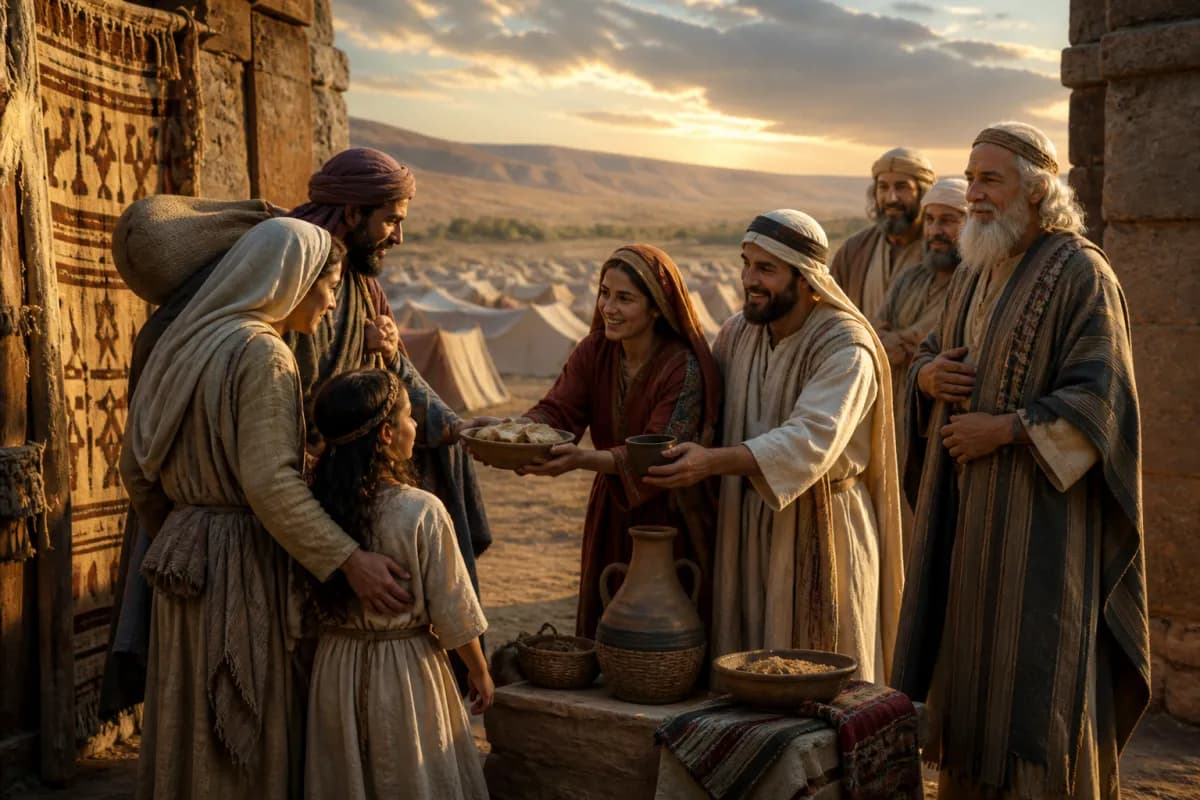
10:19Therefore love the foreigner, for you were foreigners in the land of Egypt.
10:20You shall fear the LORD your God. You shall serve him. You shall cling to him, and you shall swear by his name.
10:21He is your praise, and he is your God, who has done for you these great and awesome things which your eyes have seen.
10:22Your fathers went down into Egypt with seventy persons; and now the LORD your God has made you as the stars of the sky for multitude.
CONTEXTUAL OVERVIEW
After the golden calf, Israel’s future depends on mercy it did not earn. God commands Moses to make new tablets and places the renewed covenant words in the ark. The chapter begins with restoration before it moves to the obedience God requires.
Moses’ summary reaches its center in a searching question: “What does the Lord your God require of you?” The answer is relational and comprehensive—fear, walk, love, serve, and keep. Covenant obedience is not detached rule keeping; it is the whole life of a people carried and forgiven by God.
HISTORICAL AND LITERARY CONTEXT
Deuteronomy 10 continues the retelling of Israel’s rebellion in chapters 9–10. The renewed tablets do not deny the seriousness of the calf; they show that God’s covenant purpose continues through His mercy. Levites are set apart to bear the ark and bless in His name, placing worship at the center of communal life.
The chapter’s concern for the sojourner grows directly out of Israel’s own exodus memory. The God who is great and impartial loves the fatherless, widow, and resident alien. Israel is not told to imitate a generic ideal of kindness but the character of the God who rescued it while it was powerless in Egypt.
SECTION-BY-SECTION ANALYSIS
- Renewed tablets · Deuteronomy 10:2God’s mercy restores the covenant after rebellion, placing His words again at the center of Israel’s life.
- Circumcised heart · Deuteronomy 10:12The command reaches beyond external identity to a will no longer hardened against God.
- Love the sojourner · Deuteronomy 10:19God’s impartial care for the vulnerable becomes the pattern for the people He redeemed from Egypt.
CHRIST IN THIS PASSAGE
The prophets promise the heart transformation this command exposes as necessary, and the New Testament locates it in Christ and the Spirit. Jesus loves the Father with undivided obedience, welcomes the outsider, and bears the judgment of hard-hearted sin so that forgiven people may become new from within.
His mission joins worship and mercy rather than separating them. In Christ, people from every nation are brought near to God, and the church is taught to remember its own received mercy in the way it treats the vulnerable, stranger, and neighbor. This is not salvation by social action; it is the fruit of belonging to the Savior who first loved us.
REFLECTION
It is possible to retain a religious identity while resisting God in the heart. Deuteronomy refuses that separation. The God who forgives also asks for real love, reverent service, and a life that reflects His concern for people who lack power and protection.
Jesus meets hardened hearts with more than condemnation. Receive His mercy, ask Him to make your worship concrete in hospitality and justice, and let the memory of your own rescue make you patient toward those who need welcome and help.
Original Hebrew Word Study
Deuteronomy 10:12
יָרֵא
yare · H3372
Usually translated: to fear
Yare is reverent fear. Moses joins fearing the Lord with walking, loving, serving, and keeping His commands; covenant fear is whole-life allegiance.
Follow the Scripture trail
What the Lord Requires: Fear, Love, and Justice in the larger story
The connection: God renews His covenant with a rebellious people and calls them to reflect His holy, impartial love. Jesus fulfills the obedience Israel lacked, gives the heart renewal God promised, and sends His people to embody His mercy toward the nations and the vulnerable.
Respond to the passage
Ask Jesus to show you where outward habits have allowed you to avoid inward obedience. Receive His forgiveness, then choose one way to practice God’s impartial care—especially toward someone with less security, access, or welcome than you.
- Why does the chapter begin with renewed tablets after the golden calf?
- What does heart circumcision add to Israel’s outward covenant identity?
- How does Israel’s memory of being strangers shape its treatment of the sojourner?
Prayer
Merciful God, thank You for not abandoning Your people in their rebellion. Forgive my hard heart and renew me through Jesus. Teach me to fear and love You truly, and make Your welcome visible in the way I treat the vulnerable and the stranger. Amen.