Passage Study
Love, Remember, and Choose the Way of Life
Deuteronomy 11:1–11:32
Deuteronomy 11 calls Israel to love the Lord by remembering His acts in Egypt and the wilderness, teaching the next generation, receiving the land’s rain as His gift, and setting blessing and curse before the nation. The chapter leads to Jesus, who fulfills covenant faithfulness and brings sinners to the Father, then sends His people to love God with whole-hearted obedience rather than forgetful self-reliance.
- In this study
- 32 verses · 5 movements
Deuteronomy 11
11:1Therefore you shall love the LORD your God, and keep his instructions, his statutes, his ordinances, and his commandments, always.
11:2Know this day—for I don’t speak with your children who have not known, and who have not seen the chastisement of the LORD your God, his greatness, his mighty hand, his outstretched arm,
11:3his signs, and his works, which he did in the middle of Egypt to Pharaoh the king of Egypt, and to all his land;
11:4and what he did to the army of Egypt, to their horses, and to their chariots; how he made the water of the Red Sea to overflow them as they pursued you, and how the LORD has destroyed them to this day;
11:5and what he did to you in the wilderness until you came to this place;
11:6and what he did to Dathan and Abiram, the sons of Eliab, the son of Reuben—how the earth opened its mouth and swallowed them up, with their households, their tents, and every living thing that followed them, in the middle of all Israel;
11:7but your eyes have seen all of the LORD’s great work which he did.
11:8Therefore you shall keep the entire commandment which I command you today, that you may be strong, and go in and possess the land that you go over to possess;
11:9and that you may prolong your days in the land which the LORD swore to your fathers to give to them and to their offspring, a land flowing with milk and honey.
11:10For the land, where you go in to possess isn’t like the land of Egypt that you came out of, where you sowed your seed and watered it with your foot, as a garden of herbs;
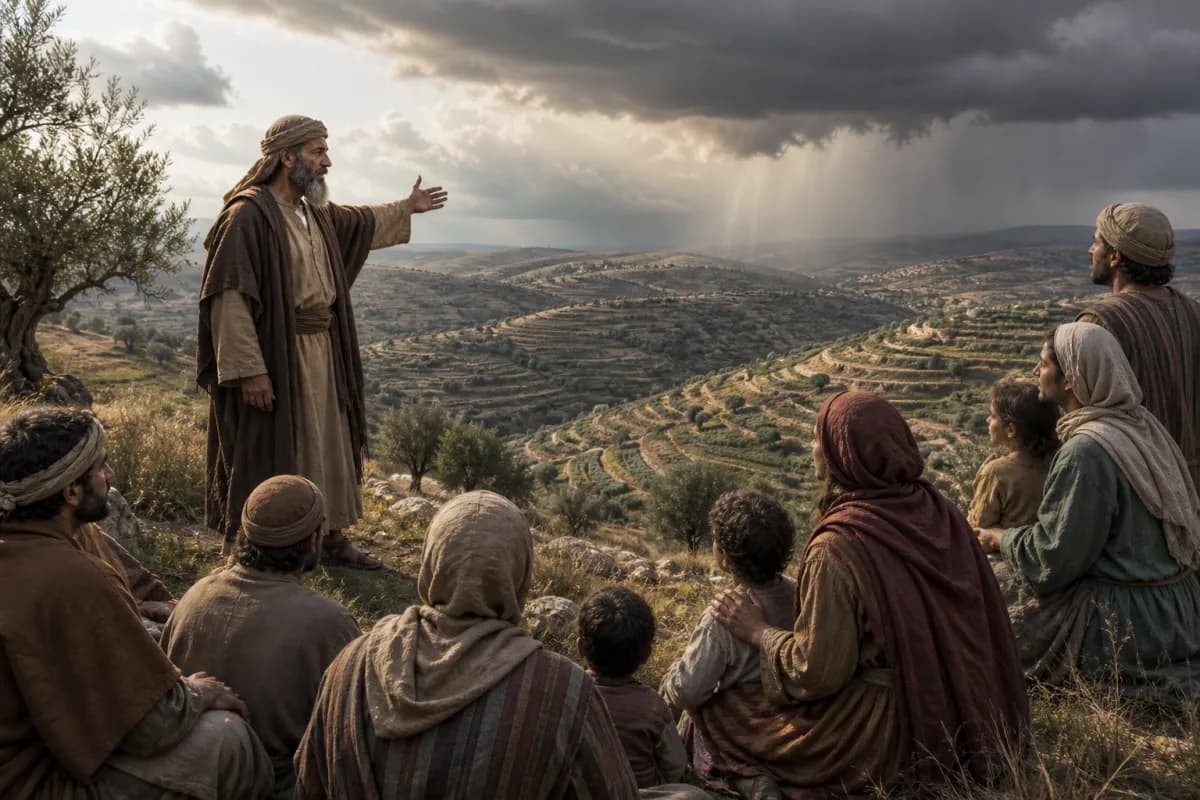
11:11but the land that you go over to possess is a land of hills and valleys which drinks water from the rain of the sky,
11:12a land which the LORD your God cares for. The LORD your God’s eyes are always on it, from the beginning of the year even to the end of the year.
11:13It shall happen, if you shall listen diligently to my commandments which I command you today, to love the LORD your God, and to serve him with all your heart and with all your soul,
11:14that I will give the rain for your land in its season, the early rain and the latter rain, that you may gather in your grain, your new wine, and your oil.
11:15I will give grass in your fields for your livestock, and you shall eat and be full.
11:16Be careful, lest your heart be deceived, and you turn away to serve other gods and worship them;
11:17and the LORD’s anger be kindled against you, and he shut up the sky so that there is no rain, and the land doesn’t yield its fruit; and you perish quickly from off the good land which the LORD gives you.
11:18Therefore you shall lay up these words of mine in your heart and in your soul. You shall bind them for a sign on your hand, and they shall be for frontlets between your eyes.
11:19You shall teach them to your children, talking of them when you sit in your house, when you walk by the way, when you lie down, and when you rise up.
11:20You shall write them on the door posts of your house and on your gates;
11:21that your days and your children’s days may be multiplied in the land which the LORD swore to your fathers to give them, as the days of the heavens above the earth.
11:22For if you shall diligently keep all these commandments which I command you—to do them, to love the LORD your God, to walk in all his ways, and to cling to him—
11:23then the LORD will drive out all these nations from before you, and you shall dispossess nations greater and mightier than yourselves.
11:24Every place on which the sole of your foot treads shall be yours: from the wilderness and Lebanon, from the river, the river Euphrates, even to the western sea shall be your border.
11:25No man will be able to stand before you. The LORD your God will lay the fear of you and the dread of you on all the land that you tread on, as he has spoken to you.
11:26Behold, I set before you today a blessing and a curse:
11:27the blessing, if you listen to the commandments of the LORD your God, which I command you today;
11:28and the curse, if you do not listen to the commandments of the LORD your God, but turn away out of the way which I command you today, to go after other gods which you have not known.
11:29It shall happen, when the LORD your God brings you into the land that you go to possess, that you shall set the blessing on Mount Gerizim, and the curse on Mount Ebal.
11:30Aren’t they beyond the Jordan, behind the way of the going down of the sun, in the land of the Canaanites who dwell in the Arabah near Gilgal, beside the oaks of Moreh?
11:31For you are to pass over the Jordan to go in to possess the land which the LORD your God gives you, and you shall possess it and dwell in it.
11:32You shall observe to do all the statutes and the ordinances which I set before you today.
CONTEXTUAL OVERVIEW
Moses speaks to people who have watched the wilderness generation fall and who now stand east of the Jordan. He does not begin with an abstract command to obey. He calls them to remember what their own eyes have seen: the Lord’s discipline, the exodus, the Red Sea, Dathan and Abiram’s judgment, and the daily care that brought them to this threshold.
The land ahead is fertile, but it will train Israel in a different kind of dependence. Egypt’s fields were watered by human labor; Canaan drinks rain from heaven. Israel’s food, security, and future will depend on the Lord’s continuing attention, so love for Him must govern the heart rather than merely the moment of crisis.
HISTORICAL AND LITERARY CONTEXT
Deuteronomy 11 concludes the opening covenant exhortations before the detailed laws begin in chapter 12. Moses speaks as Israel prepares to cross into an agricultural land after decades of wilderness dependence. The contrast with Egypt is not a scientific claim about irrigation systems alone; it is a theological contrast between a life people may imagine they control and a land where rain visibly comes from God.
The chapter’s audience includes children who did not personally witness every exodus event. Parents must teach them through speech, household habits, travel, work, and rest. Covenant faithfulness is therefore communal and intergenerational: memory is carried by a people who keep telling the truth about the God who rescued them.
SECTION-BY-SECTION ANALYSIS
- Eyes that saw · Deuteronomy 11:12Memory of God’s mighty acts gives substance to obedience and prevents Israel from treating grace as a distant story.
- Rain from heaven · Deuteronomy 11:17The land’s fruitfulness is received from the Lord, exposing the illusion that prosperity can secure itself.
- Words everywhere · Deuteronomy 11:18God’s commands are taught in ordinary life so that covenant love shapes the next generation before rival loves take root.
CHRIST IN THIS PASSAGE
Deuteronomy 11 is addressed to Israel under the Mosaic covenant, so its land and rainfall promises should not be turned into a universal guarantee of personal prosperity. Its deeper demand—whole-hearted love for God—reveals a failure that reaches every human heart. Jesus loves the Father without divided loyalty, bears the curse sin deserves, and brings those who trust Him into the blessing of communion with God.
Jesus also makes disciples by teaching them to obey all He commanded. His saving mission creates a people whose faith is spoken at tables, practiced in homes, and carried into the world. Christians remember not only the exodus but Christ’s death and resurrection, letting that grace shape their obedience and their witness to the next generation.
REFLECTION
Forgetting rarely begins with a formal rejection of God. It begins when provision feels ordinary, success feels self-made, and prayer becomes unnecessary. Deuteronomy asks us to name the mercies that brought us here before we make plans for what comes next.
Thank Jesus for one specific act of grace you have begun to treat as normal. Then choose one ordinary setting—a meal, commute, bedtime, work conversation, or act of service—in which you will speak His goodness and practice the love that His saving mercy has awakened.
Original Hebrew Word Study
Deuteronomy 11:26
בְּרָכָה
berakhah · H1293
Usually translated: blessing
Berakhah is blessing. The choice of blessing and curse places Israel’s future openly before them, linking life in the land to covenant listening.
Follow the Scripture trail
Love, Remember, and Choose the Way of Life in the larger story
The connection: Israel stands before blessing and curse, summoned to remember the Lord and love Him in a land dependent on His rain. Jesus fulfills the faithful love Israel lacked, bears sin’s curse, and sends a redeemed people to remember His grace and teach His way among the nations.
Respond to the passage
Identify one mercy you have stopped noticing and thank Jesus for it by name. Ask Him to expose any rival loyalty formed by comfort or fear, then make one deliberate habit of speaking His saving work to someone entrusted to your care.
- Why does Moses connect Israel’s future obedience to remembered acts of God rather than to national confidence?
- What does the contrast between Egypt and Canaan teach about prosperity and dependence?
- How does Christ’s bearing of the curse change the way Christians hear the chapter’s serious call to love God?
Prayer
Father, forgive my forgetfulness and the pride that treats Your gifts as self-made. Thank You for Jesus, who loved You perfectly and bore my curse. Keep Your word near my heart and make my home, work, and speech a witness to Your saving grace. Amen.