Passage Study
A Holy People in Grief, Food, and Generosity
Deuteronomy 14:1–14:29
Deuteronomy 14 calls Israel God’s children and treasured people, forbids pagan mourning practices, distinguishes clean from unclean foods, and commands a tithe that nourishes worship, Levites, resident aliens, orphans, and widows. Holiness reaches grief, meals, money, and communal care. Jesus makes a people holy through His saving work and sends them to display the Father’s generosity in everyday life.
- In this study
- 29 verses · 5 movements
Deuteronomy 14
14:1You are the children of the LORD your God. You shall not cut yourselves, nor make any baldness between your eyes for the dead.
14:2For you are a holy people to the LORD your God, and the LORD has chosen you to be a people for his own possession, above all peoples who are on the face of the earth.
14:3You shall not eat any abominable thing.
14:4These are the animals which you may eat: the ox, the sheep, the goat,
14:5the deer, the gazelle, the roebuck, the wild goat, the ibex, the antelope, and the chamois.
14:6Every animal that parts the hoof, and has the hoof split in two and chews the cud, among the animals, you may eat.
14:7Nevertheless these you shall not eat of them that chew the cud, or of those who have the hoof split: the camel, the hare, and the rabbit. Because they chew the cud but don’t part the hoof, they are unclean to you.
14:8The pig, because it has a split hoof but doesn’t chew the cud, is unclean to you. You shall not eat their meat. You shall not touch their carcasses.
14:9These you may eat of all that are in the waters: you may eat whatever has fins and scales.
14:10You shall not eat whatever doesn’t have fins and scales. It is unclean to you.
14:11Of all clean birds you may eat.
14:12But these are they of which you shall not eat: the eagle, the vulture, the osprey,
14:13the red kite, the falcon, the kite of any kind,
14:14every raven of any kind,
14:15the ostrich, the owl, the seagull, the hawk of any kind,
14:16the little owl, the great owl, the horned owl,
14:17the pelican, the vulture, the cormorant,
14:18the stork, the heron after its kind, the hoopoe, and the bat.
14:19All winged creeping things are unclean to you. They shall not be eaten.
14:20Of all clean birds you may eat.
14:21You shall not eat of anything that dies of itself. You may give it to the foreigner living among you who is within your gates, that he may eat it; or you may sell it to a foreigner; for you are a holy people to the LORD your God. You shall not boil a young goat in its mother’s milk.
14:22You shall surely tithe all the increase of your seed, that which comes out of the field year by year.
14:23You shall eat before the LORD your God, in the place which he chooses to cause his name to dwell, the tithe of your grain, of your new wine, and of your oil, and the firstborn of your herd and of your flock; that you may learn to fear the LORD your God always.
14:24If the way is too long for you, so that you are not able to carry it because the place which the LORD your God shall choose to set his name there is too far from you, when the LORD your God blesses you,
14:25then you shall turn it into money, bind up the money in your hand, and shall go to the place which the LORD your God shall choose.
14:26You shall trade the money for whatever your soul desires: for cattle, or for sheep, or for wine, or for strong drink, or for whatever your soul asks of you. You shall eat there before the LORD your God, and you shall rejoice, you and your household.
14:27You shall not forsake the Levite who is within your gates, for he has no portion nor inheritance with you.
14:28At the end of every three years you shall bring all the tithe of your increase in the same year, and shall store it within your gates.
14:29The Levite, because he has no portion nor inheritance with you, as well as the foreigner living among you, the fatherless, and the widow who are within your gates shall come, and shall eat and be satisfied; that the LORD your God may bless you in all the work of your hand which you do.
CONTEXTUAL OVERVIEW
Deuteronomy 14 begins in the raw place of grief. Israel is called the children of the Lord and is forbidden to cut itself or shave a bald patch for the dead, practices associated with surrounding mourning rites. God does not command His people to feel nothing at death; He tells them that their grief must be shaped by their belonging to Him rather than by rituals that seek other spiritual powers.
The chapter then moves through food and tithe. What Israel eats, where it rejoices, and how it shares its increase all become expressions of holy identity. The same people who refuse pagan mourning are commanded to bring their harvest before the Lord and to ensure that Levites and vulnerable neighbors are not excluded from the community’s provision.
HISTORICAL AND LITERARY CONTEXT
The food laws repeat and adapt distinctions found in Leviticus. Clean land animals both chew the cud and have divided hooves; aquatic creatures have fins and scales; certain birds and swarming creatures are excluded. The text gives Israel a daily embodied reminder that it belongs to the Lord, rather than an explanation of modern nutrition or a scale of moral worth between foods.
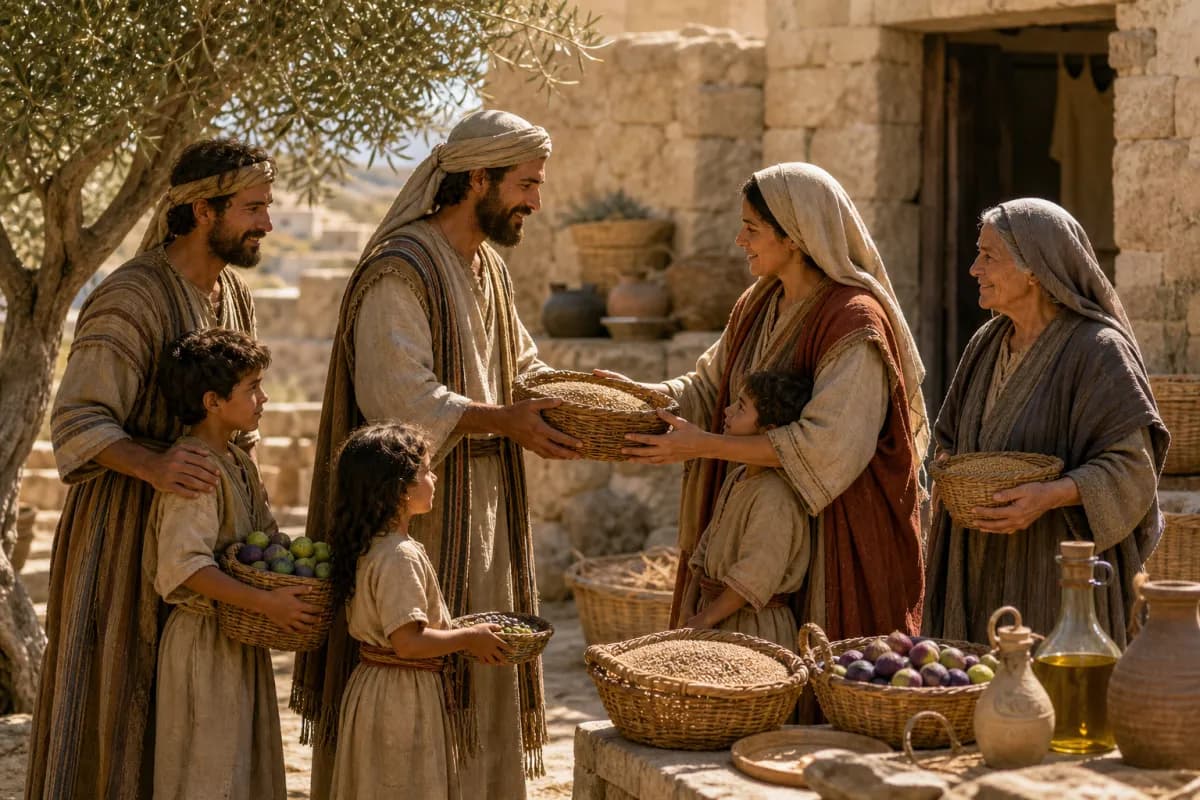
The tithe provisions assume an agrarian society in which produce and firstlings could be brought to the worship center. If the journey was too long, Israel could exchange the tithe for money and buy food and drink at the chosen place to rejoice before the Lord. Every third year, the stored tithe served Levites, resident aliens, orphans, and widows, joining worship to concrete care.
SECTION-BY-SECTION ANALYSIS
- Children and holy people · Deuteronomy 14:21Israel’s practices arise from its relationship to the Lord, not from a desire to prove itself more worthy than other nations.
- Food as formation · Deuteronomy 14:2Meals repeatedly remind Israel that ordinary appetite belongs under the holy God’s claim.
- Tithe as shared joy · Deuteronomy 14:23The produce given before the Lord becomes worship that includes servants of worship and neighbors at risk of being overlooked.
CHRIST IN THIS PASSAGE
The clean and unclean food laws marked Israel’s covenant identity; the New Testament teaches that Christ’s saving work opens the people of God to the nations and changes how believers relate to those ritual boundaries. Jesus declares that defilement comes from the heart, and Peter receives a vision that prepares him to welcome Gentiles. The change does not make holiness optional; it reveals holiness as a life made clean by Christ and directed toward love.
Jesus also brings grieving people to the Father as beloved children and creates a generous household from those once far off. His mission makes meals, money, and care for the vulnerable places of witness. Christians do not earn belonging through food rules or giving, but the Savior’s grace should make His people visibly thankful, hospitable, and attentive to those whose need is easy to miss.
REFLECTION
This passage resists compartmentalized faith. Grief, appetite, budget, celebration, and hospitality all reveal what we believe about the God to whom we belong. The question is not whether every Christian should reproduce Israel’s food laws or tithe system; it is whether our ordinary habits show that Christ has made us His own.
Bring a grief, a spending pattern, or a meal table to Jesus. Ask Him to make it a place of holy trust rather than self-protection. Then include someone in a concrete act of provision or welcome, especially a person who may lack the household security you take for granted.
Original Hebrew Word Study
Deuteronomy 14:2
קָדוֹשׁ
qadosh · H6918
Usually translated: holy
Qadosh means holy. Israel’s food and mourning practices are shaped by their identity as a people set apart for the Lord.
Follow the Scripture trail
A Holy People in Grief, Food, and Generosity in the larger story
The connection: Israel’s identity as God’s holy children reshapes mourning, meals, and harvest-sharing into daily worship. Jesus cleanses sinners and gathers people from every nation into the Father’s family, sending them to make His holiness visible through grateful hospitality and care for the vulnerable.
Respond to the passage
Choose one ordinary habit—how you eat, spend, grieve, or host—and place it deliberately before Jesus. Ask whom His generosity is calling you to include, then take a concrete step of welcome or provision this week.
- Why does the chapter begin with Israel’s identity as God’s children before speaking about mourning and food?
- What does the third-year tithe reveal about the relationship between worship and care for vulnerable neighbors?
- How does Christ’s cleansing of people from every nation deepen rather than erase the call to holy, generous living?
Prayer
Father, thank You for making Your people Your own. Meet me in my grief, appetite, and use of resources through Jesus. Make my daily habits holy, my table open, and my care for vulnerable neighbors a witness to Your generous love. Amen.