Passage Study
Refuge, Truth, and Justice without Revenge
Deuteronomy 19:1–19:21
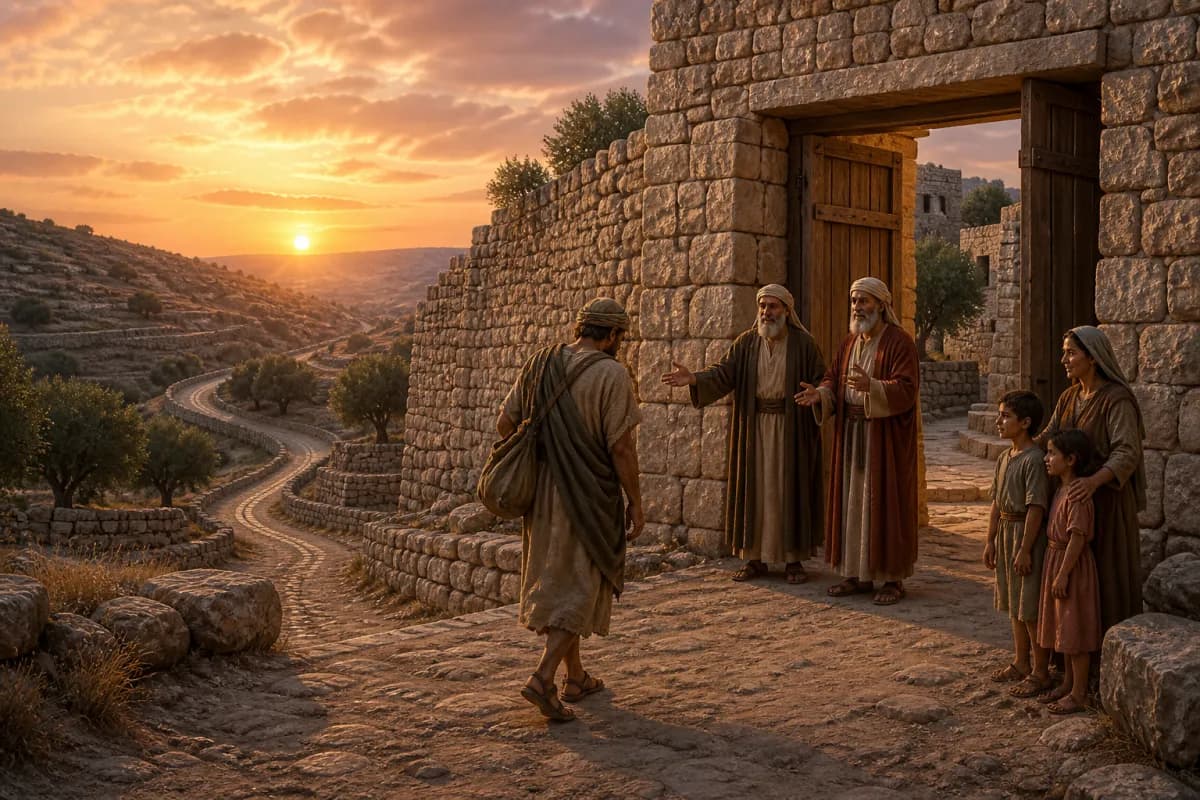
Deuteronomy 19 establishes accessible cities of refuge for unintentional killers, protects boundary markers, and requires corroborated testimony before judicial punishment. The chapter refuses both indifference to bloodshed and impulsive revenge. It directs readers to Jesus, whose saving work gives guilty sinners refuge through repentance and faith while forming a people committed to truthful speech and just judgment.
- In this study
- 21 verses · 5 movements
Deuteronomy 19
19:1When the LORD your God cuts off the nations whose land the LORD your God gives you, and you succeed them and dwell in their cities and in their houses,
19:2you shall set apart three cities for yourselves in the middle of your land, which the LORD your God gives you to possess.
19:3You shall prepare the way, and divide the borders of your land which the LORD your God causes you to inherit into three parts, that every man slayer may flee there.
19:4This is the case of the man slayer who shall flee there and live: Whoever kills his neighbor unintentionally, and didn’t hate him in time past—
19:5as when a man goes into the forest with his neighbor to chop wood and his hand swings the ax to cut down the tree, and the head slips from the handle and hits his neighbor so that he dies—he shall flee to one of these cities and live.
19:6Otherwise, the avenger of blood might pursue the man slayer while hot anger is in his heart and overtake him, because the way is long, and strike him mortally, even though he was not worthy of death, because he didn’t hate him in time past.
19:7Therefore I command you to set apart three cities for yourselves.
19:8If the LORD your God enlarges your border, as he has sworn to your fathers, and gives you all the land which he promised to give to your fathers;
19:9and if you keep all this commandment to do it, which I command you today, to love the LORD your God, and to walk ever in his ways, then you shall add three cities more for yourselves, in addition to these three.
19:10This is so that innocent blood will not be shed in the middle of your land which the LORD your God gives you for an inheritance, leaving blood guilt on you.
19:11But if any man hates his neighbor, lies in wait for him, rises up against him, strikes him mortally so that he dies, and he flees into one of these cities;
19:12then the elders of his city shall send and bring him there, and deliver him into the hand of the avenger of blood, that he may die.
19:13Your eye shall not pity him, but you shall purge the innocent blood from Israel that it may go well with you.
19:14You shall not remove your neighbor’s landmark, which they of old time have set, in your inheritance which you shall inherit, in the land that the LORD your God gives you to possess.
19:15One witness shall not rise up against a man for any iniquity, or for any sin that he sins. At the mouth of two witnesses, or at the mouth of three witnesses, shall a matter be established.
19:16If an unrighteous witness rises up against any man to testify against him of wrongdoing,
19:17then both the men, between whom the controversy is, shall stand before the LORD, before the priests and the judges who shall be in those days;
19:18and the judges shall make diligent inquisition; and behold, if the witness is a false witness, and has testified falsely against his brother,
19:19then you shall do to him as he had thought to do to his brother. So you shall remove the evil from among you.
19:20Those who remain shall hear, and fear, and will never again commit any such evil among you.
19:21Your eyes shall not pity: life for life, eye for eye, tooth for tooth, hand for hand, foot for foot.
CONTEXTUAL OVERVIEW
Deuteronomy 19 addresses situations where death, property, and testimony can quickly generate violence. A man whose axe head flies off while cutting wood is not treated as though he planned a murder, yet the loss of life is not dismissed. Israel must make a real path to refuge before a family avenger turns grief into a second death.
The chapter then turns from accidental bloodshed to the slower violence of dishonest boundaries and false charges. Moving a marker can dispossess a neighbor quietly; a single malicious witness can destroy a life publicly. God’s justice therefore cares about roads, tools, field lines, courtroom procedure, and the motives hidden beneath an accusation.
HISTORICAL AND LITERARY CONTEXT
Cities of refuge do not abolish the ancient family duty to answer bloodshed; they place it within covenant procedure. Their location and maintained roads are practical safeguards, because an accidental killer must be able to flee before anger reaches him. Deliberate murder remains a different moral category and is not protected by refuge.
Boundary stones marked inherited fields in an agrarian society where land sustained a household across generations. The witness laws likewise recognize that legal systems can be manipulated. Deuteronomy requires careful inquiry and reciprocal consequence for a witness who intentionally seeks to injure another through a lie.
SECTION-BY-SECTION ANALYSIS
- Prepare the roads · Deuteronomy 19:3Justice includes practical access: a refuge that cannot be reached in time does not protect the vulnerable.
- No prior hatred · Deuteronomy 19:6The law distinguishes tragic accident from intent by attending to the relationship and circumstances before the death.
- Two or three witnesses · Deuteronomy 19:15Corroboration protects a neighbor from a single person turning accusation into a weapon.
CHRIST IN THIS PASSAGE
The city of refuge is not a simple picture in which every detail directly represents Jesus, and its protection is explicitly for unintentional killing rather than deliberate rebellion. Still, the broader covenant pattern is strong: God makes a way for threatened people to come under just protection without denying the seriousness of bloodshed. Jesus bears the judgment sinners deserve and receives those who turn to Him in faith.
Christ also fulfills the demand for truth and justice. He is condemned through false witness, yet His resurrection vindicates Him and exposes the injustice of the verdict. His saving mission forms people who refuse revenge, protect their neighbors from slander, confess their own guilt honestly, and invite the guilty to find mercy through His cross.
REFLECTION
This chapter will not let us treat a tragic outcome, a disputed accusation, or a neighbor’s property as merely someone else’s problem. God’s people prepare paths of protection before a crisis comes: clear procedures, careful listening, accessible help, and a refusal to spread a charge before it has been tested.
Ask Jesus where fear, loyalty, or anger has made you careless with a story about another person. Practice one act of justice today: verify before repeating, protect a vulnerable neighbor’s dignity, correct a false impression, or seek help rather than acting out of revenge.
Original Hebrew Word Study
Deuteronomy 19:15
עֵד
ed · H5707
Usually translated: witness
Ed is a witness. Justice requires corroborated testimony, guarding the community from a single accusation becoming an instrument of harm.
Follow the Scripture trail
Refuge, Truth, and Justice without Revenge in the larger story
The connection: Deuteronomy insists that life, land, and testimony be guarded by accessible refuge and careful judgment. Jesus carries that concern to its saving center: through His cross sinners find mercy without truth being denied, and His people become witnesses who seek justice rather than revenge.
Respond to the passage
Come honestly to Jesus with the guilt, anger, or fear you have been hiding. Then choose one way to protect truth and your neighbor’s good name: slow down an accusation, verify evidence, or make a needed correction.
- Why does the chapter make road maintenance part of its justice for an accidental killer?
- How does the axe-head example keep Israel from confusing accident with murder?
- What does the law against malicious testimony require of Christians before they share a damaging claim?
Prayer
Lord Jesus, thank You for being my refuge through Your costly mercy. Guard me from careless speech, revenge, and unjust judgment. Make me quick to tell the truth, ready to protect my neighbor, and faithful to seek peace without ignoring real wrong. Amen.