Passage Study
Boundaries in the Wilderness: The Lord Who Gives and Withholds
Deuteronomy 2:1–2:37
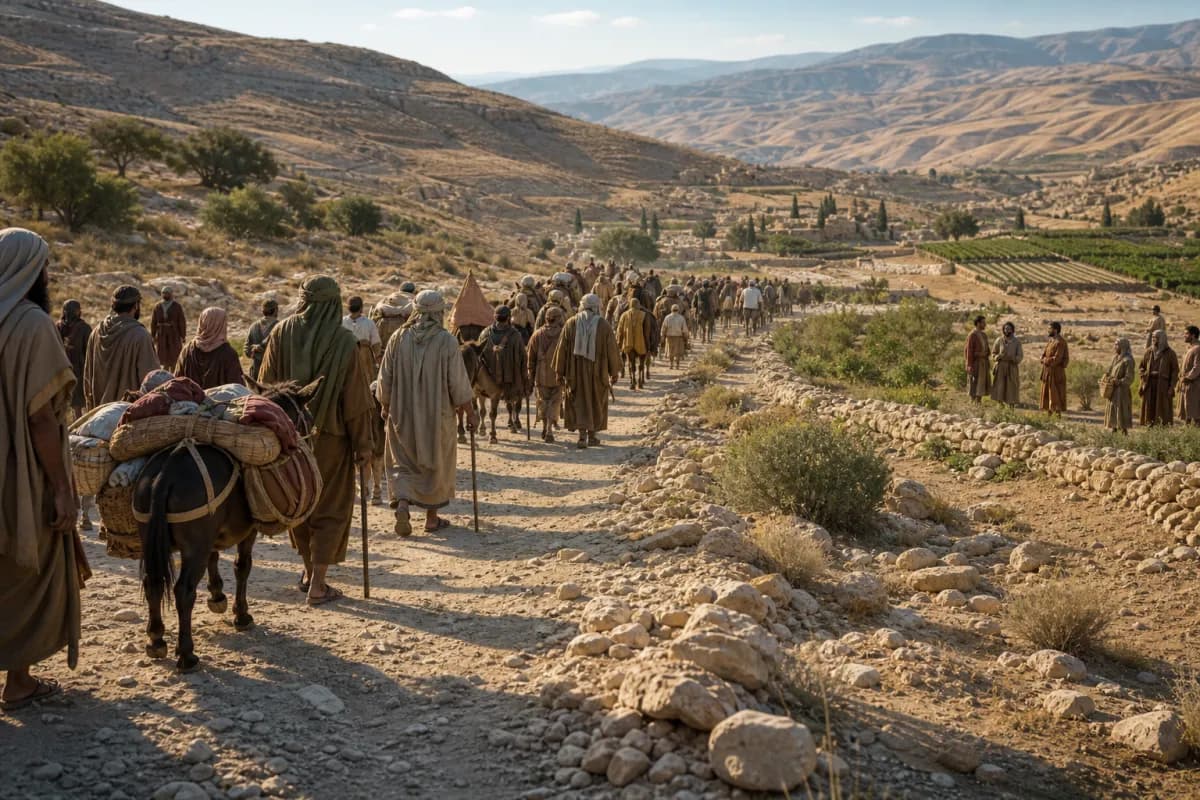
Deuteronomy 2 recounts Israel’s long movement around Edom, Moab, and Ammon before the Lord gives victory over Sihon. Israel is commanded to respect lands God has allotted to other peoples and then to advance when He gives a specific command. The chapter teaches a disciplined trust in God’s rule, which finds its deepest clarity in Jesus, the King who saves His people and sends them on His mission by His word rather than their appetite for control.
- In this study
- 37 verses · 5 movements
Deuteronomy 2
2:1Then we turned, and took our journey into the wilderness by the way to the Red Sea, as the LORD spoke to me; and we encircled Mount Seir many days.
2:2The LORD spoke to me, saying,
2:3“You have encircled this mountain long enough. Turn northward.
2:4Command the people, saying, ‘You are to pass through the border of your brothers, the children of Esau, who dwell in Seir; and they will be afraid of you. Therefore be careful.
2:5Don’t contend with them; for I will not give you any of their land, no, not so much as for the sole of the foot to tread on, because I have given Mount Seir to Esau for a possession.
2:6You shall purchase food from them for money, that you may eat. You shall also buy water from them for money, that you may drink.’”
2:7For the LORD your God has blessed you in all the work of your hands. He has known your walking through this great wilderness. These forty years, the LORD your God has been with you. You have lacked nothing.
2:8So we passed by from our brothers, the children of Esau, who dwell in Seir, from the way of the Arabah from Elath and from Ezion Geber. We turned and passed by the way of the wilderness of Moab.
2:9The LORD said to me, “Don’t bother Moab, neither contend with them in battle; for I will not give you any of his land for a possession, because I have given Ar to the children of Lot for a possession.”
2:10(The Emim lived there before, a great and numerous people, and tall as the Anakim.
2:11These also are considered to be Rephaim, as the Anakim; but the Moabites call them Emim.
2:12The Horites also lived in Seir in the past, but the children of Esau succeeded them. They destroyed them from before them, and lived in their place, as Israel did to the land of his possession, which the LORD gave to them.)
2:13“Now rise up and cross over the brook Zered.” We went over the brook Zered.
2:14The days in which we came from Kadesh Barnea until we had come over the brook Zered were thirty-eight years, until all the generation of the men of war were consumed from the middle of the camp, as the LORD swore to them.
2:15Moreover the LORD’s hand was against them, to destroy them from the middle of the camp, until they were consumed.
2:16So, when all the men of war were consumed and dead from among the people,
2:17the LORD spoke to me, saying,
2:18“You are to pass over Ar, the border of Moab, today.
2:19When you come near the border of the children of Ammon, don’t bother them, nor contend with them; for I will not give you any of the land of the children of Ammon for a possession, because I have given it to the children of Lot for a possession.”
2:20(That also is considered a land of Rephaim. Rephaim lived there in the past, but the Ammonites call them Zamzummim,
2:21a great people, many, and tall, as the Anakim; but the LORD destroyed them from before Israel, and they succeeded them, and lived in their place,
2:22as he did for the children of Esau who dwell in Seir, when he destroyed the Horites from before them; and they succeeded them, and lived in their place even to this day.
2:23Then the Avvim, who lived in villages as far as Gaza: the Caphtorim, who came out of Caphtor, destroyed them and lived in their place.)
2:24“Rise up, take your journey, and pass over the valley of the Arnon. Behold, I have given into your hand Sihon the Amorite, king of Heshbon, and his land; begin to possess it, and contend with him in battle.
2:25Today I will begin to put the dread of you and the fear of you on the peoples who are under the whole sky, who shall hear the report of you, and shall tremble and be in anguish because of you.”
2:26I sent messengers out of the wilderness of Kedemoth to Sihon king of Heshbon with words of peace, saying,
2:27“Let me pass through your land. I will go along by the highway. I will turn neither to the right hand nor to the left.
2:28You shall sell me food for money, that I may eat; and give me water for money, that I may drink. Just let me pass through on my feet,
2:29as the children of Esau who dwell in Seir, and the Moabites who dwell in Ar, did to me, until I pass over the Jordan into the land which the LORD our God gives us.”
2:30But Sihon king of Heshbon would not let us pass by him, for the LORD your God hardened his spirit and made his heart obstinate, that he might deliver him into your hand, as it is today.
2:31The LORD said to me, “Behold, I have begun to deliver up Sihon and his land before you. Begin to possess, that you may inherit his land.”
2:32Then Sihon came out against us, he and all his people, to battle at Jahaz.
2:33The LORD our God delivered him up before us; and we struck him, his sons, and all his people.
2:34We took all his cities at that time, and utterly destroyed every inhabited city, with the women and the little ones. We left no one remaining.
2:35Only the livestock we took for plunder for ourselves, with the plunder of the cities which we had taken.
2:36From Aroer, which is on the edge of the valley of the Arnon, and the city that is in the valley, even to Gilead, there was not a city too high for us. The LORD our God delivered up all before us.
2:37Only to the land of the children of Ammon you didn’t come near: all the banks of the river Jabbok, and the cities of the hill country, and wherever the LORD our God forbade us.
CONTEXTUAL OVERVIEW
Moses is teaching the generation about to enter the land. Before he tells of conquest, he remembers years of restraint. Israel had been told not to provoke Esau’s descendants, Moab, or Ammon, even when food and water were needed and the promised land still seemed far away.
That restraint makes the later command against Sihon more striking. Israel does not move whenever it feels strong enough, nor does it treat every neighboring people as an obstacle to be removed. The Lord sets the limits, supplies the need, and determines when His people are to wait and when they are to go forward.
HISTORICAL AND LITERARY CONTEXT
Deuteronomy 2 continues Moses’ retelling of the wilderness years on the plains of Moab. The chapter names Edom, Moab, Ammon, and the Amorite kingdom of Sihon, placing Israel’s story among real neighboring peoples and territories east of the Jordan. Moses’ point is theological before it is geopolitical: the Lord is not a tribal deity with a small reach; He governs the inheritance and removal of nations.
The references to earlier peoples displaced from these territories explain that Israel’s coming possession is neither automatic nor unique in the sense of exempting it from God’s judgment. Later Scripture will make the same point when Israel itself is warned that continued rebellion can lead to exile. God’s gift of land never licenses arrogance.
SECTION-BY-SECTION ANALYSIS
- Do not contend · Deuteronomy 2:9God’s commands to leave Edom, Moab, and Ammon alone show that Israel’s calling had defined limits.
- Buy food and water · Deuteronomy 2:6Ordinary transactions in the wilderness become a testimony that God had not abandoned His people.
- The Arnon crossing · Deuteronomy 2:36The change from restraint to advance comes from the Lord’s explicit direction, not from Israel’s impatience.
CHRIST IN THIS PASSAGE
Deuteronomy 2 does not turn its territorial boundaries into a direct prediction of Jesus. Its enduring pattern is that God’s redeemed people move under His authority, not under a mandate to seize whatever seems useful. Jesus fulfills God’s kingship in a way that rejects domination: He receives all authority through His death and resurrection and sends disciples to make disciples, not to take land by force.
The chapter also exposes the need for a people who can trust God’s timing. Jesus is the faithful Son who obeys the Father’s will even when the path leads through suffering. By His saving death He brings sinners into God’s kingdom, and by His Spirit He teaches the church to pursue its mission with obedience, peace, courage, and restraint.
REFLECTION
Some faithful decisions require a clear yes; others require a costly no. Israel’s long detours were not evidence that God had lost the route. They were part of learning that His provision and His boundaries could be trusted even before the promised destination was visible.
Jesus frees His people from treating every opportunity, rivalry, or possession as something they must win. Ask where impatience has dressed itself up as faith. Then bring that desire to Christ and seek the next act of obedience He has actually put before you—whether that is waiting, making peace, or moving forward with humble courage.
Original Hebrew Word Study
Deuteronomy 2:24
יָרַשׁ
yarash · H3423
Usually translated: to take possession
Yarash means to take possession. Israel’s victories are remembered as gifts the Lord gives within the boundaries He has established for the nations.
Follow the Scripture trail
Boundaries in the Wilderness: The Lord Who Gives and Withholds in the larger story
The connection: Israel learns that the Lord rules its path, its provision, and its limits before granting victory east of the Jordan. Jesus reveals that reign in its saving fullness: He gathers people into God’s kingdom by grace and sends them to serve the nations under His authority and peace.
Respond to the passage
Bring to Jesus one place where you are trying to force an outcome. Ask Him to replace control with trust, and take the next obedient step He has made clear without claiming authority He has not given you.
- Why does Moses spend so much time remembering the nations Israel was forbidden to attack?
- What does the command to buy food and water reveal about God’s care during the detour?
- How does Jesus’ mission correct the impulse to confuse Christian faithfulness with control or conquest?
Prayer
Lord Jesus, You are King over every border, season, and opportunity. Forgive me for grasping what You have not given and for fearing the path You have chosen. Teach me to trust Your provision, honor Your limits, and follow Your mission with peace and courage. Amen.