Passage Study
Courage under the Lord’s Command
Deuteronomy 20:1–20:20
Deuteronomy 20 gives Israel instructions for battle in the promised land: the priest calls the army not to fear, certain men return home, distant cities first receive an offer of peace, and the Canaanite nations face a unique judgment. The chapter cannot be detached from its covenant setting or used to bless later violence. It directs believers to Jesus, who wins His kingdom through the cross and sends His church in witness, peace, and sacrificial love.
- In this study
- 20 verses · 5 movements
Deuteronomy 20
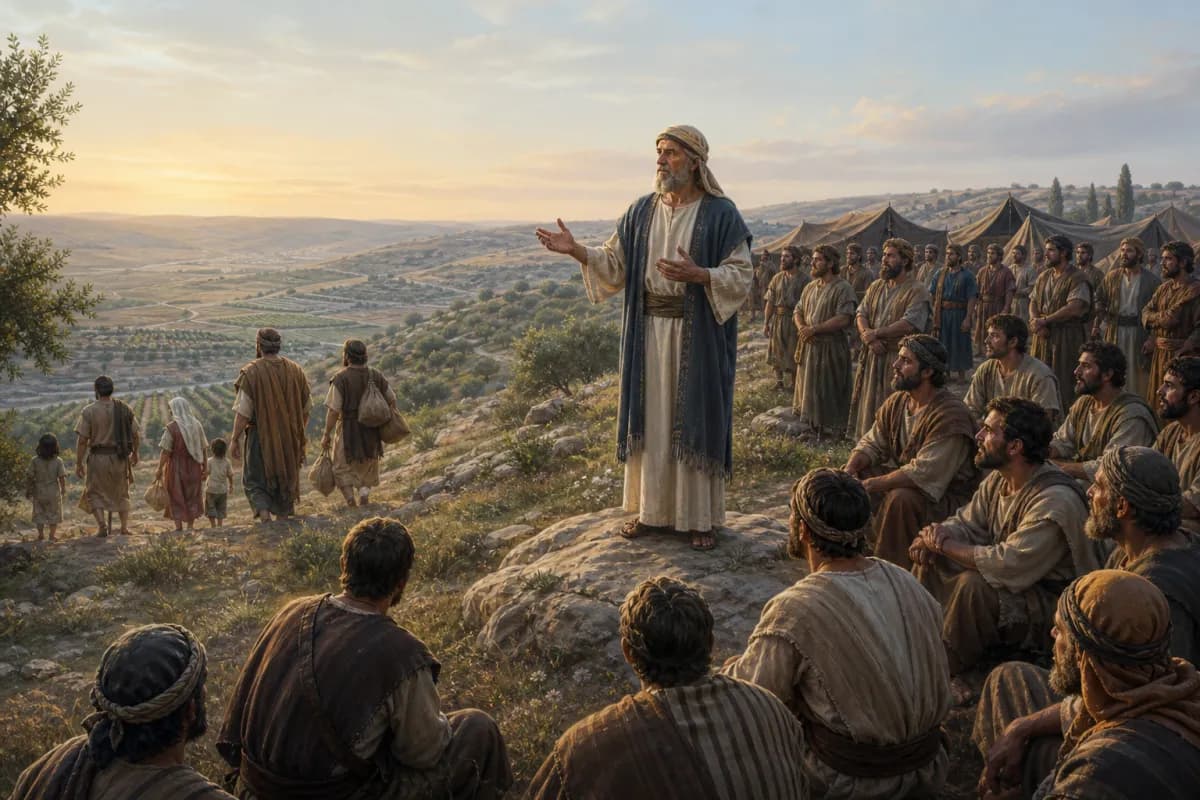
20:1When you go out to battle against your enemies, and see horses, chariots, and a people more numerous than you, you shall not be afraid of them; for the LORD your God, who brought you up out of the land of Egypt, is with you.
20:2It shall be, when you draw near to the battle, that the priest shall approach and speak to the people,
20:3and shall tell them, “Hear, Israel, you draw near today to battle against your enemies. Don’t let your heart faint! Don’t be afraid, nor tremble, neither be scared of them;
20:4for the LORD your God is he who goes with you, to fight for you against your enemies, to save you.”
20:5The officers shall speak to the people, saying, “What man is there who has built a new house, and has not dedicated it? Let him go and return to his house, lest he die in the battle, and another man dedicate it.
20:6What man is there who has planted a vineyard, and has not used its fruit? Let him go and return to his house, lest he die in the battle, and another man use its fruit.
20:7What man is there who has pledged to be married to a wife, and has not taken her? Let him go and return to his house, lest he die in the battle, and another man take her.”
20:8The officers shall speak further to the people, and they shall say, “What man is there who is fearful and faint-hearted? Let him go and return to his house, lest his brother’s heart melt as his heart.”
20:9It shall be, when the officers have finished speaking to the people, that they shall appoint captains of armies at the head of the people.
20:10When you draw near to a city to fight against it, then proclaim peace to it.
20:11It shall be, if it gives you answer of peace and opens to you, then it shall be that all the people who are found therein shall become forced laborers to you, and shall serve you.
20:12If it will make no peace with you, but will make war against you, then you shall besiege it.
20:13When the LORD your God delivers it into your hand, you shall strike every male of it with the edge of the sword;
20:14but the women, the little ones, the livestock, and all that is in the city, even all its plunder, you shall take for plunder for yourself. You may use the plunder of your enemies, which the LORD your God has given you.
20:15Thus you shall do to all the cities which are very far off from you, which are not of the cities of these nations.
20:16But of the cities of these peoples that the LORD your God gives you for an inheritance, you shall save alive nothing that breathes;
20:17but you shall utterly destroy them: the Hittite, the Amorite, the Canaanite, the Perizzite, the Hivite, and the Jebusite, as the LORD your God has commanded you;
20:18that they not teach you to follow all their abominations, which they have done for their gods; so would you sin against the LORD your God.
20:19When you shall besiege a city a long time, in making war against it to take it, you shall not destroy its trees by wielding an ax against them; for you may eat of them. You shall not cut them down, for is the tree of the field man, that it should be besieged by you?
20:20Only the trees that you know are not trees for food, you shall destroy and cut them down. You shall build bulwarks against the city that makes war with you, until it falls.
CONTEXTUAL OVERVIEW
Deuteronomy 20 speaks directly into Israel’s fear as it faces armies with horses and chariots. The priest’s opening word is not military bravado: the Lord who brought Israel up from Egypt goes with them. The exodus remains the ground for courage because the people’s future is held by the God who already rescued them.
The chapter also places clear limits around Israel’s warfare. It concerns a particular people entering a particular land under a unique covenant command. It distinguishes distant cities from the Canaanite nations named in the chapter, preserves fruit trees during siege, and refuses to let warfare become an excuse for panic, greed, or indiscriminate destruction.
HISTORICAL AND LITERARY CONTEXT
These laws sit within Deuteronomy’s covenant instruction for Israel before the conquest. They must be read alongside the repeated warnings that Israel itself will face judgment if it adopts the land’s idolatry. The conquest is not a standing commission to expand Israelite power, nor is it a model for the church to take territory by force.
The exemptions for a new house, vineyard, betrothal, and fear acknowledge the human reality of battle and limit the demand on the community. The command to preserve fruit trees recognizes that the land is God’s gift for long-term life; a siege may be necessary, but wasteful destruction of food-bearing trees is forbidden.
SECTION-BY-SECTION ANALYSIS
- Do not fear · Deuteronomy 20:1Israel’s courage comes from the Lord who brought it out of Egypt, not from matching an enemy’s military strength.
- Who has built, planted, or become engaged? · Deuteronomy 20:5The exemptions recognize ordinary callings and keep the army from consuming every part of a person’s life.
- Are trees of the field human? · Deuteronomy 20:19The question forbids the needless destruction of fruit trees and restrains warfare’s tendency to devastate future life.
CHRIST IN THIS PASSAGE
This passage requires special care. The commands are given to ancient Israel in the land under the Mosaic covenant; they do not authorize Christians to identify opponents as Canaanites or to advance Christ’s kingdom through violence. Jesus explicitly refuses to establish His reign by the sword, gives Himself for enemies, and tells His followers to love enemies and pray for persecutors.
The chapter’s truest Christ-centered connection lies in the Lord’s presence and decisive deliverance, fulfilled in a radically different way through the cross. Jesus defeats sin, death, and the powers that enslave humanity by bearing violence rather than inflicting it. His mission sends the church into every nation with the gospel of peace, confident in His authority and marked by courage, truth, and sacrificial love.
REFLECTION
Some readers rush past this chapter; others use it carelessly. Faithful reading does neither. It allows the text’s historical particularity, its severe judgment on idolatry, and its limits on warfare to speak, while refusing to transfer Israel’s conquest command to the church or to modern political violence.
Jesus gives His people a real battle, but it is fought with different weapons: prayer, truth, holiness, service, endurance, and the proclamation of the gospel. When fear rises because opposition looks stronger than you, remember the God who is with His people and choose a Christlike act of courage that seeks another person’s good.
Original Hebrew Word Study
Deuteronomy 20:2
חָזַק
chazaq · H2388
Usually translated: to be strong
Chazaq means to be strong. Israel’s courage is grounded in the Lord who goes with them, keeping fear from making the enemy’s strength decisive.
Follow the Scripture trail
Courage under the Lord’s Command in the larger story
The connection: Israel’s conquest instructions belong to a bounded moment in the covenant story and declare that the Lord, not military power, gives the land. Jesus brings God’s saving reign through His cross, conquering sin and death and sending His people into the world with the gospel of peace rather than the sword.
Respond to the passage
Where has fear tempted you either to withdraw from faithful witness or to use coercion to get your way? Bring that fear to Jesus, and choose one courageous act of truth, service, prayer, or reconciliation that reflects His kingdom.
- Why does the priest begin by reminding Israel of the exodus before mentioning the enemy’s horses and chariots?
- What limits does the chapter place around Israel’s warfare, and why do those limits matter for interpretation?
- How does Jesus’ teaching about enemies prevent Christians from turning this passage into a mandate for religious violence?
Prayer
Lord Jesus, You won Your victory by giving Yourself for sinners. Deliver me from fear, triumphalism, and every desire to control others by force. Make me courageous in truth, steadfast in prayer, and gentle in the mission of Your peace. Amen.