Passage Study
When Bloodshed Has No Known Killer
Deuteronomy 21:1–21:23
Deuteronomy 21 brings an unsolved death, vulnerable women and children, family inheritance, and the public execution of a criminal under one covenant concern: Israel must not ignore guilt or treat people as disposable. The chapter leads to Jesus, who bears the curse of sin to cleanse His people and form a community marked by truth, mercy, and reverence for life.
- In this study
- 23 verses · 5 movements
Deuteronomy 21
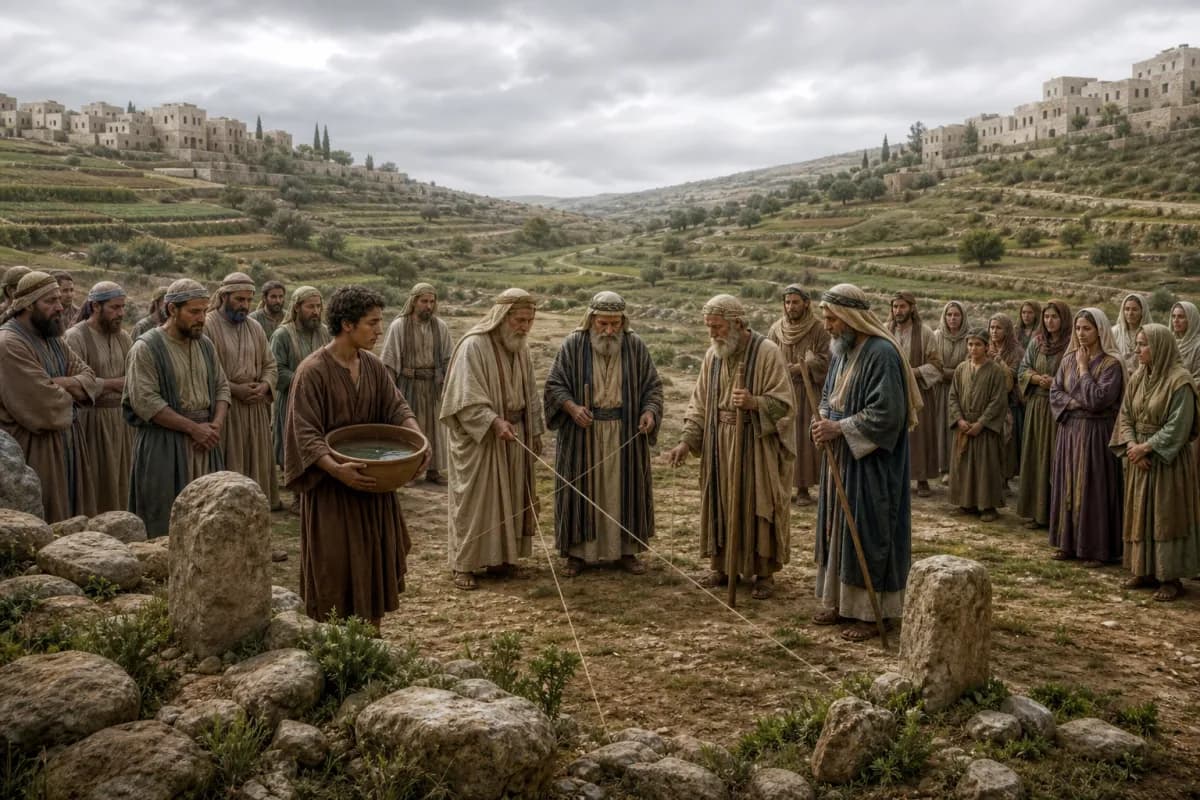
21:1If someone is found slain in the land which the LORD your God gives you to possess, lying in the field, and it isn’t known who has struck him,
21:2then your elders and your judges shall come out, and they shall measure to the cities which are around him who is slain.
21:3It shall be that the elders of the city which is nearest to the slain man shall take a heifer of the herd, which hasn’t been worked with and which has not drawn in the yoke.
21:4The elders of that city shall bring the heifer down to a valley with running water, which is neither plowed nor sown, and shall break the heifer’s neck there in the valley.
21:5The priests the sons of Levi shall come near, for them the LORD your God has chosen to minister to him, and to bless in the LORD’s name; and according to their word shall every controversy and every assault be decided.
21:6All the elders of that city which is nearest to the slain man shall wash their hands over the heifer whose neck was broken in the valley.
21:7They shall answer and say, “Our hands have not shed this blood, neither have our eyes seen it.
21:8Forgive, LORD, your people Israel, whom you have redeemed, and don’t allow innocent blood among your people Israel.” The blood shall be forgiven them.
21:9So you shall put away the innocent blood from among you, when you shall do that which is right in the LORD’s eyes.
21:10When you go out to battle against your enemies, and the LORD your God delivers them into your hands and you carry them away captive,
21:11and see among the captives a beautiful woman, and you are attracted to her, and desire to take her as your wife,
21:12then you shall bring her home to your house. She shall shave her head and trim her nails.
21:13She shall take off the clothing of her captivity, and shall remain in your house, and bewail her father and her mother a full month. After that you shall go in to her and be her husband, and she shall be your wife.
21:14It shall be, if you have no delight in her, then you shall let her go where she desires; but you shall not sell her at all for money. You shall not deal with her as a slave, because you have humbled her.
21:15If a man has two wives, the one beloved and the other hated, and they have borne him children, both the beloved and the hated, and if the firstborn son is hers who was hated,
21:16then it shall be, in the day that he causes his sons to inherit that which he has, that he may not give the son of the beloved the rights of the firstborn before the son of the hated, who is the firstborn;
21:17but he shall acknowledge the firstborn, the son of the hated, by giving him a double portion of all that he has; for he is the beginning of his strength. The right of the firstborn is his.
21:18If a man has a stubborn and rebellious son who will not obey the voice of his father or the voice of his mother, and though they chasten him, will not listen to them,
21:19then his father and his mother shall take hold of him and bring him out to the elders of his city and to the gate of his place.
21:20They shall tell the elders of his city, “This our son is stubborn and rebellious. He will not obey our voice. He is a glutton and a drunkard.”
21:21All the men of his city shall stone him to death with stones. So you shall remove the evil from among you. All Israel shall hear, and fear.
21:22If a man has committed a sin worthy of death, and he is put to death, and you hang him on a tree,
21:23his body shall not remain all night on the tree, but you shall surely bury him the same day; for he who is hanged is accursed of God. Don’t defile your land which the LORD your God gives you for an inheritance.
CONTEXTUAL OVERVIEW
Deuteronomy 21 begins outside a town with a body in an open field and no identified murderer. The law will not allow the nearest community to call the death someone else’s problem. Elders measure the distance, priests supervise a rite, and the people ask God not to leave innocent blood unaddressed among them.
The chapter then moves through difficult household cases: a woman taken in war, the son of an unloved wife, a persistently destructive son, and a person executed for a capital offense. These instructions are not unrelated fragments. They insist that power, family preference, rebellion, guilt, and punishment all remain answerable to the holy God who gives Israel its land.
HISTORICAL AND LITERARY CONTEXT
These laws belong to Israel’s covenant life in the promised land. The rite for an unknown killer does not identify the culprit or claim that the town committed the murder; it publicly acknowledges that shed blood defiles communal life and that only God can provide cleansing. The heifer has not been put to work, underscoring that the rite is set apart from ordinary economic use.
The household laws give limited protections in a patriarchal setting. A captive woman may not be immediately treated as property for sale, and a disliked wife’s firstborn son cannot lose his lawful portion because of his father’s preference. The chapter neither idealizes Israel’s broken family arrangements nor leaves them beyond God’s concern; it restrains injustice within a fallen social world.
SECTION-BY-SECTION ANALYSIS
- Measure to the towns · Deuteronomy 21:2The nearest community must respond, making care for a lost life concrete rather than abstract.
- The double portion · Deuteronomy 21:17Inheritance is protected by birthright rather than a father’s changing affections.
- Do not leave the body overnight · Deuteronomy 21:23Judgment must be carried out under God’s limits, with the land and the dignity of embodied life kept in view.
CHRIST IN THIS PASSAGE
The closing command has an explicit New Testament connection. Paul cites the statement that a hanged person is under God’s curse to explain the astonishing exchange at the cross: Christ willingly bears the curse that sinners deserve so that the blessing promised to Abraham may reach the nations. Jesus is not guilty of the violence or rebellion described here; He is the righteous One who gives Himself for the guilty.
The chapter also sharpens the need for cleansing that no human court can finally supply. Jesus’ saving mission confronts real evil without treating people as expendable. Through His death He makes forgiveness possible, and through His resurrection He establishes a people who honor life, resist favoritism, and bring hidden harm into the light rather than ignoring it.
REFLECTION
Unsolved wrong can tempt a community to become numb. Deuteronomy refuses that numbness. It teaches God’s people to notice suffering that is easy to pass by, to accept responsibility appropriate to their place, and to seek justice without pretending they can control every outcome.
Come to Jesus with the wrong you cannot repair by yourself—whether harm you have caused, grief you carry, or injustice you have witnessed. Ask Him to cleanse your conscience and show you one faithful response: tell the truth, protect someone vulnerable, support a just process, or refuse to let another person’s pain become invisible.
Original Hebrew Word Study
Deuteronomy 21:8
כָּפַר
kaphar · H3722
Usually translated: to make atonement
Kaphar is to make atonement. The unsolved murder rite keeps hidden bloodshed from being ignored and asks God to cleanse the land of communal guilt.
Follow the Scripture trail
When Bloodshed Has No Known Killer in the larger story
The connection: Israel is taught that hidden bloodshed, family power, and public punishment all matter before the God who dwells in the land. Jesus bears sin’s curse without becoming a sinner, cleanses those who trust Him, and sends a people into the world who defend truth and the worth of their neighbors.
Respond to the passage
Bring to Jesus the guilt or grief you have kept at a distance. Ask Him to show you a person or wrong you have been tempted to overlook, then take one honest, protective step in the light of His mercy.
- Why does the chapter require the nearest town to respond when the killer is unknown?
- What protections do the family laws provide in situations marked by unequal power and preference?
- How does Galatians use the final command about a hanged person to explain Christ’s saving death?
Prayer
Lord Jesus, You bore the curse I deserved without abandoning truth or justice. Forgive my indifference to hidden harm. Cleanse my conscience, make me attentive to the vulnerable, and teach me to act with mercy under Your holy rule. Amen.