Passage Study
Love That Does Not Look Away
Deuteronomy 22:1–22:30
Deuteronomy 22 makes covenant love visible in ordinary moments: returning lost animals, helping a fallen donkey, building a parapet, respecting created distinctions, and guarding sexual faithfulness. These commands teach Israel not to hide from a neighbor’s need or use freedom without responsibility. Jesus fulfills this neighbor-loving righteousness and forms a people whose witness makes His care tangible.
- In this study
- 30 verses · 5 movements
Deuteronomy 22
22:1You shall not see your brother’s ox or his sheep go astray and hide yourself from them. You shall surely bring them again to your brother.
22:2If your brother isn’t near to you, or if you don’t know him, then you shall bring it home to your house, and it shall be with you until your brother comes looking for it, and you shall restore it to him.
22:3So you shall do with his donkey. So you shall do with his garment. So you shall do with every lost thing of your brother’s, which he has lost and you have found. You may not hide yourself.
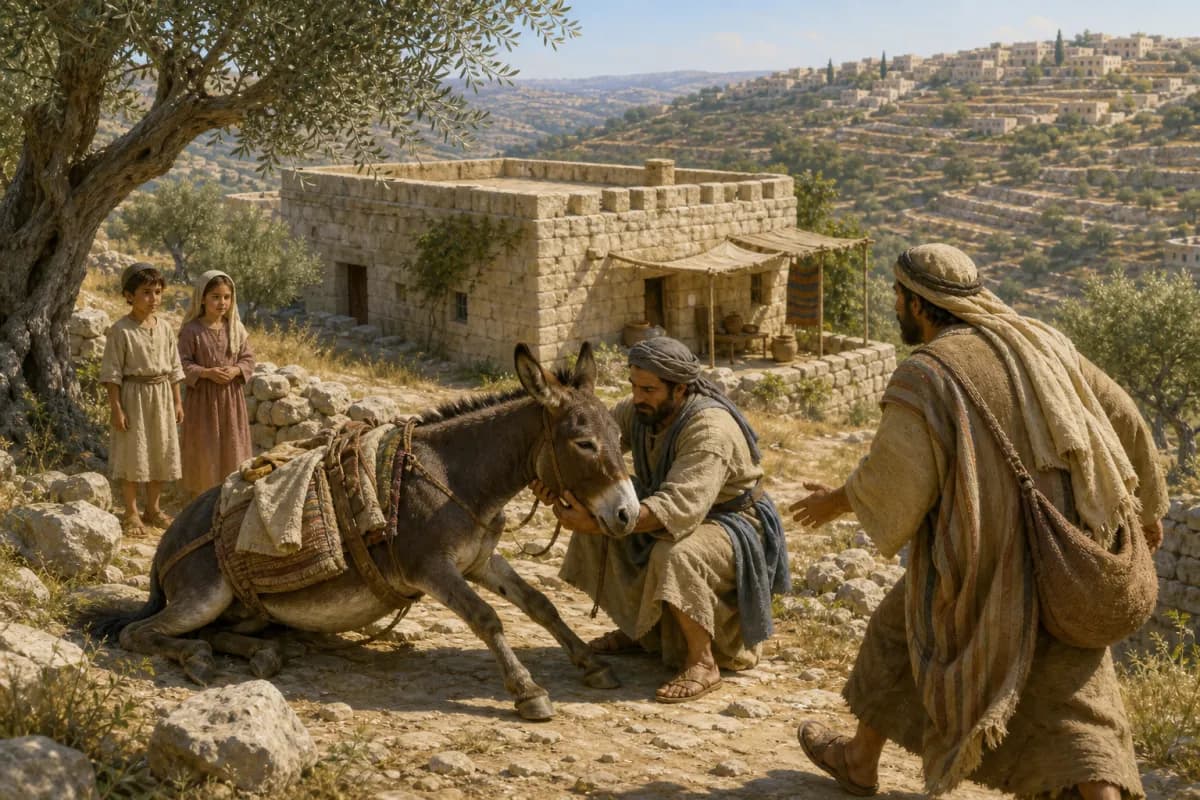
22:4You shall not see your brother’s donkey or his ox fallen down by the way, and hide yourself from them. You shall surely help him to lift them up again.
22:5A woman shall not wear men’s clothing, neither shall a man put on women’s clothing; for whoever does these things is an abomination to the LORD your God.
22:6If you come across a bird’s nest on the way, in any tree or on the ground, with young ones or eggs, and the hen sitting on the young, or on the eggs, you shall not take the hen with the young.
22:7You shall surely let the hen go, but the young you may take for yourself, that it may be well with you, and that you may prolong your days.
22:8When you build a new house, then you shall make a railing around your roof, so that you don’t bring blood on your house if anyone falls from there.
22:9You shall not sow your vineyard with two kinds of seed, lest all the fruit be defiled, the seed which you have sown, and the increase of the vineyard.
22:10You shall not plow with an ox and a donkey together.
22:11You shall not wear clothes of wool and linen woven together.
22:12You shall make yourselves fringes on the four corners of your cloak with which you cover yourself.
22:13If any man takes a wife, and goes in to her, hates her,
22:14accuses her of shameful things, gives her a bad name, and says, “I took this woman, and when I came near to her, I didn’t find in her the tokens of virginity;”
22:15then the young lady’s father and mother shall take and bring the tokens of the young lady’s virginity to the elders of the city in the gate.
22:16The young lady’s father shall tell the elders, “I gave my daughter to this man as his wife, and he hates her.
22:17Behold, he has accused her of shameful things, saying, ‘I didn’t find in your daughter the tokens of virginity;’ and yet these are the tokens of my daughter’s virginity.” They shall spread the cloth before the elders of the city.
22:18The elders of that city shall take the man and chastise him.
22:19They shall fine him one hundred shekels of silver, and give them to the father of the young lady, because he has given a bad name to a virgin of Israel. She shall be his wife. He may not put her away all his days.
22:20But if this thing is true, that the tokens of virginity were not found in the young lady,
22:21then they shall bring out the young lady to the door of her father’s house, and the men of her city shall stone her to death with stones, because she has done folly in Israel, to play the prostitute in her father’s house. So you shall remove the evil from among you.
22:22If a man is found lying with a woman married to a husband, then they shall both die, the man who lay with the woman and the woman. So you shall remove the evil from Israel.
22:23If there is a young lady who is a virgin pledged to be married to a husband, and a man finds her in the city, and lies with her,
22:24then you shall bring them both out to the gate of that city, and you shall stone them to death with stones; the lady, because she didn’t cry, being in the city; and the man, because he has humbled his neighbor’s wife. So you shall remove the evil from among you.
22:25But if the man finds the lady who is pledged to be married in the field, and the man forces her and lies with her, then only the man who lay with her shall die;
22:26but to the lady you shall do nothing. There is in the lady no sin worthy of death; for as when a man rises against his neighbor and kills him, even so is this matter;
22:27for he found her in the field, the pledged to be married lady cried, and there was no one to save her.
22:28If a man finds a lady who is a virgin, who is not pledged to be married, grabs her and lies with her, and they are found,
22:29then the man who lay with her shall give to the lady’s father fifty shekels of silver. She shall be his wife, because he has humbled her. He may not put her away all his days.
22:30A man shall not take his father’s wife, and shall not uncover his father’s skirt.
CONTEXTUAL OVERVIEW
The first commands sound small: do not watch a brother’s ox wander away and pretend not to see; do not pass a collapsed donkey under its load. Yet Moses repeats the refusal to hide. Neighbor-love begins where inconvenience makes it easy to avert the eyes.
The chapter widens from roads and rooftops to fields, clothing, marriage, and sexual faithfulness. Israel’s daily habits must testify that life before the Lord has order, accountability, and protection for people whose vulnerability could otherwise be exploited.
HISTORICAL AND LITERARY CONTEXT
Deuteronomy’s covenant laws place worship and ordinary life under the same Lord. An unfenced flat roof could become a site of fatal injury, so a parapet is required. Mixed agricultural and clothing commands mark Israel as a distinct people in its concrete practices, although the text does not explain every rationale behind each boundary.
The sexual laws belong to an ancient legal setting concerned with marriage, household honor, and public justice. Readers should not import modern procedures into every detail or minimize the chapter’s severe penalties. Its central moral claim is clear: sexual union is not casual property use, and the strong may not manipulate or violate the vulnerable without answerability to God.
SECTION-BY-SECTION ANALYSIS
- Do not hide yourself · Deuteronomy 22:3Love requires more than refusing harm; it takes responsibility for a neighbor’s visible need.
- Build a parapet · Deuteronomy 22:8Foreseeable safety is part of faithfulness, because a home owner must not disregard preventable danger.
- You shall not violate · Deuteronomy 22:1The sexual laws reject treating another person’s body, promise, or vulnerability as a tool for desire.
CHRIST IN THIS PASSAGE
Jesus affirms the law’s call to love God and neighbor, then makes the neighbor question painfully concrete in the parable of the Samaritan. The Samaritan does not pass by the wounded man as though the injury belongs to someone else. In Christ, the command not to hide becomes a summons to costly mercy that crosses ordinary boundaries of convenience and group loyalty.
Jesus also gives His own body to rescue people damaged by sin, shame, and exploitation. His saving mission never relaxes God’s concern for holiness, but it welcomes repentant sinners with forgiveness and new life. The church’s care for safety, faithfulness, and the vulnerable becomes part of its public testimony to the Lord who came near in mercy.
REFLECTION
Many opportunities for love arrive without drama: a problem at work that someone else caused, a neighbor whose need disrupts a schedule, a risk we could prevent if we bothered to act. Deuteronomy names avoidance as a spiritual problem because it leaves responsibility to the person already burdened.
Ask Jesus where you have trained yourself not to notice. Then choose one practical expression of His care: return what is not yours, help carry a burden, correct a safety hazard, or offer truthful support to someone whose dignity is under pressure.
Original Hebrew Word Study
Deuteronomy 22:1
אָח
ach · H251
Usually translated: brother or fellow covenant member
Ach means brother. The repeated command to care for a brother’s lost property makes neighbor-love practical, visible, and inconvenient.
Follow the Scripture trail
Love That Does Not Look Away in the larger story
The connection: Israel learns to make love visible in lost property, safe homes, protected boundaries, and faithful relationships. Jesus embodies that love by coming near to the wounded and giving Himself to make sinners holy, then sends His people to display His mercy in the ordinary places of life.
Respond to the passage
Ask Jesus to interrupt the habit of looking away. Identify one person, burden, or preventable risk in front of you, and respond with the practical mercy His love has made possible.
- Why is the repeated command not to hide yourself so important to the chapter’s vision of neighbor-love?
- What does the parapet law reveal about responsibility for foreseeable harm?
- How does Jesus’ parable of the Samaritan help Christians carry this chapter’s call to mercy into daily life?
Prayer
Lord Jesus, You did not pass me by in my need. Forgive my avoidance and self-protection. Give me eyes to see the burdens around me, courage to act with wisdom, and purity that honors the people You made and love. Amen.