Passage Study
A Holy Camp because the Lord Walks There
Deuteronomy 23:1–23:25
Deuteronomy 23 addresses assembly membership, sanitation, escaped slaves, prostitution, vows, lending, and labor in a neighbor’s field. Its governing reason is striking: the Lord walks in Israel’s camp. The passage directs Christians to Jesus, who brings outsiders near by His blood and forms a holy people whose embodied, economic, and relational life bears witness to His saving presence.
- In this study
- 25 verses · 5 movements
Deuteronomy 23
23:1He who is emasculated by crushing or cutting shall not enter into the LORD’s assembly.
23:2A person born of a forbidden union shall not enter into the LORD’s assembly; even to the tenth generation shall no one of his enter into the LORD’s assembly.
23:3An Ammonite or a Moabite shall not enter into the LORD’s assembly; even to the tenth generation shall no one belonging to them enter into the LORD’s assembly forever,
23:4because they didn’t meet you with bread and with water on the way when you came out of Egypt, and because they hired against you Balaam the son of Beor from Pethor of Mesopotamia, to curse you.
23:5Nevertheless the LORD your God wouldn’t listen to Balaam, but the LORD your God turned the curse into a blessing to you, because the LORD your God loved you.
23:6You shall not seek their peace nor their prosperity all your days forever.
23:7You shall not abhor an Edomite, for he is your brother. You shall not abhor an Egyptian, because you lived as a foreigner in his land.
23:8The children of the third generation who are born to them may enter into the LORD’s assembly.
23:9When you go out and camp against your enemies, then you shall keep yourselves from every evil thing.
23:10If there is among you any man who is not clean by reason of that which happens to him by night, then shall he go outside of the camp. He shall not come within the camp;
23:11but it shall be, when evening comes, he shall bathe himself in water. When the sun is down, he shall come within the camp.
23:12You shall have a place also outside of the camp where you go relieve yourself.
23:13You shall have a trowel among your weapons. It shall be, when you relieve yourself, you shall dig with it, and shall turn back and cover your excrement;
23:14for the LORD your God walks in the middle of your camp, to deliver you, and to give up your enemies before you. Therefore your camp shall be holy, that he may not see an unclean thing in you, and turn away from you.
23:15You shall not deliver to his master a servant who has escaped from his master to you.
23:16He shall dwell with you, among you, in the place which he shall choose within one of your gates, where it pleases him best. You shall not oppress him.
23:17There shall be no prostitute of the daughters of Israel, neither shall there be a sodomite of the sons of Israel.
23:18You shall not bring the hire of a prostitute, or the wages of a male prostitute, into the house of the LORD your God for any vow; for both of these are an abomination to the LORD your God.
23:19You shall not lend on interest to your brother: interest of money, interest of food, interest of anything that is lent on interest.
23:20You may charge a foreigner interest; but you shall not charge your brother interest, that the LORD your God may bless you in all that you put your hand to, in the land where you go in to possess it.
23:21When you vow a vow to the LORD your God, you shall not be slack to pay it, for the LORD your God will surely require it of you; and it would be sin in you.
23:22But if you refrain from making a vow, it shall be no sin in you.
23:23You shall observe and do that which has gone out of your lips. Whatever you have vowed to the LORD your God as a free will offering, which you have promised with your mouth, you must do.
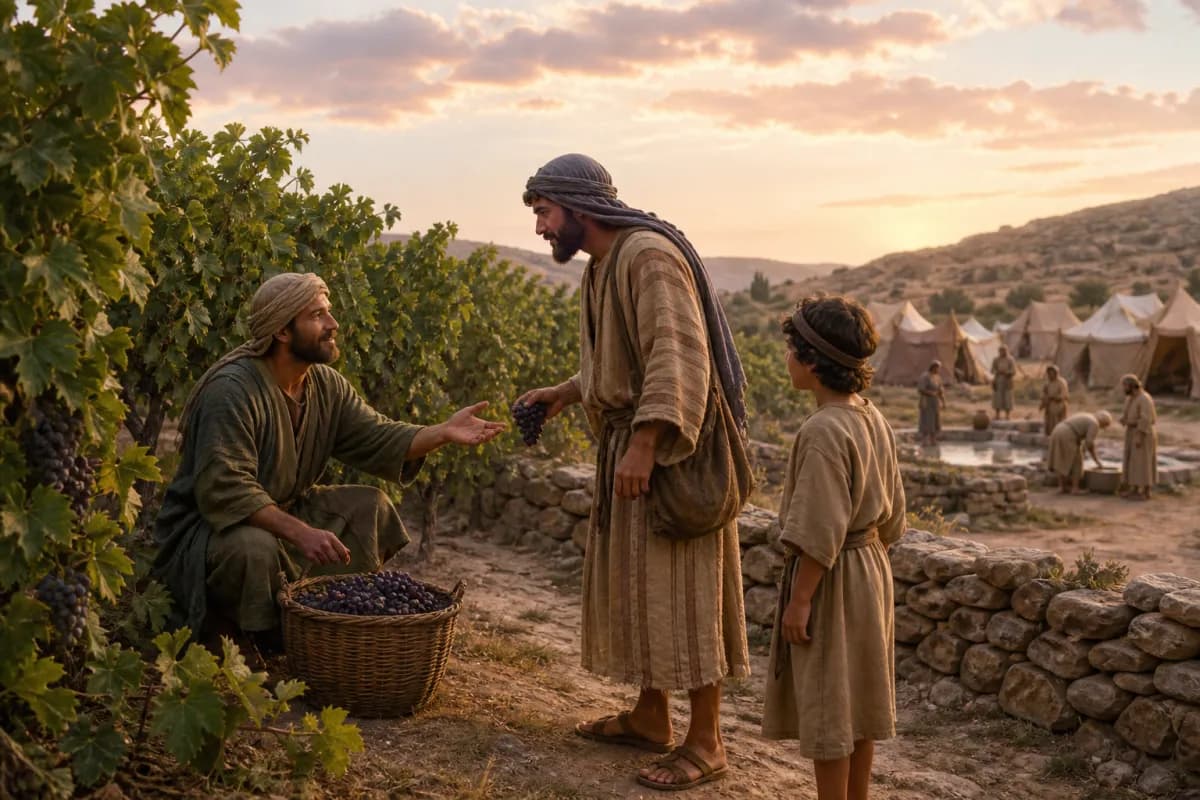
23:24When you come into your neighbor’s vineyard, then you may eat your fill of grapes at your own pleasure; but you shall not put any in your container.
23:25When you come into your neighbor’s standing grain, then you may pluck the ears with your hand; but you shall not use a sickle on your neighbor’s standing grain.
CONTEXTUAL OVERVIEW
Deuteronomy 23 covers matters that may feel far apart: who may enter the assembly, a latrine outside the camp, a slave seeking refuge, money lent to a brother, and grain plucked by hand. The chapter gives one unifying reason for its concern with bodily, social, and economic life: the Lord walks in the camp of His people.
Holiness here is neither private spirituality nor an excuse for contempt. Israel must guard the purity of its worship, but it must also provide refuge to an escaped slave, keep promises, and let a hungry person eat from a neighbor’s field. God’s presence produces both moral seriousness and concrete mercy.
HISTORICAL AND LITERARY CONTEXT
The assembly regulations reflect Israel’s covenant identity and memories of particular nations. They should be read with the chapter’s explicit exception for third-generation Egyptians and Edomites, the command not to abhor them, and the larger biblical story in which God’s mercy reaches the nations. These instructions are not a timeless ethnic ranking system.
Camp sanitation had practical value, but Deuteronomy gives it a theological ground: God is present among His people. The rules about vows, lending, and harvesting likewise address an agrarian society in which debt, hunger, and labor could quickly become occasions for exploitation. Holiness safeguards both worship and neighborly life.
SECTION-BY-SECTION ANALYSIS
- The Lord walks in your camp · Deuteronomy 23:14God’s nearness gives moral weight to sanitation, warfare, and every shared space.
- Do not hand over the slave · Deuteronomy 23:20The fugitive receives protection rather than automatic return to an oppressor.
- You may eat, but not carry away · Deuteronomy 23:24The final law joins generosity toward hunger with respect for a neighbor’s livelihood.
CHRIST IN THIS PASSAGE
The New Testament announces that Jesus brings those who were far off near through His blood. That does not erase Deuteronomy’s call to holiness; it reveals the saving purpose toward which God’s covenant story moves. In Christ, status markers that once separated peoples cannot become grounds for pride, because access to God comes by grace through the crucified Messiah.
Jesus also makes God’s dwelling personal and lasting. By His death He cleanses sinners, and by His Spirit He forms the church as God’s dwelling place. His mission therefore joins gospel welcome to transformed life: the people He gathers are called to truthfulness, sexual integrity, mercy toward the oppressed, and generosity that does not exploit need.
REFLECTION
It is easy to desire God’s blessing while treating daily habits as spiritually neutral. Deuteronomy says otherwise. The way a community uses its spaces, handles promises, responds to a vulnerable stranger, and shares food tells the truth about whether it remembers that God is near.
Bring your ordinary routines before Jesus: money, speech, sexuality, work, and the people who depend on you. Ask Him to make His mercy visible there. A faithful next step may be honoring a promise, stopping an exploitative arrangement, offering refuge, or sharing what you can without pretending another person’s need is beneath notice.
Original Hebrew Word Study
Deuteronomy 23:14
קָדוֹשׁ
qadosh · H6918
Usually translated: holy
Qadosh means holy. The camp must remain holy because the Lord walks in its midst, bringing everyday bodily and social practices under His presence.
Follow the Scripture trail
A Holy Camp because the Lord Walks There in the larger story
The connection: Israel’s camp is ordered around the God who walks among His people, so cleanliness, refuge, vows, and food all matter. Jesus brings outsiders near through His saving death and creates a holy, hospitable people whose shared life makes His presence credible before the nations.
Respond to the passage
Invite Jesus into one ordinary area you have treated as detached from discipleship. Choose a concrete act of holiness and mercy there: keep a promise, protect a vulnerable person, end an exploitative practice, or share provision with integrity.
- How does the statement that the Lord walks in the camp connect the chapter’s very different commands?
- What mercy does the chapter require toward people who are vulnerable because of slavery, hunger, or debt?
- How does Christ bringing the far-off near reshape the way the church reads the assembly regulations?
Prayer
Lord Jesus, thank You for bringing me near to God through Your blood. Cleanse my ordinary life and make me honest, pure, generous, and protective of the vulnerable. Let Your presence among Your people be visible in the way we treat one another. Amen.