Passage Study
Remember You Were Slaves
Deuteronomy 24:1–24:22
Deuteronomy 24 regulates divorce, pledges, wages, punishment, gleaning, and household mercy with a recurring command to remember Israel’s slavery in Egypt. God’s redeemed people must not reproduce the oppression from which they were rescued. The chapter finds its saving center in Jesus, who redeems sinners and sends them to practice costly mercy, honest work, and care for those with least social power.
- In this study
- 22 verses · 5 movements
Deuteronomy 24
24:1When a man takes a wife and marries her, then it shall be, if she finds no favor in his eyes because he has found some unseemly thing in her, that he shall write her a certificate of divorce, put it in her hand, and send her out of his house.
24:2When she has departed out of his house, she may go and be another man’s wife.
24:3If the latter husband hates her, and writes her a certificate of divorce, puts it in her hand, and sends her out of his house; or if the latter husband dies, who took her to be his wife;
24:4her former husband, who sent her away, may not take her again to be his wife after she is defiled; for that would be an abomination to the LORD. You shall not cause the land to sin, which the LORD your God gives you for an inheritance.
24:5When a man takes a new wife, he shall not go out in the army, neither shall he be assigned any business. He shall be free at home one year, and shall cheer his wife whom he has taken.
24:6No man shall take the mill or the upper millstone as a pledge, for he takes a life in pledge.
24:7If a man is found stealing any of his brothers of the children of Israel, and he deals with him as a slave, or sells him, then that thief shall die. So you shall remove the evil from among you.
24:8Be careful in the plague of leprosy, that you observe diligently and do according to all that the Levitical priests teach you. As I commanded them, so you shall observe to do.
24:9Remember what the LORD your God did to Miriam, by the way as you came out of Egypt.
24:10When you lend your neighbor any kind of loan, you shall not go into his house to get his pledge.
24:11You shall stand outside, and the man to whom you lend shall bring the pledge outside to you.
24:12If he is a poor man, you shall not sleep with his pledge.
24:13You shall surely restore to him the pledge when the sun goes down, that he may sleep in his garment and bless you. It shall be righteousness to you before the LORD your God.
24:14You shall not oppress a hired servant who is poor and needy, whether he is one of your brothers or one of the foreigners who are in your land within your gates.
24:15In his day you shall give him his wages, neither shall the sun go down on it, for he is poor and sets his heart on it, lest he cry against you to the LORD, and it be sin to you.
24:16The fathers shall not be put to death for the children, neither shall the children be put to death for the fathers. Every man shall be put to death for his own sin.
24:17You shall not deprive the foreigner or the fatherless of justice, nor take a widow’s clothing in pledge;
24:18but you shall remember that you were a slave in Egypt, and the LORD your God redeemed you there. Therefore I command you to do this thing.
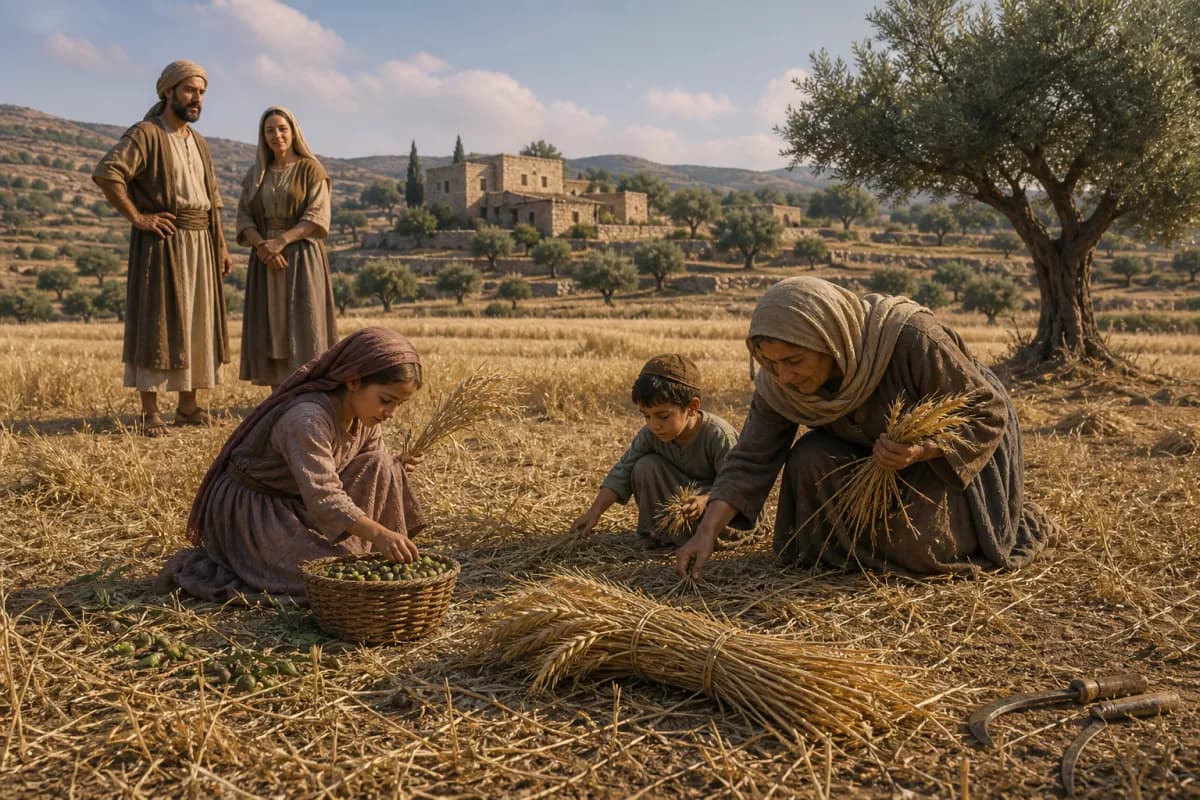
24:19When you reap your harvest in your field, and have forgotten a sheaf in the field, you shall not go again to get it. It shall be for the foreigner, for the fatherless, and for the widow, that the LORD your God may bless you in all the work of your hands.
24:20When you beat your olive tree, you shall not go over the boughs again. It shall be for the foreigner, for the fatherless, and for the widow.
24:21When you harvest your vineyard, you shall not glean it after yourselves. It shall be for the foreigner, for the fatherless, and for the widow.
24:22You shall remember that you were a slave in the land of Egypt. Therefore I command you to do this thing.
CONTEXTUAL OVERVIEW
Deuteronomy 24 places highly personal and economic questions beside each other: marriage, a millstone pledged for debt, the wages of a poor worker, a forgotten sheaf, and olives left on a tree. Each command asks Israel to remember what redemption means in the life of a neighbor who has little leverage.
The repeated memory of Egypt is the chapter’s moral engine. Israel knows what it is to be vulnerable to another’s power. Therefore it may not turn a poor household’s cloak into an instrument of pressure, withhold a laborer’s wage, or harvest every last remainder while the alien, orphan, and widow go hungry.
HISTORICAL AND LITERARY CONTEXT
The divorce instruction assumes a broken marital situation and regulates what may happen afterward; it should not be read as a command to divorce or as a complete biblical theology of marriage. Its immediate concern is that a first husband cannot treat a former wife as a possession to reclaim after she has become another man’s wife.
A pledge was security for a loan, but it could also strip a poor family of what kept life going. A millstone was essential for preparing food, and an outer cloak could be needed for sleep. Deuteronomy restrains lending power, then extends the same concern to prompt wages and harvest practices in an agrarian community.
SECTION-BY-SECTION ANALYSIS
- Do not take the millstone · Deuteronomy 24:4A lender may not secure a debt by taking the tool that keeps a household fed.
- Give the wage that day · Deuteronomy 24:15A poor laborer’s need is immediate, so delayed payment becomes an abuse of power.
- Leave it for the alien, orphan, and widow · Deuteronomy 24:19Harvest abundance is deliberately shared with people who lack land, family protection, or secure income.
CHRIST IN THIS PASSAGE
Jesus speaks seriously about divorce while also exposing the hardness of heart that can hide behind legal permission. He honors God’s intention for covenant faithfulness and protects people from casual dismissal. His teaching calls readers beyond the question of what can be gotten away with toward the question of love, truth, and faithfulness before God.
The chapter’s exodus memory reaches its fullest meaning in Christ. Jesus redeems people enslaved to sin, not so that they may build another system of exploitation, but so that they may become His merciful people. His mission makes wages, debts, harvests, and household power places where the grace of the gospel can be seen in costly justice.
REFLECTION
The person who needs a loan, a day’s wage, or a little food has less room to negotiate. Deuteronomy asks whether redeemed people will use that imbalance to get more for themselves or to protect the dignity and survival of their neighbor. Remembering grace should change the way power is used.
Thank Jesus for freeing you from the debt you could not pay. Then examine one place where your choices affect someone with less leverage: an employee, contractor, tenant, customer, family member, or person asking for help. Choose a just and merciful action that does not make their need work to your advantage.
Original Hebrew Word Study
Deuteronomy 24:13
חֶסֶד
chesed · H2617
Usually translated: steadfast love or covenant mercy
Chesed is loyal mercy. The commands about pledges, wages, gleaning, and vulnerable people make covenant love concrete in economic life.
Follow the Scripture trail
Remember You Were Slaves in the larger story
The connection: Israel’s freedom from Egypt must become mercy in marriage, lending, pay, and harvest. Jesus redeems His people from a deeper slavery and sends them to embody His grace by refusing exploitation and protecting those whose need leaves them exposed.
Respond to the passage
Remember before Jesus the grace you have received. Identify one relationship shaped by unequal power, and take a concrete step that protects the other person’s dignity, meets an honest obligation promptly, or shares provision without calculation.
- Why does the chapter return so often to Israel’s memory of slavery in Egypt?
- What do the laws about pledges and wages reveal about the ways debt can threaten a poor household?
- How does Christ’s redemption challenge Christians to use financial and social power mercifully?
Prayer
Lord Jesus, You paid the debt I could never repay. Keep me from using another person’s need for my advantage. Make me faithful in my obligations, generous with what I have received, and quick to remember Your mercy when I hold power over someone else. Amen.