Passage Study
Honest Weights and the Memory of Amalek
Deuteronomy 25:1–25:19
Deuteronomy 25 orders fair punishment, care for an animal at work, levirate responsibility, honest measures, and Israel’s remembrance of Amalek’s attack on the weak. The chapter rejects humiliation, exploitation, fraud, and predatory violence. It directs readers to Jesus, the righteous Judge who bears shame for sinners and forms a people whose justice reaches the marketplace and protects the vulnerable.
- In this study
- 19 verses · 5 movements
Deuteronomy 25
25:1If there is a controversy between men, and they come to judgment and the judges judge them, then they shall justify the righteous and condemn the wicked.
25:2It shall be, if the wicked man is worthy to be beaten, that the judge shall cause him to lie down and to be beaten before his face, according to his wickedness, by number.
25:3He may sentence him to no more than forty stripes. He shall not give more, lest if he should give more and beat him more than that many stripes, then your brother will be degraded in your sight.
25:4You shall not muzzle the ox when he treads out the grain.
25:5If brothers dwell together, and one of them dies and has no son, the wife of the dead shall not be married outside to a stranger. Her husband’s brother shall go in to her, and take her as his wife, and perform the duty of a husband’s brother to her.
25:6It shall be that the firstborn whom she bears shall succeed in the name of his brother who is dead, that his name not be blotted out of Israel.
25:7If the man doesn’t want to take his brother’s wife, then his brother’s wife shall go up to the gate to the elders, and say, “My husband’s brother refuses to raise up to his brother a name in Israel. He will not perform the duty of a husband’s brother to me.”
25:8Then the elders of his city shall call him, and speak to him. If he stands and says, “I don’t want to take her,”
25:9then his brother’s wife shall come to him in the presence of the elders, and loose his sandal from off his foot, and spit in his face. She shall answer and say, “So shall it be done to the man who does not build up his brother’s house.”
25:10His name shall be called in Israel, “The house of him who had his sandal removed.”
25:11When men strive against each other, and the wife of one draws near to deliver her husband out of the hand of him who strikes him, and puts out her hand, and grabs him by his private parts,
25:12then you shall cut off her hand. Your eye shall have no pity.
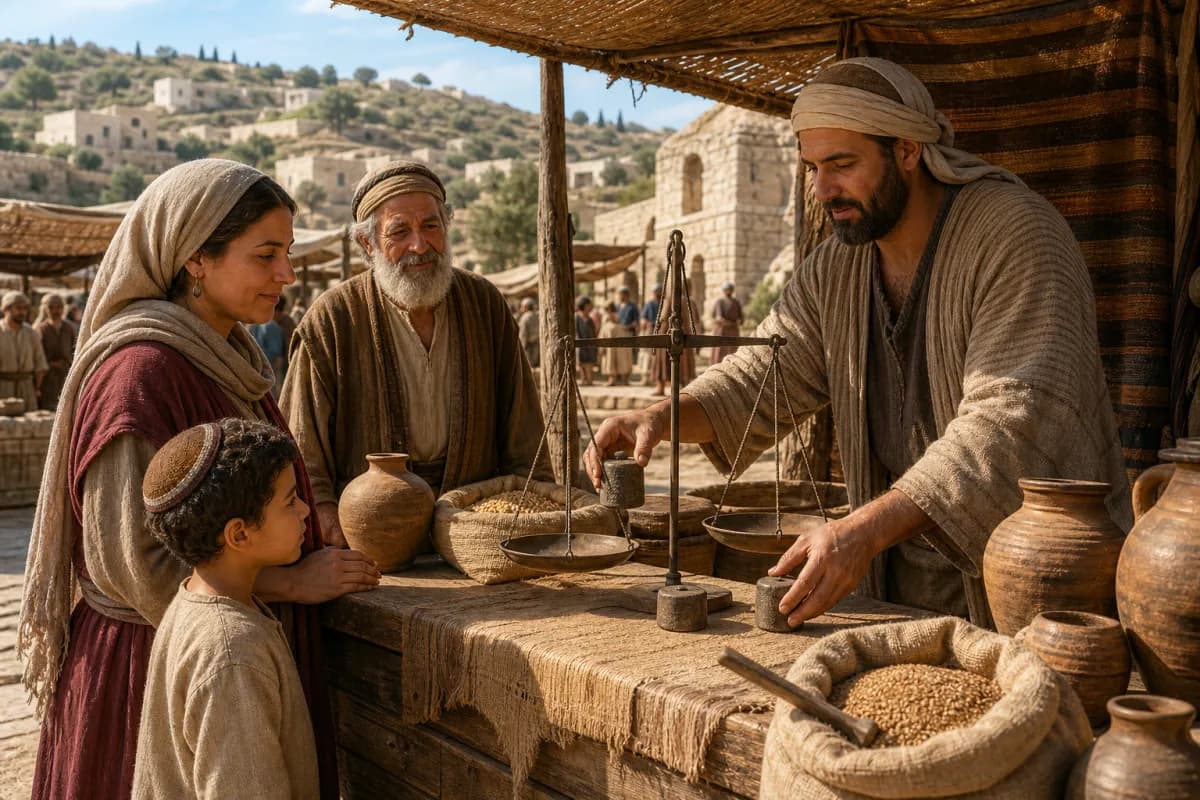
25:13You shall not have in your bag diverse weights, one heavy and one light.
25:14You shall not have in your house diverse measures, one large and one small.
25:15You shall have a perfect and just weight. You shall have a perfect and just measure, that your days may be long in the land which the LORD your God gives you.
25:16For all who do such things, all who do unrighteously, are an abomination to the LORD your God.
25:17Remember what Amalek did to you by the way as you came out of Egypt,
25:18how he met you by the way, and struck the rearmost of you, all who were feeble behind you, when you were faint and weary; and he didn’t fear God.
25:19Therefore it shall be, when the LORD your God has given you rest from all your enemies all around, in the land which the LORD your God gives you for an inheritance to possess it, that you shall blot out the memory of Amalek from under the sky. You shall not forget.
CONTEXTUAL OVERVIEW
Deuteronomy 25 moves from a courtroom to a threshing floor, a family gate, a merchant’s bag of weights, and the rear of Israel’s wilderness march. The locations differ, but the chapter asks the same question: will the strong use authority, labor, kinship, trade, or military advantage to crush those with less power?
The last memory of Amalek gives the chapter a sharp edge. Amalek attacked the faint and weary stragglers after Israel left Egypt. The laws before it train Israel not to imitate such predation in smaller, respectable forms—through excessive punishment, withholding care, fraudulent commerce, or indifference to family vulnerability.
HISTORICAL AND LITERARY CONTEXT
The forty-stripe limit restricts a judicial penalty so that a guilty person is not publicly degraded beyond measure. The ox law concerns a working animal at the threshing floor, where it should not be prevented from eating. Both commands demonstrate that justice includes limits on the power of an employer or court.
Levirate marriage preserves a deceased brother’s name and inheritance in a society where widowhood could mean severe insecurity. The public sandal ceremony records a refusal to carry that family duty; it is a social pressure toward responsibility, not a romantic ideal. The command about weights addresses daily commerce, where dishonest measures quietly enrich a seller at a buyer’s expense.
SECTION-BY-SECTION ANALYSIS
- Your brother must not be degraded · Deuteronomy 25:3Punishment has a limit because guilt does not erase a person’s covenant standing or human dignity.
- Do not muzzle the ox · Deuteronomy 25:4Those whose labor produces provision must not be denied every share of that good.
- A full and honest weight · Deuteronomy 25:15Faithfulness to God is measured in routine transactions where dishonesty can be easy to conceal.
CHRIST IN THIS PASSAGE
Jesus undergoes unjust judgment, public shame, and death even though He is righteous. His cross does not make justice unimportant; it reveals both the violence of human sin and the depth of God’s saving love. He bears shame so that those who trust Him may be forgiven, restored, and taught never to degrade another person for personal gain or religious pride.
The New Testament carries several themes from this chapter forward: Paul cites the ox law when discussing support for gospel workers, and Jesus condemns religious leaders who exploit widows while seeking public honor. Christ’s mission creates a people whose worship cannot be separated from honest commerce, fair treatment of labor, and courageous protection of the weak.
REFLECTION
A dishonest weight may appear insignificant because no crowd sees it. Deuteronomy says God sees it, and that small fraud belongs to the same moral world as contempt for the weak. The Lord cares about what happens when no one seems able to challenge the person who holds the scale, the payroll, or the public platform.
Bring your business, work, and family responsibilities to Jesus. Where are you tempted to use one standard when receiving and another when giving? Let His grace produce integrity: pay fairly, speak truthfully, keep proportion in correction, and notice the person who is weary at the edge of the group.
Original Hebrew Word Study
Deuteronomy 25:15
צֶדֶק
tsedeq · H6664
Usually translated: righteousness or just measure
Tsedeq is righteous justice. Honest weights and fair treatment protect the vulnerable and show that worship of the Lord reaches the marketplace.
Follow the Scripture trail
Honest Weights and the Memory of Amalek in the larger story
The connection: Israel is called to reject every form of predation, from a fraudulent scale to an attack on the exhausted. Jesus bears the shame of unjust judgment and saves a people who reflect His righteous rule through honest work, measured discipline, and care for those others overlook.
Respond to the passage
Ask Jesus to examine the weights and measures of your own life. Make one concrete correction where you have benefited from opacity, imbalance, or someone else’s weakness, and look for one weary person whose burden you can help carry.
- How do the limits on lashes and the ox at the threshing floor express the chapter’s concern for dignity?
- Why are dishonest weights a spiritual issue rather than merely a business mistake?
- How does the memory of Amalek sharpen Israel’s responsibility toward vulnerable people?
Prayer
Lord Jesus, You endured shame and injustice to save me. Keep me from hidden dishonesty, harshness, and neglect of the weak. Make my work truthful, my correction measured, and my life a witness to Your righteous and merciful kingdom. Amen.