Passage Study
A Basket, a Story, and the God Who Rescued
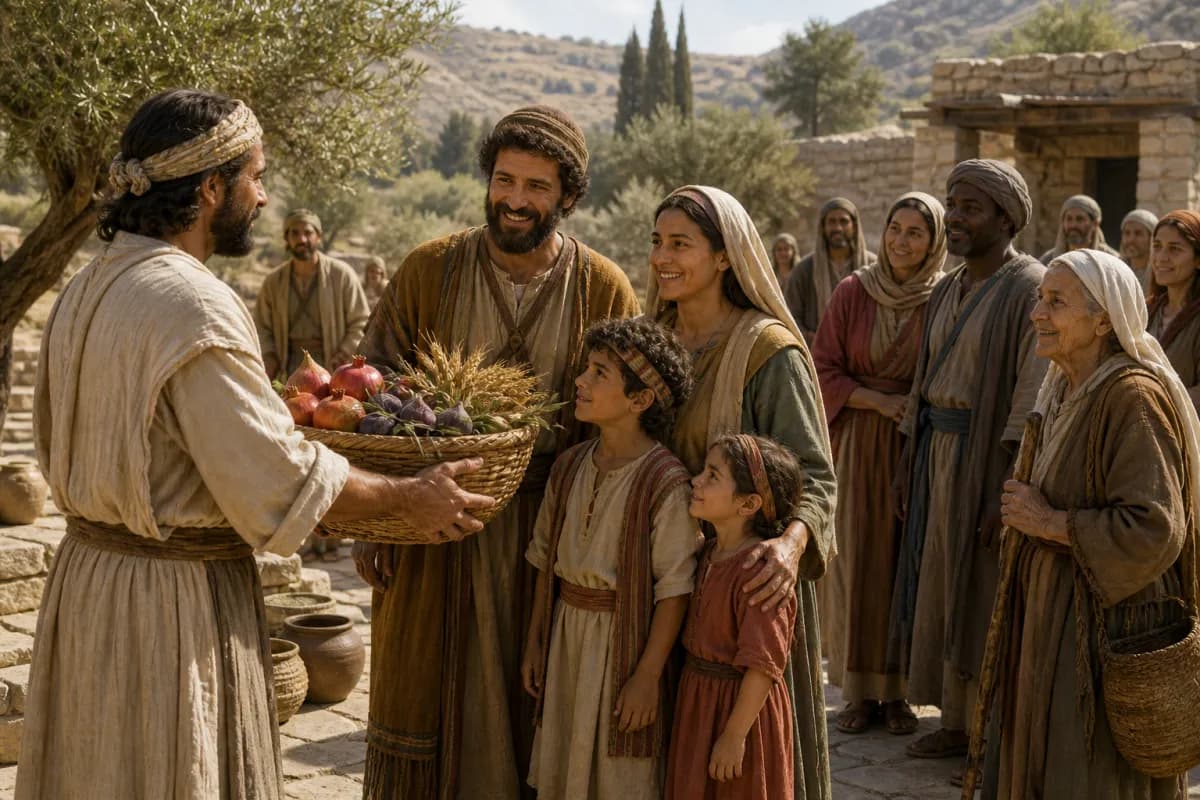
Deuteronomy 26:1–26:19
Deuteronomy 26 turns Israel’s firstfruits and tithe into a spoken confession: the Lord heard its afflicted ancestors, brought them out of Egypt, and gave them a land. Gratitude is therefore neither private nor vague. It leads to worship, shared provision, and covenant obedience, and it reaches its saving center in Jesus, who brings redeemed people to the Father and sends them to bless the nations.
- In this study
- 19 verses · 5 movements
Deuteronomy 26
26:1It shall be, when you have come in to the land which the LORD your God gives you for an inheritance, possess it, and dwell in it,
26:2that you shall take some of the first of all the fruit of the ground, which you shall bring in from your land that the LORD your God gives you. You shall put it in a basket, and shall go to the place which the LORD your God shall choose to cause his name to dwell there.
26:3You shall come to the priest who shall be in those days, and tell him, “I profess today to the LORD your God, that I have come to the land which the LORD swore to our fathers to give us.”
26:4The priest shall take the basket out of your hand, and set it down before the LORD your God’s altar.
26:5You shall answer and say before the LORD your God, “My father was a Syrian ready to perish. He went down into Egypt, and lived there, few in number. There he became a great, mighty, and populous nation.
26:6The Egyptians mistreated us, afflicted us, and imposed hard labor on us.
26:7Then we cried to the LORD, the God of our fathers. The LORD heard our voice, and saw our affliction, our toil, and our oppression.
26:8The LORD brought us out of Egypt with a mighty hand, with an outstretched arm, with great terror, with signs, and with wonders;
26:9and he has brought us into this place, and has given us this land, a land flowing with milk and honey.
26:10Now, behold, I have brought the first of the fruit of the ground, which you, the LORD, have given me.” You shall set it down before the LORD your God, and worship before the LORD your God.
26:11You shall rejoice in all the good which the LORD your God has given to you, and to your house, you, and the Levite, and the foreigner who is among you.
26:12When you have finished tithing all the tithe of your increase in the third year, which is the year of tithing, then you shall give it to the Levite, to the foreigner, to the fatherless, and to the widow, that they may eat within your gates and be filled.
26:13You shall say before the LORD your God, “I have put away the holy things out of my house, and also have given them to the Levite, to the foreigner, to the fatherless, and to the widow, according to all your commandment which you have commanded me. I have not transgressed any of your commandments, neither have I forgotten them.
26:14I have not eaten of it in my mourning, neither have I removed any of it while I was unclean, nor given of it for the dead. I have listened to the LORD my God’s voice. I have done according to all that you have commanded me.
26:15Look down from your holy habitation, from heaven, and bless your people Israel, and the ground which you have given us, as you swore to our fathers, a land flowing with milk and honey.”
26:16Today the LORD your God commands you to do these statutes and ordinances. You shall therefore keep and do them with all your heart and with all your soul.
26:17You have declared today that the LORD is your God, and that you would walk in his ways, keep his statutes, his commandments, and his ordinances, and listen to his voice.
26:18The LORD has declared today that you are a people for his own possession, as he has promised you, and that you should keep all his commandments.
26:19He will make you high above all nations that he has made, in praise, in name, and in honor, and that you may be a holy people to the LORD your God, as he has spoken.
CONTEXTUAL OVERVIEW
Deuteronomy 26 places a basket of firstfruits in the worshiper’s hands and a long memory on the worshiper’s lips. A farmer does not approach the altar merely to celebrate a successful crop. He tells the story of a wandering ancestor, oppression in Egypt, the Lord’s mighty rescue, and the gift of a fertile land.
The chapter then turns from harvest worship to a third-year tithe. Levites without territorial inheritance, resident aliens, orphans, and widows are named as those who must eat and be satisfied. Israel’s confession that all it has comes from God becomes credible through the way its abundance is shared.
HISTORICAL AND LITERARY CONTEXT
These instructions come as Israel waits to enter the land promised to the patriarchs. Firstfruits acknowledge that the harvest is not self-created wealth; it is received within the Lord’s covenant gift. The fixed confession guards the next generation from treating Canaan as an achievement detached from the exodus.
The prayer in verses 13–15 is deliberately concrete. The worshiper says the sacred portion has been given as commanded, asks God to look down and bless, and remembers that Israel is addressing the God who has already acted. This is not bargaining for crops but covenant thanksgiving expressed with integrity.
SECTION-BY-SECTION ANALYSIS
- My ancestor was a wandering Aramean · Deuteronomy 26:14The worshiper’s identity begins with God’s faithfulness to an endangered family, not with inherited self-importance.
- You shall rejoice · Deuteronomy 26:11Harvest joy is widened to include people without land or ordinary household security.
- A people holy to the Lord · Deuteronomy 26:19Covenant identity is received from God and expressed through listening to His voice.
CHRIST IN THIS PASSAGE
Jesus brings Deuteronomy’s rescue-shaped worship to its goal. He is the true Israelite who obeys the Father without withholding what is due, and through His death and resurrection He creates a people whose access to God rests on grace rather than the adequacy of their offering. The firstfruits theme also becomes a New Testament sign of resurrection hope: Christ is called the firstfruits of those who have died.
His saving mission gathers people from every nation into one grateful family. Christians do not repeat Israel’s land-tithe system as a condition of salvation, but the chapter’s logic remains searching: those delivered by Christ remember their rescue, honor God as giver, and make provision for neighbors who lack security. Generosity is a witness to the gospel, not a payment for it.
REFLECTION
Success can narrow memory. We begin to tell a story in which our discipline, talent, or planning explains everything we have. Deuteronomy 26 asks a better question: can you name the mercy of God that brought you here, and has that memory changed how you treat people with fewer resources?
Thank Jesus for the particular ways He has met you in need. Then let gratitude become material: give generously, share a meal, support work that serves the vulnerable, or refuse the quiet pride that treats received gifts as personal possession.
Original Hebrew Word Study
Deuteronomy 26:2
רֵאשִׁית
reshit · H7225
Usually translated: firstfruits or beginning
Reshit is the first portion. Bringing firstfruits turns harvest into confession: the land, the increase, and Israel’s identity are gifts from the Lord.
Follow the Scripture trail
A Basket, a Story, and the God Who Rescued in the larger story
The connection: Israel’s basket and confession recall a God who hears, rescues, gives, and gathers the vulnerable into joy. Jesus completes the rescue story through His death and resurrection, forming a grateful people whose generosity commends His saving mission to the world.
Respond to the passage
Tell Jesus the rescue story you most need to remember today. Then choose one concrete way to treat a received gift as His: share it with someone in need, give with joy, or speak honestly about the grace that has sustained you.
- Why does Moses require the farmer to tell Israel’s exodus story while bringing firstfruits?
- What does the third-year tithe reveal about the kind of joy God intends for His people?
- How does Christ as the firstfruits deepen this chapter’s language of received blessing?
Prayer
Lord Jesus, every good gift comes from Your Fatherly care. Keep me from forgetting the mercy that rescued me. Make my gratitude truthful, my resources openhanded, and my life a witness to Your grace. Amen.