Passage Study
Amen beneath the Blessing and the Curse
Deuteronomy 27:1–27:26
Deuteronomy 27 commands Israel to write the law on stones, build an altar on Mount Ebal, and answer Amen to curses against hidden covenant evil. The ceremony makes public what sin tries to keep private: the Lord sees idolatry, injustice, sexual exploitation, and violence. It points to Jesus, who bears the law’s curse for sinners and forms a truthful people who walk in the light.
- In this study
- 26 verses · 5 movements
Deuteronomy 27
27:1Moses and the elders of Israel commanded the people, saying, “Keep all the commandment which I command you today.
27:2It shall be on the day when you shall pass over the Jordan to the land which the LORD your God gives you, that you shall set yourself up great stones, and coat them with plaster.
27:3You shall write on them all the words of this law, when you have passed over, that you may go in to the land which the LORD your God gives you, a land flowing with milk and honey, as the LORD, the God of your fathers, has promised you.
27:4It shall be, when you have crossed over the Jordan, that you shall set up these stones, which I command you today, on Mount Ebal, and you shall coat them with plaster.
27:5There you shall build an altar to the LORD your God, an altar of stones. You shall not use any iron tool on them.
27:6You shall build the LORD your God’s altar of uncut stones. You shall offer burnt offerings on it to the LORD your God.
27:7You shall sacrifice peace offerings, and shall eat there. You shall rejoice before the LORD your God.
27:8You shall write on the stones all the words of this law very plainly.”
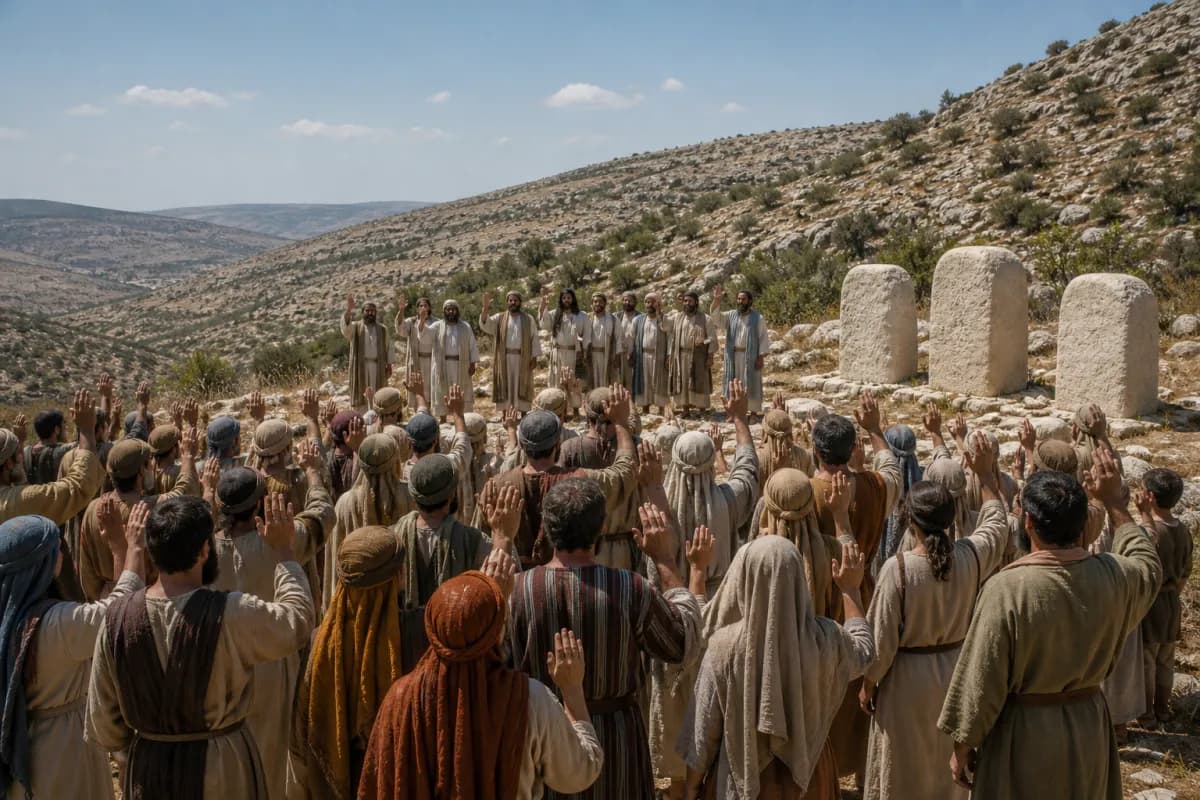
27:9Moses and the Levitical priests spoke to all Israel, saying, “Be silent and listen, Israel! Today you have become the people of the LORD your God.
27:10You shall therefore obey the LORD your God’s voice, and do his commandments and his statutes, which I command you today.”
27:11Moses commanded the people the same day, saying,
27:12“These shall stand on Mount Gerizim to bless the people, when you have crossed over the Jordan: Simeon, Levi, Judah, Issachar, Joseph, and Benjamin.
27:13These shall stand on Mount Ebal for the curse: Reuben, Gad, Asher, Zebulun, Dan, and Naphtali.
27:14With a loud voice, the Levites shall say to all the men of Israel,
27:15‘Cursed is the man who makes an engraved or molten image, an abomination to the LORD, the work of the hands of the craftsman, and sets it up in secret.’ All the people shall answer and say, ‘Amen.’
27:16‘Cursed is he who dishonors his father or his mother.’ All the people shall say, ‘Amen.’
27:17‘Cursed is he who removes his neighbor’s landmark.’ All the people shall say, ‘Amen.’
27:18‘Cursed is he who leads the blind astray on the road.’ All the people shall say, ‘Amen.’
27:19‘Cursed is he who withholds justice from the foreigner, fatherless, and widow.’ All the people shall say, ‘Amen.’
27:20‘Cursed is he who lies with his father’s wife, because he dishonors his father’s bed.’ All the people shall say, ‘Amen.’
27:21‘Cursed is he who lies with any kind of animal.’ All the people shall say, ‘Amen.’
27:22‘Cursed is he who lies with his sister, his father’s daughter or his mother’s daughter.’ All the people shall say, ‘Amen.’
27:23‘Cursed is he who lies with his mother-in-law.’ All the people shall say, ‘Amen.’
27:24‘Cursed is he who secretly kills his neighbor.’ All the people shall say, ‘Amen.’
27:25‘Cursed is he who takes a bribe to kill an innocent person.’ All the people shall say, ‘Amen.’
27:26‘Cursed is he who doesn’t uphold the words of this law by doing them.’ All the people shall say, ‘Amen.’”
CONTEXTUAL OVERVIEW
Before Israel possesses the land, Moses tells it to put the covenant in public view. Large stones, covered with plaster and written with the law, stand as a visible declaration that life in the land belongs under the Lord’s voice. The people are not entering a blank territory where they may invent their own moral order.
The chapter’s final litany moves toward sins that can be hidden from a court or neighbor: a secret idol, moving a boundary marker, misleading the blind, perverting justice for vulnerable people, forbidden sexual acts, and striking someone in secret. Israel answers Amen, accepting that God’s covenant reaches places where human observation fails.
HISTORICAL AND LITERARY CONTEXT
The ceremony is located at Mounts Ebal and Gerizim near Shechem, a region already weighty in Israel’s story through Abraham and Jacob. The altar is made of uncut stones, so Israel’s worship cannot be treated as an achievement of artistic mastery or manipulated by a human image. Burnt offerings and well-being offerings join atonement, fellowship, and rejoicing before the Lord.
Chapter 27 introduces the blessings and curses developed in chapter 28. It does not claim that every hardship can be traced to one hidden sin. Rather, it establishes covenant accountability: Israel cannot enjoy God’s land while blessing practices that destroy neighbor, family, worship, and justice.
SECTION-BY-SECTION ANALYSIS
- Write them clearly · Deuteronomy 27:3The law is made publicly accessible rather than held as secret knowledge for a ruling class.
- An altar of uncut stones · Deuteronomy 27:6Israel approaches God by His provision, not by making worship an occasion for human display.
- All the people shall say, Amen · Deuteronomy 27:16The whole covenant community owns the truth of God’s judgment against even concealed wrongdoing.
CHRIST IN THIS PASSAGE
The final curse exposes a problem Israel cannot solve by public agreement: no sinner has upheld God’s law without failure. Paul draws this covenant logic into the gospel, then declares that Christ redeemed people from the curse of the law by becoming a curse for them. Jesus does not minimize the evil named here; He bears sin’s judgment so that guilty people may receive forgiveness and the promised Spirit.
His mission also brings hidden things into the light. Jesus confronts hypocrisy while welcoming those who confess and turn to Him. The church must never use grace to conceal abuse, injustice, or exploitation. Because Christ has carried the curse, His people can tell the truth, seek repair, and live as a community whose repentance points others to His mercy.
REFLECTION
Private sin feels manageable because it can remain unseen by other people. Deuteronomy 27 says that secrecy does not make evil small; God sees it, especially where power is used against those least able to defend themselves. The repeated Amen asks us to agree with God before we try to excuse ourselves.
Come to Jesus without editing the truth. Receive the forgiveness He purchased, bring any needed confession into wise pastoral or legal care, and take a fitting step toward repair. His grace frees us from hiding, not from responsibility.
Original Hebrew Word Study
Deuteronomy 27:15
אָרוּר
arur · H779
Usually translated: cursed
Arur means cursed. The litany names hidden covenant violations and calls the whole people to answer Amen, making their shared responsibility explicit.
Follow the Scripture trail
Amen beneath the Blessing and the Curse in the larger story
The connection: At the threshold of the land, Israel publicly accepts the Lord’s judgment on hidden sin. Jesus takes that judgment upon Himself for those who trust Him and sends a forgiven people to walk honestly before God and neighbor.
Respond to the passage
Ask Jesus to show you any place where secrecy has become self-protection. Confess it truthfully to Him, seek appropriate help if another person has been harmed, and trust His cross to meet you with both mercy and a new path of obedience.
- Why are the law, altar, sacrifices, and covenant curses placed together in this ceremony?
- Which kinds of wrongdoing does the litany emphasize, and why might they be easy to hide?
- How does Paul’s use of the curse in Galatians clarify both the seriousness of sin and the grace of Christ?
Prayer
Lord Jesus, You bore the curse my sin deserves. Keep me from hiding what You already see. Give me courage to confess, wisdom to seek repair, and a life in the light that honors Your costly mercy. Amen.