Passage Study
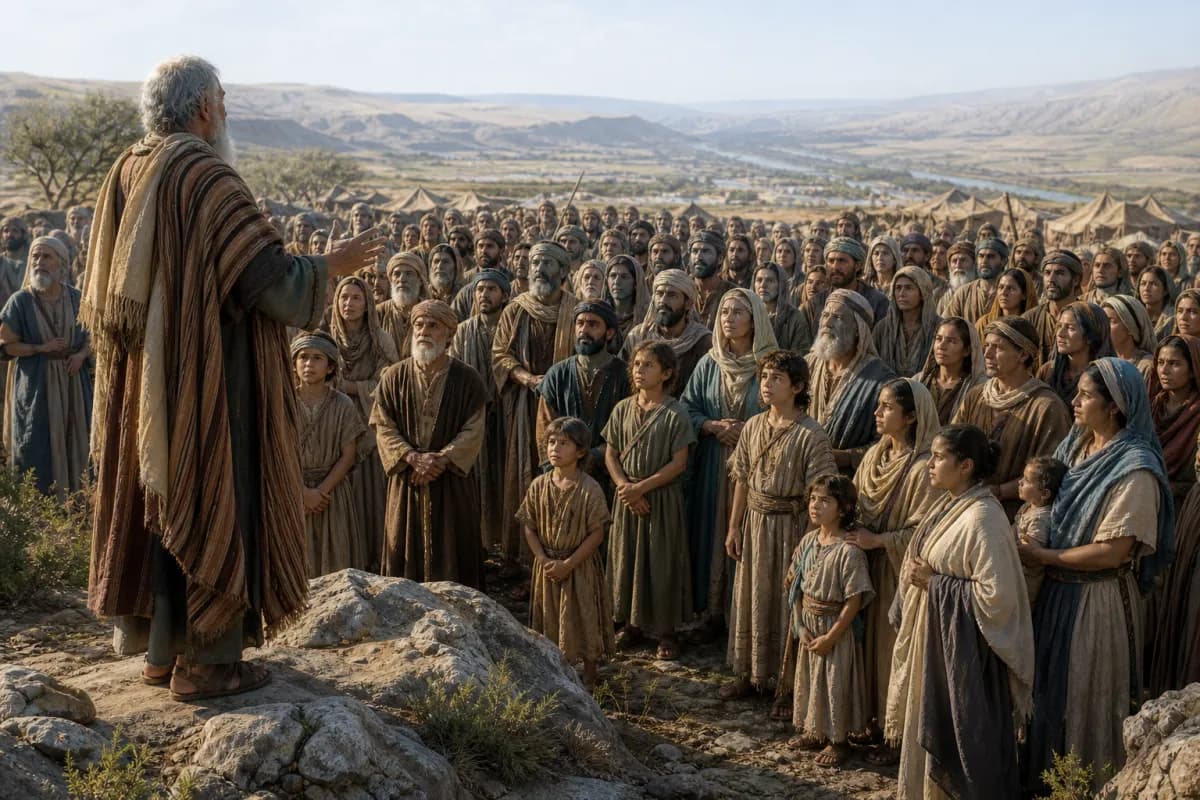
Standing before the Lord at Moab
Deuteronomy 29:1–29:29
Deuteronomy 29 renews the covenant with every part of Israel on the plains of Moab, recalls the Lord’s provision in the wilderness, warns against a secret root of idolatry, and distinguishes God’s hidden counsel from the word He has revealed. The passage leads to Jesus, who establishes the new covenant through His blood and gathers people openly to repent, trust, and live under God’s revealed grace.
- In this study
- 29 verses · 5 movements
Deuteronomy 29
29:1These are the words of the covenant which the LORD commanded Moses to make with the children of Israel in the land of Moab, in addition to the covenant which he made with them in Horeb.
29:2Moses called to all Israel, and said to them: Your eyes have seen all that the LORD did in the land of Egypt to Pharaoh, and to all his servants, and to all his land;
29:3the great trials which your eyes saw, the signs, and those great wonders.
29:4But the LORD has not given you a heart to know, eyes to see, and ears to hear, to this day.
29:5I have led you forty years in the wilderness. Your clothes have not grown old on you, and your sandals have not grown old on your feet.
29:6You have not eaten bread, neither have you drunk wine or strong drink, that you may know that I am the LORD your God.
29:7When you came to this place, Sihon the king of Heshbon and Og the king of Bashan came out against us to battle, and we struck them.
29:8We took their land, and gave it for an inheritance to the Reubenites, and to the Gadites, and to the half-tribe of the Manassites.
29:9Therefore keep the words of this covenant and do them, that you may prosper in all that you do.
29:10All of you stand today in the presence of the LORD your God: your heads, your tribes, your elders, and your officers, even all the men of Israel,
29:11your little ones, your wives, and the foreigners who are in the middle of your camps, from the one who cuts your wood to the one who draws your water,
29:12that you may enter into the covenant of the LORD your God, and into his oath, which the LORD your God makes with you today,
29:13that he may establish you today as his people, and that he may be your God, as he spoke to you and as he swore to your fathers, to Abraham, to Isaac, and to Jacob.
29:14Neither do I make this covenant and this oath with you only,
29:15but with those who stand here with us today before the LORD our God, and also with those who are not here with us today
29:16(for you know how we lived in the land of Egypt, and how we came through the middle of the nations through which you passed;
29:17and you have seen their abominations and their idols of wood, stone, silver, and gold, which were among them);
29:18lest there should be among you man, woman, family, or tribe whose heart turns away today from the LORD our God, to go to serve the gods of those nations; lest there should be among you a root that produces bitter poison;
29:19and it happen, when he hears the words of this curse, that he bless himself in his heart, saying, “I shall have peace, though I walk in the stubbornness of my heart,” to destroy the moist with the dry.
29:20The LORD will not pardon him, but then the LORD’s anger and his jealousy will smoke against that man, and all the curse that is written in this book will fall on him, and the LORD will blot out his name from under the sky.
29:21The LORD will set him apart for evil out of all the tribes of Israel, according to all the curses of the covenant written in this book of the law.
29:22The generation to come—your children who will rise up after you, and the foreigner who will come from a far land—will say, when they see the plagues of that land, and the sicknesses with which the LORD has made it sick,
29:23that all of its land is sulfur, salt, and burning, that it is not sown, doesn’t produce, nor does any grass grow in it, like the overthrow of Sodom, Gomorrah, Admah, and Zeboiim, which the LORD overthrew in his anger, and in his wrath.
29:24Even all the nations will say, “Why has the LORD done this to this land? What does the heat of this great anger mean?”
29:25Then men will say, “Because they abandoned the covenant of the LORD, the God of their fathers, which he made with them when he brought them out of the land of Egypt,
29:26and went and served other gods and worshiped them, gods that they didn’t know and that he had not given to them.
29:27Therefore the LORD’s anger burned against this land, to bring on it all the curses that are written in this book.
29:28The LORD rooted them out of their land in anger, in wrath, and in great indignation, and thrust them into another land, as it is today.”
29:29The secret things belong to the LORD our God; but the things that are revealed belong to us and to our children forever, that we may do all the words of this law.
CONTEXTUAL OVERVIEW
Deuteronomy 29 gathers Israel at Moab, not as a crowd of interchangeable listeners but as leaders, tribes, elders, children, wives, resident aliens, woodcutters, and water-drawers. Covenant life includes people with different authority and different social location. All stand before the Lord who has kept them through wilderness years and is about to lead them into the land.
Moses is especially alert to a hidden turn of the heart. Someone may hear the covenant curse and still bless himself inwardly, imagining that stubbornness will bring peace. The image of a root bearing poisonous fruit warns that private idolatry does not stay private; it poisons a community and invites covenant ruin.
HISTORICAL AND LITERARY CONTEXT
This is a renewal of the covenant after the generation that left Egypt has largely died in the wilderness. Moses recalls clothes that did not wear out, food and drink sustained by God, and victories east of the Jordan. The people’s survival is evidence of God’s faithfulness, even though verse 4 soberly says the Lord had not yet given them a heart to understand fully.
The chapter speaks of a covenant made with those present and those not present. In its immediate setting this extends the covenant responsibility to Israel’s future generations, not to unknown outsiders as though every person automatically belongs to it. The final contrast between secret things and revealed things guards against speculation that evades obedience.
SECTION-BY-SECTION ANALYSIS
- You are standing today · Deuteronomy 29:12Covenant renewal gathers the whole people before God rather than addressing only its elite.
- A root bearing poisonous fruit · Deuteronomy 29:18A concealed allegiance to other gods can become a source of communal destruction.
- The things revealed · Deuteronomy 29:29God gives sufficient truth for faithful obedience without granting creatures mastery of every hidden purpose.
CHRIST IN THIS PASSAGE
Jesus establishes the new covenant through His blood, accomplishing what Israel’s repeated renewals could not secure in human strength. He gives forgiveness for covenant breakers and, by the Spirit, writes God’s law on the heart. The warning against secret self-blessing remains relevant because Jesus calls for real repentance, not a religious confidence that refuses His lordship.
His saving mission also changes how believers live with mystery. Jesus reveals the Father and gives clear commands to love, trust, forgive, and proclaim the gospel, while the timing and many outcomes of history remain in God’s hands. The church need not manufacture secret knowledge; it bears witness to the Christ God has openly given.
REFLECTION
We can hear warnings and still privately tell ourselves that they apply to someone else. Deuteronomy exposes that inner bargain. A hidden idol may be respectability, money, sexual autonomy, political power, or control over the future; whatever it is, it will not remain harmless simply because it is unnamed.
Stand honestly before Jesus. Ask Him to uncover any allegiance competing with His rule, receive His covenant mercy, and practice the next revealed duty instead of escaping into speculation. Faithfulness often begins with a confession, a repaired relationship, or a straightforward act of obedience.
Original Hebrew Word Study
Deuteronomy 29:10
עָמַד
amad · H5975
Usually translated: to stand
Amad means to stand. Every group in Israel stands before the Lord to enter the covenant, showing that this renewal embraces the whole community.
Follow the Scripture trail
Standing before the Lord at Moab in the larger story
The connection: Israel stands together before God, warned that secret idolatry destroys the covenant community. Jesus establishes the new covenant through His blood, gives His Spirit to change hearts, and sends a truthful people to proclaim what God has revealed.
Respond to the passage
Bring any hidden allegiance into Jesus’ light. Rather than demanding knowledge He has not given, receive His mercy and act on one clear command: confess, forgive, serve, speak the gospel, or turn from an idol.
- Why does Moses name so many different groups as standing before the Lord?
- What is the danger of blessing oneself inwardly while hearing God’s warning?
- How does the distinction between secret and revealed things guide faithful Christian decision-making?
Prayer
Lord Jesus, You know every hidden part of my heart. Tear out the roots of false allegiance and establish me in Your mercy. Give me contentment with what You have not revealed and courage to obey what You have. Amen.