Passage Study
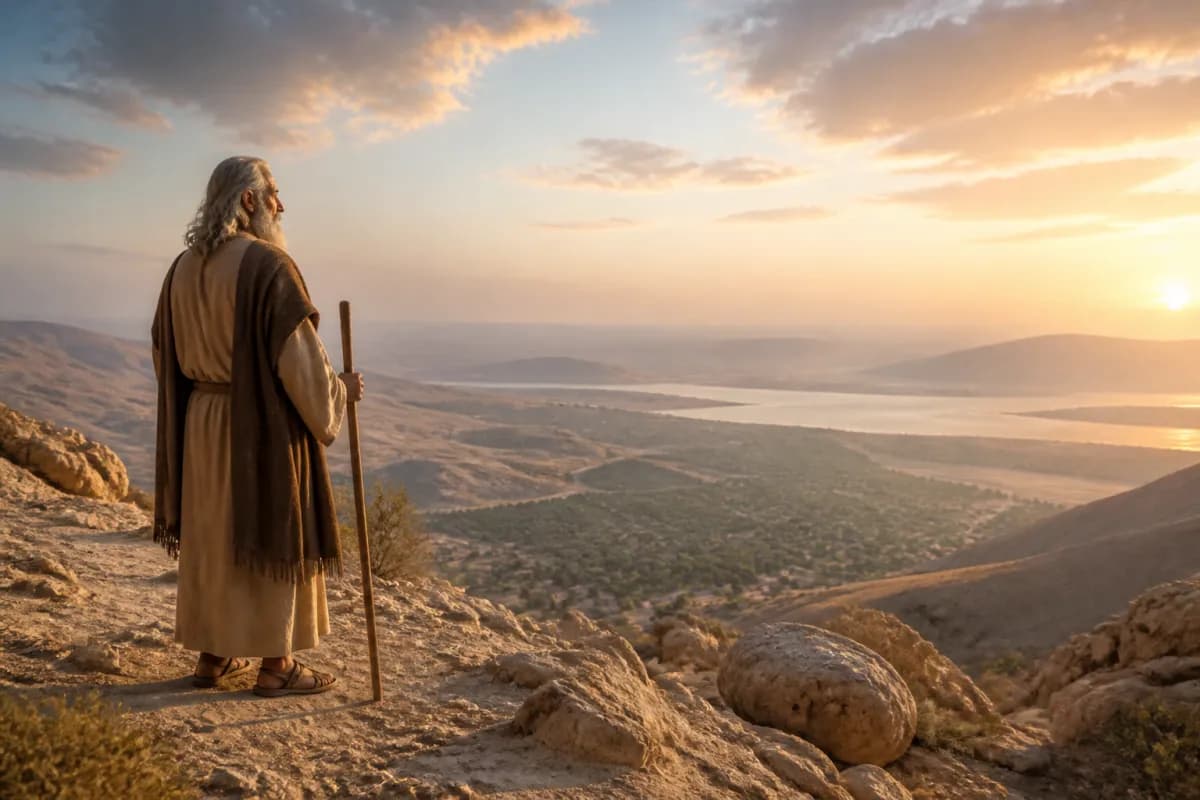
Moses Dies Looking toward the Promise
Deuteronomy 34:1–34:12
Deuteronomy 34 records Moses viewing the promised land from Nebo, dying outside it, and being mourned by Israel. The book ends by honoring his unmatched prophetic role while saying no prophet like him had yet arisen. That unfinished longing points decisively to Jesus, who knows the Father perfectly, brings His people into God’s promised rest, and conquers death through His resurrection.
- In this study
- 12 verses · 5 movements
Deuteronomy 34
34:1Moses went up from the plains of Moab to Mount Nebo, to the top of Pisgah, that is opposite Jericho. The LORD showed him all the land of Gilead to Dan,
34:2and all Naphtali, and the land of Ephraim and Manasseh, and all the land of Judah, to the Western Sea,
34:3and the south, and the Plain of the valley of Jericho the city of palm trees, to Zoar.
34:4The LORD said to him, “This is the land which I swore to Abraham, to Isaac, and to Jacob, saying, ‘I will give it to your offspring.’ I have caused you to see it with your eyes, but you shall not go over there.”
34:5So Moses the servant of the LORD died there in the land of Moab, according to the LORD’s word.
34:6He buried him in the valley in the land of Moab opposite Beth Peor, but no man knows where his tomb is to this day.
34:7Moses was one hundred twenty years old when he died. His eye was not dim, nor his strength gone.
34:8The children of Israel wept for Moses in the plains of Moab thirty days, until the days of weeping in the mourning for Moses were ended.
34:9Joshua the son of Nun was full of the spirit of wisdom, for Moses had laid his hands on him. The children of Israel listened to him, and did as the LORD commanded Moses.
34:10Since then, there has not arisen a prophet in Israel like Moses, whom the LORD knew face to face,
34:11in all the signs and the wonders which the LORD sent him to do in the land of Egypt, to Pharaoh, and to all his servants, and to all his land,
34:12and in all the mighty hand, and in all the awesome deeds, which Moses did in the sight of all Israel.
CONTEXTUAL OVERVIEW
Deuteronomy ends at a mountain east of the Jordan. Moses sees the breadth of the land promised to Abraham, Isaac, and Jacob, but he does not enter it. The moment is both tender and severe: the Lord fulfills His word by showing the gift, yet Moses’ own disobedience means that his leadership ends before the crossing.
Israel mourns Moses for thirty days, then listens to Joshua, who is filled with the spirit of wisdom because Moses laid hands on him. The final sentences do not simply close a biography. They leave the reader waiting: no prophet like Moses, who knew the Lord face to face and performed signs in Egypt, has yet arisen in Israel.
HISTORICAL AND LITERARY CONTEXT
The chapter completes the Pentateuch’s account of Moses, who has led Israel from slavery to the threshold of inheritance. His exclusion from the land recalls the judgment connected with Meribah, where he did not uphold the Lord’s holiness before the people. Even Israel’s greatest human mediator remains accountable to God.
The notice that the Lord buried Moses and that no one knows his burial place prevents his grave from becoming an Israelite shrine. The final assessment preserves both honor and expectation. Moses is unique within Israel’s history, but Deuteronomy 18 had promised a prophet like him, so the book closes with a question that its later canon continues to answer.
SECTION-BY-SECTION ANALYSIS
- You shall see it · Deuteronomy 34:4Moses receives a true vision of the promise even while accepting the limit God has set.
- The servant of the Lord · Deuteronomy 34:5Moses’ lasting identity is not celebrity or achievement but belonging to and serving God.
- No prophet like Moses · Deuteronomy 34:10The ending honors Moses while creating expectation for God’s promised future spokesman.
CHRIST IN THIS PASSAGE
The New Testament identifies Jesus as the prophet like Moses, yet greater than Moses. Moses speaks with God face to face; Jesus is the eternal Son who reveals the Father. Moses leads Israel to the edge of earthly inheritance; Jesus, through His death and resurrection, brings believers into reconciliation with God and the lasting rest that Joshua’s land cannot finally provide.
Moses’ death also clarifies what human faithfulness cannot overcome. Every leader dies, and every generation needs more than a successor. Jesus dies willingly for sinners and rises never to die again. His saving mission gives the church a living Lord, not merely a revered memory, and sends it to proclaim life in His name.
REFLECTION
Moses’ death teaches the humility of unfinished work. A person may serve God deeply and still leave tasks for others to carry. This is not failure when it is received under God’s wise rule. The promise belongs to the Lord, and no individual is indispensable to its completion.
Bring Jesus your grief over limits, endings, or work you cannot finish. Honor those who have served faithfully, encourage the next generation, and trust the risen Christ to carry forward what no human leader can secure.
Original Hebrew Word Study
Deuteronomy 34:10
נָבִיא
navi · H5030
Usually translated: prophet
Navi is a prophet. Moses is remembered as Israel’s unique prophet who knew the Lord face to face, leaving the people waiting for God’s promised prophet like him.
Follow the Scripture trail
Moses Dies Looking toward the Promise in the larger story
The connection: Moses sees the promise, dies as the Lord’s servant, and leaves Israel still waiting for the prophet like him. Jesus fulfills that expectation, defeats death, and brings His people into the lasting life and rest God promised.
Respond to the passage
Place before Jesus the work, relationship, or hope you cannot control to completion. Thank Him for faithful servants who came before you, support someone carrying the next task, and trust the risen Lord with the future.
- Why does the chapter combine Moses’ remarkable strength with the plain fact of his death?
- What does the final statement about no prophet like Moses leave readers expecting?
- How does Jesus’ resurrection change the way Christians face the limits of human leaders and unfinished work?
Prayer
Lord Jesus, You are greater than every faithful servant and You live forever. Teach me humility about my limits, gratitude for those who have led well, and confidence that Your saving work will not fail. Amen.