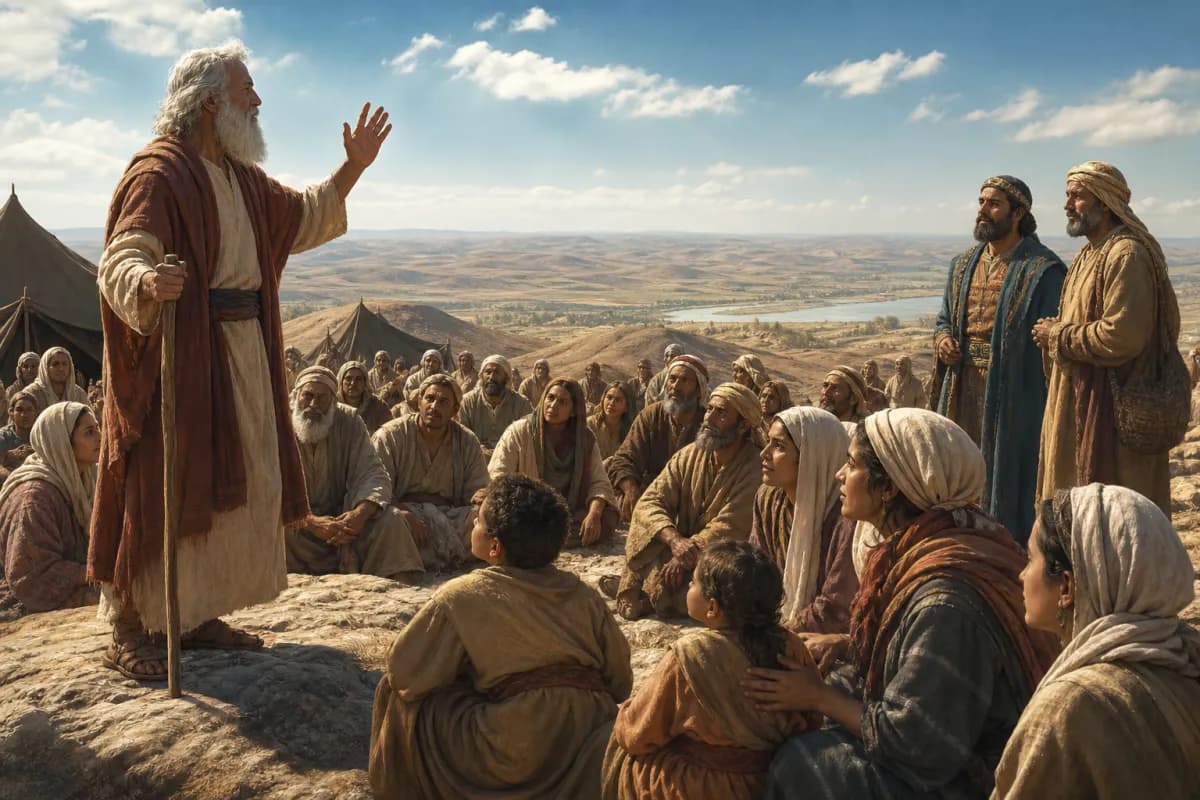
Passage Study
Hear and Live: God’s Wisdom before the Nations
Deuteronomy 4:1–4:49
Deuteronomy 4:1–40 calls Israel to hear and obey the statutes God gives as they enter the land. Moses grounds obedience in God’s nearness, uniqueness, and past rescue, warning against idolatry and forgetfulness. Jesus fulfills the law’s holy purpose and gathers a people whose life before God becomes a witness to His saving wisdom among the nations.
- In this study
- 49 verses · 5 movements
Deuteronomy 4
4:1Now, Israel, listen to the statutes and to the ordinances which I teach you, to do them, that you may live and go in and possess the land which the LORD, the God of your fathers, gives you.
4:2You shall not add to the word which I command you, neither shall you take away from it, that you may keep the commandments of the LORD your God which I command you.
4:3Your eyes have seen what the LORD did because of Baal Peor; for the LORD your God has destroyed all the men who followed Baal Peor from among you.
4:4But you who were faithful to the LORD your God are all alive today.
4:5Behold, I have taught you statutes and ordinances, even as the LORD my God commanded me, that you should do so in the middle of the land where you go in to possess it.
4:6Keep therefore and do them; for this is your wisdom and your understanding in the sight of the peoples who shall hear all these statutes and say, “Surely this great nation is a wise and understanding people.”
4:7For what great nation is there that has a god so near to them as the LORD our God is whenever we call on him?
4:8What great nation is there that has statutes and ordinances so righteous as all this law which I set before you today?
4:9Only be careful, and keep your soul diligently, lest you forget the things which your eyes saw, and lest they depart from your heart all the days of your life; but make them known to your children and your children’s children—
4:10the day that you stood before the LORD your God in Horeb, when the LORD said to me, “Assemble the people to me, and I will make them hear my words, that they may learn to fear me all the days that they live on the earth, and that they may teach their children.”
4:11You came near and stood under the mountain. The mountain burned with fire to the heart of the sky, with darkness, cloud, and thick darkness.
4:12The LORD spoke to you out of the middle of the fire: you heard the voice of words, but you saw no form; you only heard a voice.
4:13He declared to you his covenant, which he commanded you to perform, even the ten commandments. He wrote them on two stone tablets.
4:14The LORD commanded me at that time to teach you statutes and ordinances, that you might do them in the land where you go over to possess it.
4:15Be very careful, for you saw no kind of form on the day that the LORD spoke to you in Horeb out of the middle of the fire,
4:16lest you corrupt yourselves, and make yourself a carved image in the form of any figure, the likeness of male or female,
4:17the likeness of any animal that is on the earth, the likeness of any winged bird that flies in the sky,
4:18the likeness of anything that creeps on the ground, the likeness of any fish that is in the water under the earth;
4:19and lest you lift up your eyes to the sky, and when you see the sun and the moon and the stars, even all the army of the sky, you are drawn away and worship them, and serve them, which the LORD your God has allotted to all the peoples under the whole sky.
4:20But the LORD has taken you, and brought you out of the iron furnace, out of Egypt, to be to him a people of inheritance, as it is today.
4:21Furthermore the LORD was angry with me for your sakes, and swore that I should not go over the Jordan, and that I should not go in to that good land which the LORD your God gives you for an inheritance;
4:22but I must die in this land. I must not go over the Jordan, but you shall go over and possess that good land.
4:23Be careful, lest you forget the covenant of the LORD your God, which he made with you, and make yourselves a carved image in the form of anything which the LORD your God has forbidden you.
4:24For the LORD your God is a devouring fire, a jealous God.
4:25When you father children and children’s children, and you have been long in the land, and then corrupt yourselves, and make a carved image in the form of anything, and do that which is evil in the LORD your God’s sight to provoke him to anger,
4:26I call heaven and earth to witness against you today, that you will soon utterly perish from off the land which you go over the Jordan to possess it. You will not prolong your days on it, but will utterly be destroyed.
4:27The LORD will scatter you among the peoples, and you will be left few in number among the nations where the LORD will lead you away.
4:28There you will serve gods, the work of men’s hands, wood and stone, which neither see, nor hear, nor eat, nor smell.
4:29But from there you shall seek the LORD your God, and you will find him when you search after him with all your heart and with all your soul.
4:30When you are in oppression, and all these things have come on you, in the latter days you shall return to the LORD your God and listen to his voice.
4:31For the LORD your God is a merciful God. He will not fail you nor destroy you, nor forget the covenant of your fathers which he swore to them.
4:32For ask now of the days that are past, which were before you, since the day that God created man on the earth, and from the one end of the sky to the other, whether there has been anything as great as this thing is, or has been heard like it?
4:33Did a people ever hear the voice of God speaking out of the middle of the fire, as you have heard, and live?
4:34Or has God tried to go and take a nation for himself from among another nation, by trials, by signs, by wonders, by war, by a mighty hand, by an outstretched arm, and by great terrors, according to all that the LORD your God did for you in Egypt before your eyes?
4:35It was shown to you so that you might know that the LORD is God. There is no one else besides him.
4:36Out of heaven he made you to hear his voice, that he might instruct you. On earth he made you to see his great fire; and you heard his words out of the middle of the fire.
4:37Because he loved your fathers, therefore he chose their offspring after them, and brought you out with his presence, with his great power, out of Egypt;
4:38to drive out nations from before you greater and mightier than you, to bring you in, to give you their land for an inheritance, as it is today.
4:39Know therefore today, and take it to heart, that the LORD himself is God in heaven above and on the earth beneath. There is no one else.
4:40You shall keep his statutes and his commandments which I command you today, that it may go well with you and with your children after you, and that you may prolong your days in the land which the LORD your God gives you for all time.
4:41Then Moses set apart three cities beyond the Jordan toward the sunrise,
4:42that the man slayer might flee there, who kills his neighbor unintentionally and didn’t hate him in time past, and that fleeing to one of these cities he might live:
4:43Bezer in the wilderness, in the plain country, for the Reubenites; and Ramoth in Gilead for the Gadites; and Golan in Bashan for the Manassites.
4:44This is the law which Moses set before the children of Israel.
4:45These are the testimonies, and the statutes, and the ordinances which Moses spoke to the children of Israel when they came out of Egypt,
4:46beyond the Jordan, in the valley opposite Beth Peor, in the land of Sihon king of the Amorites, who lived at Heshbon, whom Moses and the children of Israel struck when they came out of Egypt.
4:47They took possession of his land and the land of Og king of Bashan, the two kings of the Amorites, who were beyond the Jordan toward the sunrise;
4:48from Aroer, which is on the edge of the valley of the Arnon, even to Mount Siyon (also called Hermon),
4:49and all the Arabah beyond the Jordan eastward, even to the sea of the Arabah, under the slopes of Pisgah.
CONTEXTUAL OVERVIEW
Standing on the edge of the land, Moses links hearing with life. Israel is not being offered rules as an alternative to grace; the Lord who brought them out of Egypt now teaches them how a rescued people lives in fellowship with Him.
The chapter repeatedly returns to memory. Israel heard a voice at Horeb but saw no form, so it must not exchange the living God for an image. Forgetting both the exodus and the covenant will make idolatry appear reasonable.
HISTORICAL AND LITERARY CONTEXT
Deuteronomy 4 concludes Moses’ opening historical instruction and leads toward the restatement of the covenant law. The laws are meant to display wisdom before surrounding peoples, but Israel’s distinctive witness depends on worshiping the Lord rather than borrowing the gods of the nations.
Moses speaks realistically about the future. He foresees scattering for persistent idolatry, yet he also announces that the people may seek the Lord and find Him because He is merciful. Judgment and restoration are both framed by God’s covenant character.
SECTION-BY-SECTION ANALYSIS
- Hear and live · Deuteronomy 4:10Listening to God is presented as the path of life within the gift of the land.
- No form · Deuteronomy 4:16The absence of an image guards Israel from reducing the Creator to something human hands can manage.
- Seek and find · Deuteronomy 4:29Even the exile warning contains mercy: wholehearted seeking turns back toward the God who has not abandoned His covenant.
CHRIST IN THIS PASSAGE
Jesus embodies the perfect human hearing and obedience Israel failed to render. He also reveals the invisible God without turning God into an object of human control. In Him, God’s nearness reaches its fullest expression: the Son makes the Father known and bears the curse of covenant-breaking idolatry.
The nations-wide purpose also reaches fulfillment in Christ. The church is not called to display ethnic superiority, but to proclaim the saving wisdom of God in the crucified and risen Jesus. By His Spirit, believers are freed from idols and formed into a people whose worship and love point others to the one true God.
REFLECTION
Idolatry is not limited to carved images. It appears whenever we treat a created good—security, approval, power, nation, or pleasure—as something that can give what only God gives. Deuteronomy calls that movement back into the light of the God who has spoken and rescued.
Jesus does not merely expose idols; He welcomes those who turn from them. Receive His mercy, let His word reorder your loves, and live so that ordinary faithfulness makes God’s nearness and wisdom believable to people who do not yet know Him.
Original Hebrew Word Study
Deuteronomy 4:1
שָׁמַע
shema · H8085
Usually translated: to hear and obey
Shema is hearing that leads to obedience. Moses calls Israel to listen so that they may live, receive the land, and display God’s wisdom before the nations.
Follow the Scripture trail
Hear and Live: God’s Wisdom before the Nations in the larger story
The connection: Israel’s life in the land was meant to show the nations that the Lord alone is near, wise, and merciful. Jesus reveals that God fully, redeems idolaters, and sends His people to display and proclaim His saving wisdom to every people.
Respond to the passage
Identify one created thing you have been asking to give you security or identity that belongs to God alone. Turn to Jesus, who makes the Father known and frees people from idols, then choose one concrete practice of listening to His word this week.
- Why does Moses connect Israel’s obedience with the nations seeing wisdom?
- How does the fact that Israel saw no form at Sinai protect true worship?
- What modern idols make it difficult to trust the God who has drawn near in Jesus?
Prayer
One true God, forgive me for giving created things the trust and love that belong to You. Thank You for revealing Yourself in Jesus and for rescuing me by grace. Teach me to hear Your word, worship You alone, and show Your wisdom to the people around me. Amen.