Passage Study
The Covenant at Horeb: A People Called to Hear God’s Voice
Deuteronomy 5:1–5:33
Deuteronomy 5 repeats the Ten Commandments and remembers Israel’s fear at Horeb, where the Lord spoke from the fire. The commandments reveal the shape of life under the God who delivered Israel from Egypt, while the people’s request for a mediator exposes their need for someone who can stand before God on their behalf. Jesus fulfills that need as the faithful mediator whose saving work brings forgiven people into covenant life.
- In this study
- 33 verses · 5 movements
Deuteronomy 5
5:1Moses called to all Israel, and said to them, “Hear, Israel, the statutes and the ordinances which I speak in your ears today, that you may learn them, and observe to do them.”
5:2The LORD our God made a covenant with us in Horeb.
5:3The LORD didn’t make this covenant with our fathers, but with us, even us, who are all of us here alive today.
5:4The LORD spoke with you face to face on the mountain out of the middle of the fire,
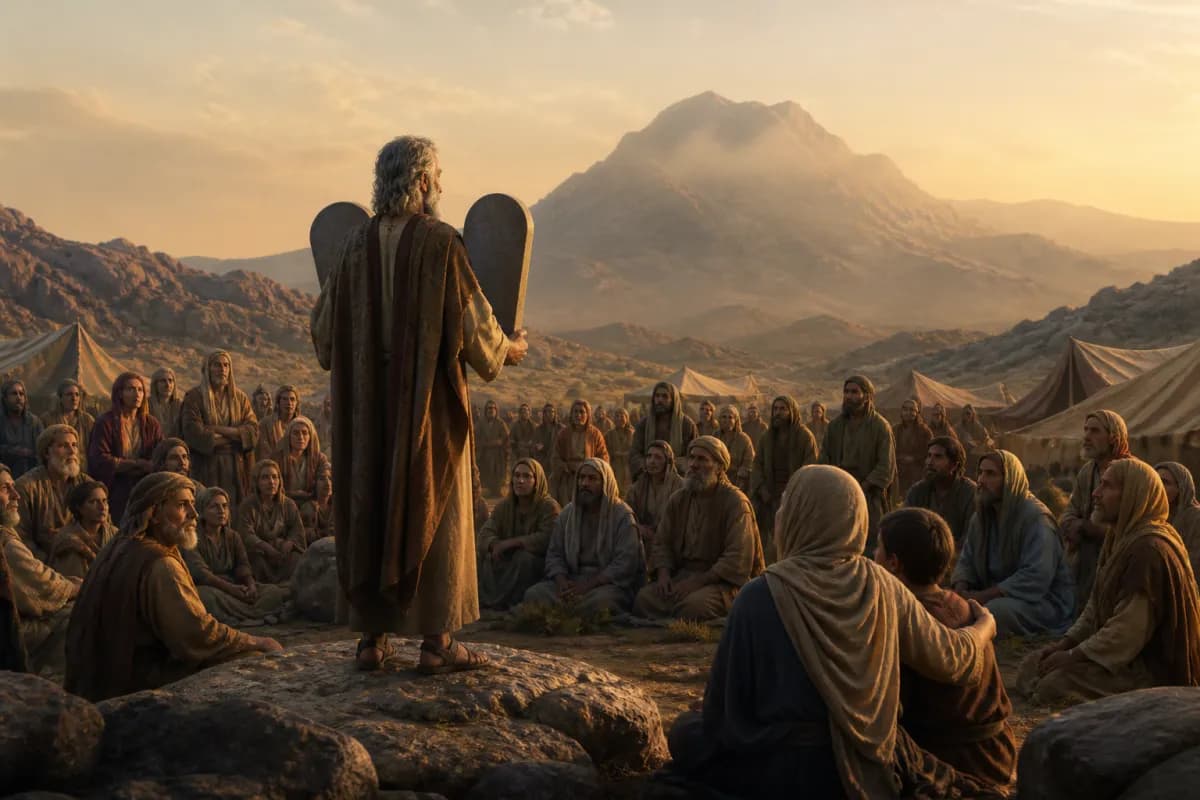
5:5(I stood between the LORD and you at that time, to show you the LORD’s word; for you were afraid because of the fire, and didn’t go up onto the mountain) saying,
5:6“I am the LORD your God, who brought you out of the land of Egypt, out of the house of bondage.
5:7“You shall have no other gods before me.
5:8“You shall not make a carved image for yourself—any likeness of what is in heaven above, or what is in the earth beneath, or that is in the water under the earth.
5:9You shall not bow yourself down to them, nor serve them, for I, the LORD your God, am a jealous God, visiting the iniquity of the fathers on the children and on the third and on the fourth generation of those who hate me
5:10and showing loving kindness to thousands of those who love me and keep my commandments.
5:11“You shall not misuse the name of the LORD your God; for the LORD will not hold him guiltless who misuses his name.
5:12“Observe the Sabbath day, to keep it holy, as the LORD your God commanded you.
5:13You shall labor six days, and do all your work;
5:14but the seventh day is a Sabbath to the LORD your God, in which you shall not do any work—neither you, nor your son, nor your daughter, nor your male servant, nor your female servant, nor your ox, nor your donkey, nor any of your livestock, nor your stranger who is within your gates; that your male servant and your female servant may rest as well as you.
5:15You shall remember that you were a servant in the land of Egypt, and the LORD your God brought you out of there by a mighty hand and by an outstretched arm. Therefore the LORD your God commanded you to keep the Sabbath day.
5:16“Honor your father and your mother, as the LORD your God commanded you, that your days may be long and that it may go well with you in the land which the LORD your God gives you.
5:17“You shall not murder.
5:18“You shall not commit adultery.
5:19“You shall not steal.
5:20“You shall not give false testimony against your neighbor.
5:21“You shall not covet your neighbor’s wife. Neither shall you desire your neighbor’s house, his field, or his male servant, or his female servant, his ox, or his donkey, or anything that is your neighbor’s.”
5:22The LORD spoke these words to all your assembly on the mountain out of the middle of the fire, of the cloud, and of the thick darkness, with a great voice. He added no more. He wrote them on two stone tablets, and gave them to me.
5:23When you heard the voice out of the middle of the darkness, while the mountain was burning with fire, you came near to me, even all the heads of your tribes, and your elders;
5:24and you said, “Behold, the LORD our God has shown us his glory and his greatness, and we have heard his voice out of the middle of the fire. We have seen today that God does speak with man, and he lives.
5:25Now therefore, why should we die? For this great fire will consume us. If we hear the LORD our God’s voice any more, then we shall die.
5:26For who is there of all flesh who has heard the voice of the living God speaking out of the middle of the fire, as we have, and lived?
5:27Go near, and hear all that the LORD our God shall say, and tell us all that the LORD our God tells you; and we will hear it, and do it.”
5:28The LORD heard the voice of your words when you spoke to me; and the LORD said to me, “I have heard the voice of the words of this people which they have spoken to you. They have well said all that they have spoken.
5:29Oh that there were such a heart in them that they would fear me and keep all my commandments always, that it might be well with them and with their children forever!
5:30“Go tell them, ‘Return to your tents.’
5:31But as for you, stand here by me, and I will tell you all the commandments, and the statutes, and the ordinances, which you shall teach them, that they may do them in the land which I give them to possess.”
5:32You shall observe to do therefore as the LORD your God has commanded you. You shall not turn away to the right hand or to the left.
5:33You shall walk in all the way which the LORD your God has commanded you, that you may live and that it may be well with you, and that you may prolong your days in the land which you shall possess.
CONTEXTUAL OVERVIEW
Moses addresses the generation now standing in Moab and says that the covenant at Horeb is not distant history. Though their parents stood at the mountain, the living claim of God’s word reaches the people now before him. They are called first to hear, learn, and do.
The Ten Commandments are introduced by grace: the Lord is the God who brought Israel out of the house of slavery. The commands do not offer a ladder by which slaves earn rescue. They describe the allegiance, worship, truthfulness, rest, and neighbor-love that belong to a people already delivered by their covenant Lord.
HISTORICAL AND LITERARY CONTEXT
Deuteronomy 5 revisits Exodus 20 while speaking to the new wilderness generation. The wording of the Sabbath command particularly highlights Israel’s former slavery: rest is a weekly refusal to live as though Pharaoh still owns the people. The command therefore touches worship, labor, household life, and memory together.
The chapter’s final scene returns to Sinai’s fire, cloud, and darkness. The people recognize that hearing the living God’s voice is dangerous for sinners, and they ask Moses to hear on their behalf. Moses’ role is real, but the scene also leaves open the longing for a mediator whose access to God and obedience to God will be complete.
SECTION-BY-SECTION ANALYSIS
- Out of the house of slavery · Deuteronomy 5:6The covenant commands begin with God’s prior rescue, placing obedience within grace and gratitude.
- Remember you were a slave · Deuteronomy 5:15Sabbath rest teaches Israel that neither people nor animals exist merely as instruments of endless production.
- Go near and hear · Deuteronomy 5:27The people ask Moses to mediate God’s word because holy presence exposes their inability to stand safely on their own.
CHRIST IN THIS PASSAGE
Deuteronomy 5 does not say that Moses himself is the final mediator, but the people’s plea makes their need visible. Jesus is the mediator of the new covenant: fully faithful to the Father, truly human with His people, and able through His sacrifice to bring sinners near without denying God’s holiness.
Jesus also fulfills the law rather than loosening its moral seriousness. He loves the Father without idolatry and loves neighbors without deceit or self-protection. Through His saving death and gift of the Spirit, He forgives lawbreakers and begins to write God’s will on their hearts, forming a people whose obedience becomes grateful witness to the God who saves.
REFLECTION
The commandments expose more than public behavior; they reach desire, speech, rest, and the way we treat people closest to us. This is good news for people tired of shallow religion, because God cares about the whole life. It is also humbling news, because none of us has loved Him and neighbor with the wholeness these commands require.
Bring that exposure to Jesus rather than hiding from it. He does not excuse sin, but He is the mediator who bears it and gives mercy. Let one commandment that unsettles you become a doorway to confession, repair, and a more truthful witness before the people God has placed near you.
Original Hebrew Word Study
Deuteronomy 5:2
בְּרִית
berit · H1285
Usually translated: covenant
Berit is a covenant bond. The commandments are repeated as the terms of a relationship the Lord has graciously established with a rescued people.
Follow the Scripture trail
The Covenant at Horeb: A People Called to Hear God’s Voice in the larger story
The connection: At Horeb, Israel hears the holy God’s covenant and asks for a mediator, while the commandments reveal the life rescued people are meant to live. Jesus fulfills the saving hope of that scene: He mediates forgiveness, gives a new heart, and sends a people whose love for God and neighbor bears witness to His grace.
Respond to the passage
Do not use God’s commands to measure yourself against other people. Let them bring you honestly to Jesus, the mediator who forgives and renews. Choose one relationship or habit where grateful obedience can make His mercy visible this week.
- Why does the chapter begin the commandments with Israel’s rescue from slavery?
- How does the Sabbath command connect rest with the memory of the exodus?
- What does Israel’s request for Moses to hear God’s voice reveal about the human need for mediation?
Prayer
Holy God, Your commands show me both the beauty of Your will and the dividedness of my heart. Thank You for Jesus, the faithful mediator who bears my sin and brings me near. Write Your ways more deeply within me and make my life a witness to Your freeing grace. Amen.