Passage Study
Hear, O Israel: Loving the One Lord
Deuteronomy 6:1–6:25
Deuteronomy 6:1–25 calls Israel to love the one Lord with heart, soul, and strength, to teach His words within the household, and to remember that its life in the land is an undeserved gift. Jesus identifies this as the greatest command and fulfills it as the faithful Son, forming a people whose love for God becomes a witness to His saving grace.
- In this study
- 25 verses · 5 movements
Deuteronomy 6
6:1Now these are the commandments, the statutes, and the ordinances, which the LORD your God commanded to teach you, that you might do them in the land that you go over to possess;
6:2that you might fear the LORD your God, to keep all his statutes and his commandments, which I command you—you, your son, and your son’s son, all the days of your life; and that your days may be prolonged.
6:3Hear therefore, Israel, and observe to do it, that it may be well with you, and that you may increase mightily, as the LORD, the God of your fathers, has promised to you, in a land flowing with milk and honey.
6:4Hear, Israel: The LORD is our God. The LORD is one.
6:5You shall love the LORD your God with all your heart, with all your soul, and with all your might.
6:6These words, which I command you today, shall be on your heart;
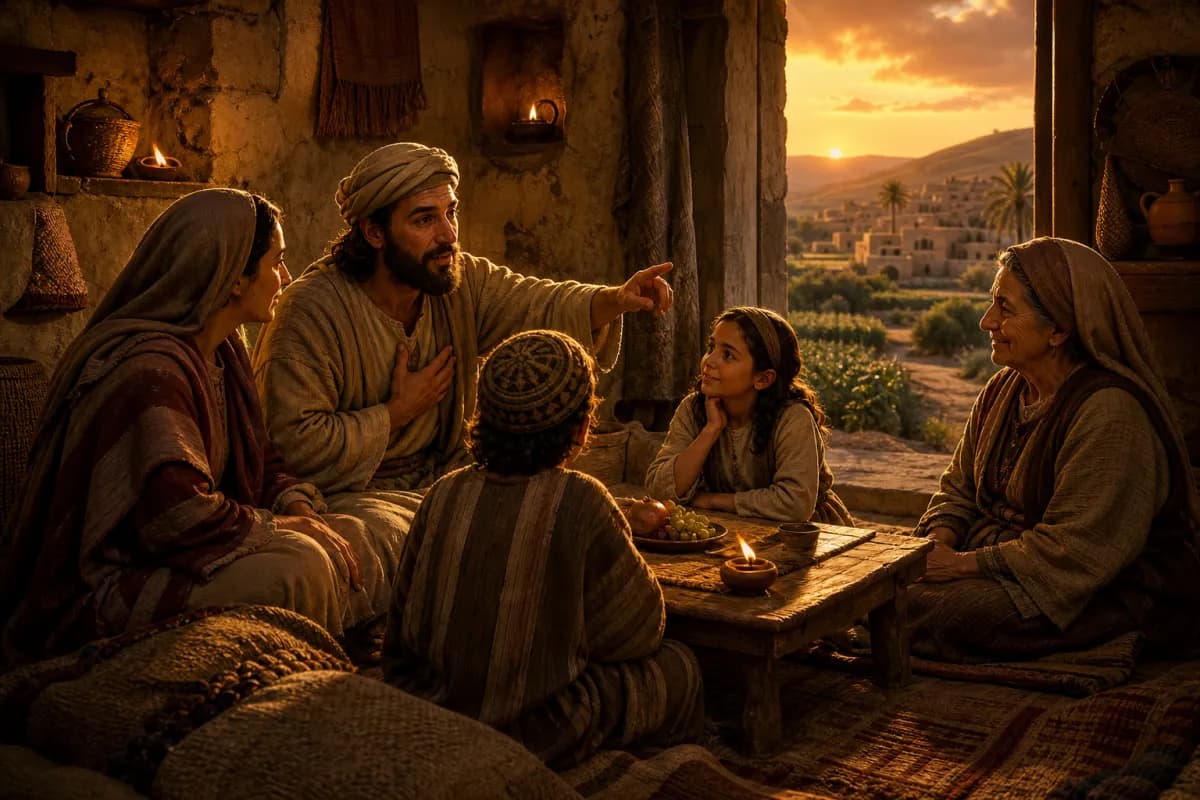
6:7and you shall teach them diligently to your children, and shall talk of them when you sit in your house, and when you walk by the way, and when you lie down, and when you rise up.
6:8You shall bind them for a sign on your hand, and they shall be for frontlets between your eyes.
6:9You shall write them on the door posts of your house and on your gates.
6:10It shall be, when the LORD your God brings you into the land which he swore to your fathers, to Abraham, to Isaac, and to Jacob, to give you, great and goodly cities which you didn’t build,
6:11and houses full of all good things which you didn’t fill, and cisterns dug out which you didn’t dig, vineyards and olive trees which you didn’t plant, and you shall eat and be full;
6:12then beware lest you forget the LORD, who brought you out of the land of Egypt, out of the house of bondage.
6:13You shall fear the LORD your God; and you shall serve him, and shall swear by his name.
6:14You shall not go after other gods, of the gods of the peoples who are around you,
6:15for the LORD your God among you is a jealous God, lest the anger of the LORD your God be kindled against you, and he destroy you from off the face of the earth.
6:16You shall not tempt the LORD your God, as you tempted him in Massah.
6:17You shall diligently keep the commandments of the LORD your God, and his testimonies, and his statutes, which he has commanded you.
6:18You shall do that which is right and good in the LORD’s sight, that it may be well with you and that you may go in and possess the good land which the LORD swore to your fathers,
6:19to thrust out all your enemies from before you, as the LORD has spoken.
6:20When your son asks you in time to come, saying, “What do the testimonies, the statutes, and the ordinances, which the LORD our God has commanded you mean?”
6:21then you shall tell your son, “We were Pharaoh’s slaves in Egypt. The LORD brought us out of Egypt with a mighty hand;
6:22and the LORD showed great and awesome signs and wonders on Egypt, on Pharaoh, and on all his house, before our eyes;
6:23and he brought us out from there, that he might bring us in, to give us the land which he swore to our fathers.
6:24The LORD commanded us to do all these statutes, to fear the LORD our God, for our good always, that he might preserve us alive, as we are today.
6:25It shall be righteousness to us, if we observe to do all these commandments before the LORD our God, as he has commanded us.”
CONTEXTUAL OVERVIEW
Deuteronomy 6 stands at the heart of Moses’ covenant instruction. The command to love God is given to a people already rescued from Egypt and approaching a land they did not build or plant. Love is therefore the grateful allegiance of a redeemed people, not a route to earning rescue.
The chapter moves from public confession to household practice. God’s words are to be on the heart, spoken in ordinary rhythms, and displayed as a continual reminder. Israel’s children must learn not only what to do but why: the Lord brought us out to give us life.
HISTORICAL AND LITERARY CONTEXT
The opening confession, often called the Shema from its first Hebrew word, distinguishes Israel’s worship from the many-god patterns around it. The Lord is one; Israel therefore cannot divide trust between Him and the gods, powers, or security systems of the land.
Moses knows prosperity creates a distinctive spiritual danger. In the wilderness, need made dependence visible; in houses full of good things, Israel may forget who gave them. The warning is not against receiving God’s gifts but against enjoying them as though God were absent.
SECTION-BY-SECTION ANALYSIS
- The one Lord · Deuteronomy 6:4Exclusive worship follows from God’s unique identity; no rival can share the allegiance that belongs to Him.
- On the heart · Deuteronomy 6:5God’s words are not merely external markers but are meant to shape desire, memory, and daily practice.
- Tell the rescue · Deuteronomy 6:21The next generation learns obedience by hearing that the Lord first delivered their ancestors from slavery.
CHRIST IN THIS PASSAGE
Jesus names love for God from Deuteronomy 6 as the greatest command, and He alone renders it with unbroken faithfulness. In the wilderness He answers temptation by quoting this chapter, refusing to test God or serve another. He is the faithful Israelite and Son where Israel repeatedly forgot.
His saving mission also transforms the command’s setting. Jesus delivers people from slavery to sin, brings them into the Father’s family, and gives the Spirit who pours God’s love into their hearts. Christian obedience is not an attempt to recreate the exodus by effort; it is grateful participation in the redemption Christ has accomplished.
REFLECTION
The test of love for God is often found in the unremarkable places named here: conversations at home, what our routines rehearse, and what we remember when life is comfortable. The passage invites believers to make the story of God’s rescue in Christ normal speech rather than occasional religious language.
Jesus frees us from pretending that divided loves are harmless. Bring the rival trust to Him, receive His forgiveness, and ask Him to reshape your home, work, and habits so that those near you can see what it means to love the Lord who saves.
Original Hebrew Word Study
Deuteronomy 6:5
אָהַב
ahav · H157
Usually translated: to love
Ahav means to love. Israel is called to love the one Lord with the whole heart, life, and strength, making covenant obedience a response of personal devotion.
Follow the Scripture trail
Hear, O Israel: Loving the One Lord in the larger story
The connection: The God who brought Israel out of Egypt calls them to love Him alone and to tell that rescue to their children. Jesus fulfills this covenant love, redeems people from deeper slavery, and sends His people to make His saving grace known in every household and nation.
Respond to the passage
Choose one ordinary rhythm—a meal, drive, morning, or bedtime—where you can remember aloud what Jesus has done. Ask Him to expose a rival love and to make grateful, wholehearted devotion more visible in the life you share with others.
- Why does Moses connect the command to love God with the memory of the exodus?
- What does the chapter’s household language suggest about how faith is formed?
- How does Jesus’ use of Deuteronomy 6 in temptation show His faithful love for the Father?
Prayer
Lord, You alone are God. Forgive my divided loves and my tendency to forget Your gifts come from Your hand. Thank You for Jesus, who loved You perfectly and redeemed me by grace. Put Your word deep in my heart and make my life a faithful witness to Your saving love. Amen.