Passage Study
Remember in Plenty: The God Who Humbles and Provides
Deuteronomy 8:1–8:20
Deuteronomy 8 calls Israel to remember the wilderness when it enters a land of abundance. Hunger, manna, clothing that did not wear out, and the discipline of a father all taught that life depends on God’s word and generosity. Jesus enters this wilderness lesson faithfully and becomes the bread of life, calling His people to receive provision with gratitude and join His saving mission without pride.
- In this study
- 20 verses · 5 movements
Deuteronomy 8
8:1You shall observe to do all the commandments which I command you today, that you may live, and multiply, and go in and possess the land which the LORD swore to your fathers.
8:2You shall remember all the way which the LORD your God has led you these forty years in the wilderness, that he might humble you, to test you, to know what was in your heart, whether you would keep his commandments or not.
8:3He humbled you, allowed you to be hungry, and fed you with manna, which you didn’t know, neither did your fathers know, that he might teach you that man does not live by bread only, but man lives by every word that proceeds out of the LORD’s mouth.
8:4Your clothing didn’t grow old on you, neither did your foot swell, these forty years.
8:5You shall consider in your heart that as a man disciplines his son, so the LORD your God disciplines you.
8:6You shall keep the commandments of the LORD your God, to walk in his ways, and to fear him.
8:7For the LORD your God brings you into a good land, a land of brooks of water, of springs, and underground water flowing into valleys and hills;
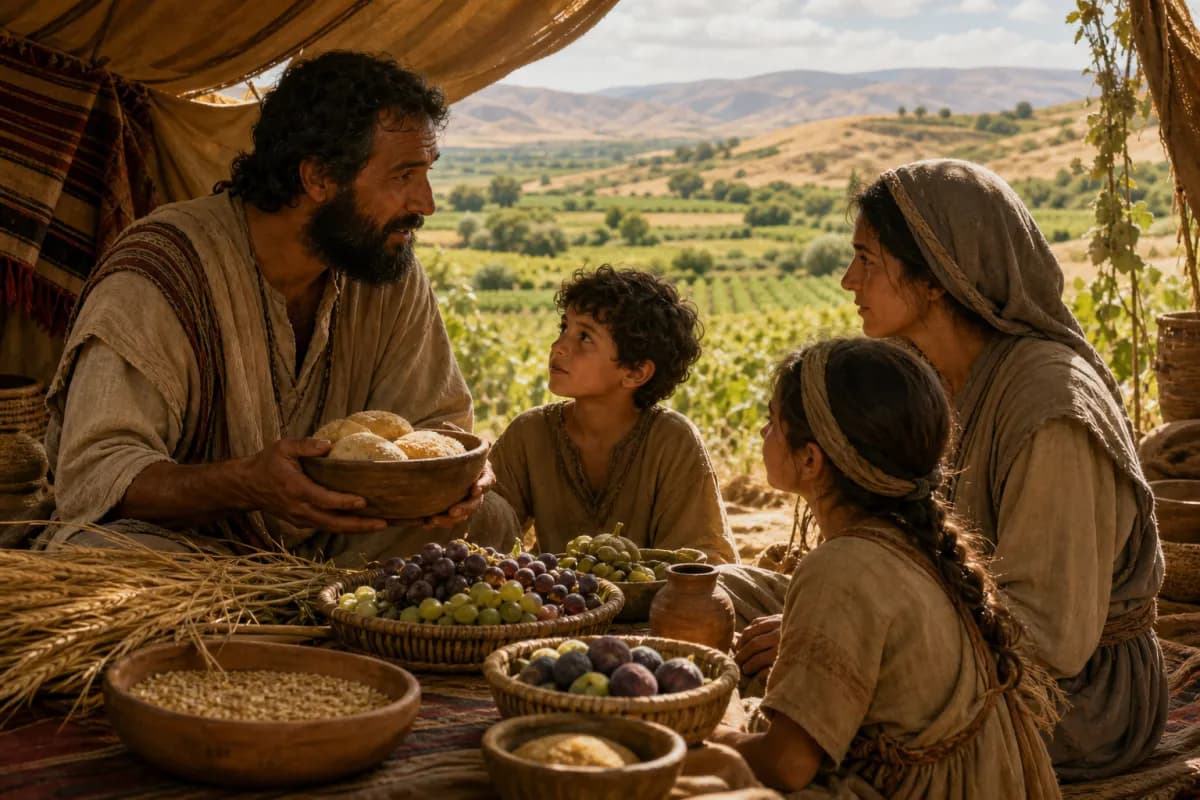
8:8a land of wheat, barley, vines, fig trees, and pomegranates; a land of olive trees and honey;
8:9a land in which you shall eat bread without scarcity, you shall not lack anything in it; a land whose stones are iron, and out of whose hills you may dig copper.
8:10You shall eat and be full, and you shall bless the LORD your God for the good land which he has given you.
8:11Beware lest you forget the LORD your God, in not keeping his commandments, his ordinances, and his statutes, which I command you today;
8:12lest, when you have eaten and are full, and have built fine houses and lived in them;
8:13and when your herds and your flocks multiply, and your silver and your gold is multiplied, and all that you have is multiplied;
8:14then your heart might be lifted up, and you forget the LORD your God, who brought you out of the land of Egypt, out of the house of bondage;
8:15who led you through the great and terrible wilderness, with venomous snakes and scorpions, and thirsty ground where there was no water; who poured water for you out of the rock of flint;
8:16who fed you in the wilderness with manna, which your fathers didn’t know, that he might humble you, and that he might prove you, to do you good at your latter end;
8:17and lest you say in your heart, “My power and the might of my hand has gotten me this wealth.”
8:18But you shall remember the LORD your God, for it is he who gives you power to get wealth, that he may establish his covenant which he swore to your fathers, as it is today.
8:19It shall be, if you shall forget the LORD your God, and walk after other gods, and serve them and worship them, I testify against you today that you shall surely perish.
8:20As the nations that the LORD makes to perish before you, so you shall perish, because you wouldn’t listen to the LORD your God’s voice.
CONTEXTUAL OVERVIEW
Israel stands at the threshold of a land with streams, wheat, vines, oil, honey, iron, and stone. Moses knows that lack can make dependence obvious, but abundance can make forgetfulness feel natural. He therefore tells the people to carry the wilderness with them into prosperity as a memory of who fed them and why.
The chapter refuses a simple contrast between hard wilderness and good land. The wilderness was a place of testing, hunger, discipline, and miraculous provision; the land is a gift that can become spiritually dangerous if it encourages Israel to say, “My power and the might of my own hand have gained me this wealth.”
HISTORICAL AND LITERARY CONTEXT
Deuteronomy 8 belongs to Moses’ covenant instruction before Israel enters Canaan. The manna narrative reaches back to Exodus 16, while the warning about prosperity anticipates the settled agricultural life the people have not yet experienced. Moses interprets both scarcity and abundance through the same covenant relationship.
The image of fatherly discipline does not romanticize wilderness suffering. It says that the Lord’s testing had a purpose: to reveal what was in Israel’s heart and to teach dependence. The chapter does not claim every hardship can be neatly explained; it speaks specifically about Israel’s formative wilderness journey under God’s covenant care.
SECTION-BY-SECTION ANALYSIS
- Manna in the wilderness · Deuteronomy 8:16God’s daily provision teaches Israel that survival and flourishing depend on His word and mercy.
- As a parent disciplines a child · Deuteronomy 8:5The chapter interprets this covenant wilderness season as formative discipline aimed at faithful life.
- The power to gain wealth · Deuteronomy 8:17Ability, opportunity, and material fruit are all received gifts, leaving no room for self-made boasting.
CHRIST IN THIS PASSAGE
Jesus quotes Deuteronomy 8:3 when He is hungry in the wilderness and refuses to use His power apart from the Father’s will. Where Israel repeatedly grumbled and forgot, Jesus trusts the word of God. His obedience is not merely an example for hungry people; it belongs to His faithful saving work for those whose trust has failed.
Jesus also calls Himself the bread of life. The manna points by pattern to a provision greater than physical food: the Son gives Himself so that those who come to Him receive eternal life. His mission turns grateful dependence outward as well, freeing His people to use material gifts for love, generosity, and witness rather than for self-exaltation.
REFLECTION
Prosperity often hides its spiritual pressure because it feels like the reward for competence. Deuteronomy 8 asks a direct question: when life is full, do we bless God, or do we quietly narrate the fullness as proof that we have made ourselves secure?
Jesus welcomes people who are tired, hungry, ashamed, and proud alike. Receive your work and resources as gifts from His hand, then let gratitude take visible form. A generous decision, an honest prayer of thanks, or a refusal to build identity on achievement can become a small but real testimony to the Bread of Life.
Original Hebrew Word Study
Deuteronomy 8:2
זָכַר
zakar · H2142
Usually translated: to remember
Zakar means to remember in a way that shapes present faithfulness. Israel must remember the wilderness so prosperity does not make them forget the God who provided.
Follow the Scripture trail
Remember in Plenty: The God Who Humbles and Provides in the larger story
The connection: God fed Israel in the wilderness so they would remember that every good gift comes from Him and life rests on His word. Jesus fulfills this lesson as the faithful Son and the bread of life, saving proud and hungry people and sending them to use His gifts for love and witness.
Respond to the passage
Thank Jesus by name for one provision you have begun to treat as normal or self-made. Then choose one way to loosen your grip on it—through generosity, rest, or service—so that your life tells the truth about the God who provides.
- Why does Moses want Israel to remember hunger after it enters a land of plenty?
- What is the difference between working diligently and claiming self-made independence?
- How does Jesus’ use of this chapter in His temptation change the way believers face need and abundance?
Prayer
Father, every good gift comes from Your hand, yet I often turn Your provision into a reason to trust myself. Thank You for Jesus, the faithful Son and bread of life. Teach me gratitude, contentment, and generosity so that others may see Your saving goodness. Amen.