Passage Study
Not Because of Your Righteousness: Mercy after the Golden Calf
Deuteronomy 9:1–9:29
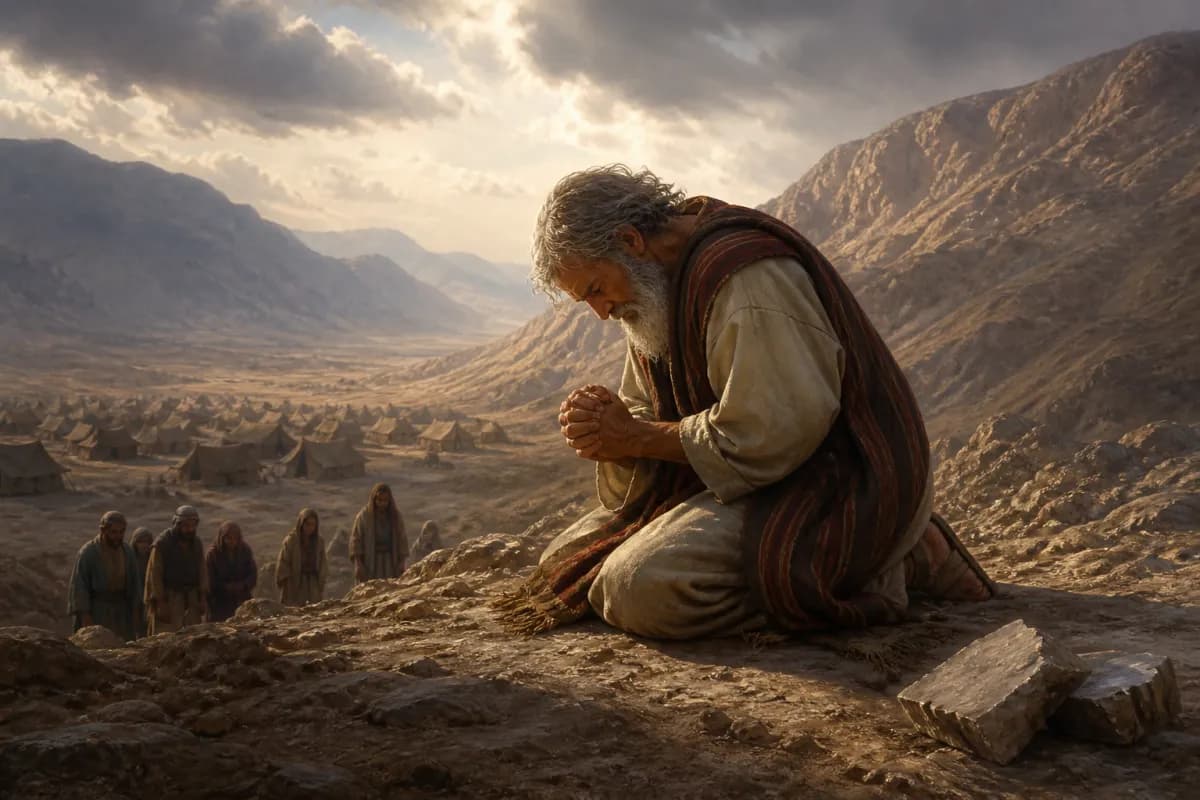
Deuteronomy 9 strips Israel of any claim that it receives the land because it is righteous. Moses recalls rebellion at Horeb, the golden calf, broken tablets, and his long intercession for a stiff-necked people. The chapter prepares readers for Jesus, the greater mediator whose saving death addresses real guilt and whose mission forms a humble people who live by mercy rather than self-congratulation.
- In this study
- 29 verses · 5 movements
Deuteronomy 9
9:1Hear, Israel! You are to pass over the Jordan today, to go in to dispossess nations greater and mightier than yourself, cities great and fortified up to the sky,
9:2a people great and tall, the sons of the Anakim, whom you know, and of whom you have heard say, “Who can stand before the sons of Anak?”
9:3Know therefore today that the LORD your God is he who goes over before you as a devouring fire. He will destroy them and he will bring them down before you. So you shall drive them out and make them perish quickly, as the LORD has spoken to you.
9:4Don’t say in your heart, after the LORD your God has thrust them out from before you, “For my righteousness the LORD has brought me in to possess this land;” because the LORD drives them out before you because of the wickedness of these nations.
9:5Not for your righteousness or for the uprightness of your heart do you go in to possess their land; but for the wickedness of these nations the LORD your God does drive them out from before you, and that he may establish the word which the LORD swore to your fathers, to Abraham, to Isaac, and to Jacob.
9:6Know therefore that the LORD your God doesn’t give you this good land to possess for your righteousness, for you are a stiff-necked people.
9:7Remember, and don’t forget, how you provoked the LORD your God to wrath in the wilderness. From the day that you left the land of Egypt until you came to this place, you have been rebellious against the LORD.
9:8Also in Horeb you provoked the LORD to wrath, and the LORD was angry with you to destroy you.
9:9When I had gone up onto the mountain to receive the stone tablets, even the tablets of the covenant which the LORD made with you, then I stayed on the mountain forty days and forty nights. I neither ate bread nor drank water.
9:10The LORD delivered to me the two stone tablets written with God’s finger. On them were all the words which the LORD spoke with you on the mountain out of the middle of the fire in the day of the assembly.
9:11It came to pass at the end of forty days and forty nights that the LORD gave me the two stone tablets, even the tablets of the covenant.
9:12The LORD said to me, “Arise, get down quickly from here; for your people whom you have brought out of Egypt have corrupted themselves. They have quickly turned away from the way which I commanded them. They have made a molten image for themselves!”
9:13Furthermore the LORD spoke to me, saying, “I have seen these people, and behold, they are a stiff-necked people.
9:14Leave me alone, that I may destroy them, and blot out their name from under the sky; and I will make of you a nation mightier and greater than they.”
9:15So I turned and came down from the mountain, and the mountain was burning with fire. The two tablets of the covenant were in my two hands.
9:16I looked, and behold, you had sinned against the LORD your God. You had made yourselves a molded calf. You had quickly turned away from the way which the LORD had commanded you.
9:17I took hold of the two tablets, and threw them out of my two hands, and broke them before your eyes.
9:18I fell down before the LORD, as at the first, forty days and forty nights. I neither ate bread nor drank water, because of all your sin which you sinned, in doing that which was evil in the LORD’s sight, to provoke him to anger.
9:19For I was afraid of the anger and hot displeasure with which the LORD was angry against you to destroy you. But the LORD listened to me that time also.
9:20The LORD was angry enough with Aaron to destroy him. I prayed for Aaron also at the same time.
9:21I took your sin, the calf which you had made, and burned it with fire, and crushed it, grinding it very small, until it was as fine as dust. I threw its dust into the brook that descended out of the mountain.
9:22At Taberah, at Massah, and at Kibroth Hattaavah you provoked the LORD to wrath.
9:23When the LORD sent you from Kadesh Barnea, saying, “Go up and possess the land which I have given you,” you rebelled against the commandment of the LORD your God, and you didn’t believe him or listen to his voice.
9:24You have been rebellious against the LORD from the day that I knew you.
9:25So I fell down before the LORD the forty days and forty nights that I fell down, because the LORD had said he would destroy you.
9:26I prayed to the LORD, and said, “Lord GOD, don’t destroy your people and your inheritance that you have redeemed through your greatness, that you have brought out of Egypt with a mighty hand.
9:27Remember your servants, Abraham, Isaac, and Jacob. Don’t look at the stubbornness of this people, nor at their wickedness, nor at their sin,
9:28lest the land you brought us out from say, ‘Because the LORD was not able to bring them into the land which he promised to them, and because he hated them, he has brought them out to kill them in the wilderness.’
9:29Yet they are your people and your inheritance, which you brought out by your great power and by your outstretched arm.”
CONTEXTUAL OVERVIEW
Israel is about to enter a land occupied by peoples stronger and taller than itself. That circumstance could tempt the people to imagine that victory proves their moral superiority. Moses cuts off that reading before it begins: the land is not given because of Israel’s righteousness, and Israel itself has repeatedly provoked the Lord.
The central memory is the golden calf at Horeb. While Moses received the covenant tablets, the people made an image and quickly turned aside. The new generation needs to know this history because a promised inheritance can become poison when it is used to manufacture a flattering story about the people who receive it.
HISTORICAL AND LITERARY CONTEXT
Deuteronomy 9 revisits Exodus 32–34 and several episodes from Numbers. Moses preaches the past as covenant diagnosis: Israel’s rebellion is not a one-time accident caused by unusual pressure. The repeated phrase “stiff-necked” names a settled resistance to God’s direction.
Moses also places Israel’s story within the wider moral setting of the land. The nations’ wickedness is part of the explanation for their dispossession, and God’s promise to Abraham, Isaac, and Jacob is the other part. Israel’s merit is expressly excluded. This passage does not authorize readers to declare themselves righteous by comparing themselves with other sinners.
SECTION-BY-SECTION ANALYSIS
- Not because of your righteousness · Deuteronomy 9:4Moses forbids Israel from turning God’s gift into evidence that it has earned His favor.
- The broken tablets · Deuteronomy 9:9Moses’ action makes visible the covenant rupture Israel caused by exchanging God for a calf.
- Forty days of intercession · Deuteronomy 9:11Moses pleads on the basis of God’s covenant and reputation, showing Israel’s need for mercy beyond itself.
CHRIST IN THIS PASSAGE
Moses’ intercession is significant, but Deuteronomy 9 does not present him as sufficient to remove the people’s stubbornness forever. The passage therefore exposes the need for a greater mediator. Jesus bears the judgment sinners deserve, rises to intercede for His people, and secures forgiveness that does not depend on their moral résumé.
This connection is not a permission to use grace as denial or entitlement. Christ’s saving mission humbles people because His cross tells the truth about sin, then changes them because His Spirit gives new life. The church can confess failure honestly and still live with hope because its standing rests in Jesus’ mercy, not its comparative goodness.
REFLECTION
The temptation to call ourselves righteous often appears in more polite clothing: success, sound opinions, family reputation, ministry achievement, or contrast with people whose failures are easier to see. Moses interrupts every version of that story. Whatever good we receive is grace before it is evidence of superiority.
Come to Jesus with plain speech about your sin rather than a polished defense. His mercy is strong enough for the truth. Then let humility make you more patient, more repentant, and more ready to tell others that the hope you have comes from the Savior who intercedes for the undeserving.
Original Hebrew Word Study
Deuteronomy 9:6
קָשֶׁה
qasheh · H7186
Usually translated: hard or stiff
Qasheh means hard or stiff. Israel’s stiff neck describes a will resistant to God, so the land is received by His righteousness and mercy rather than theirs.
Follow the Scripture trail
Not Because of Your Righteousness: Mercy after the Golden Calf in the larger story
The connection: Israel’s golden-calf rebellion proves that God’s gifts cannot be explained by Israel’s righteousness, while Moses’ prayer displays the need for mercy and mediation. Jesus fulfills that saving hope by bearing guilt, interceding for sinners, and forming a humble people who tell the truth about sin and the greater truth of His grace.
Respond to the passage
Stop using comparison to protect your self-image. Confess one specific place where you have explained God’s kindness as though it proved your superiority, receive Christ’s mercy, and let that humility shape how you speak to someone who needs hope.
- Why does Moses insist that Israel’s coming victory is not evidence of its righteousness?
- How do the broken tablets and Moses’ intercession interpret the seriousness of the golden calf?
- How does Jesus’ intercession free believers to confess sin without despair or self-protection?
Prayer
Merciful Father, forgive me for turning Your gifts into reasons to boast. Thank You for Jesus, who bore my guilt and lives to intercede for me. Give me an honest, repentant heart and make my life a humble witness to Your saving grace. Amen.