Passage Study
Israel Multiplies in Egypt: God’s Promise Under Pressure
Exodus 1:1–1:7
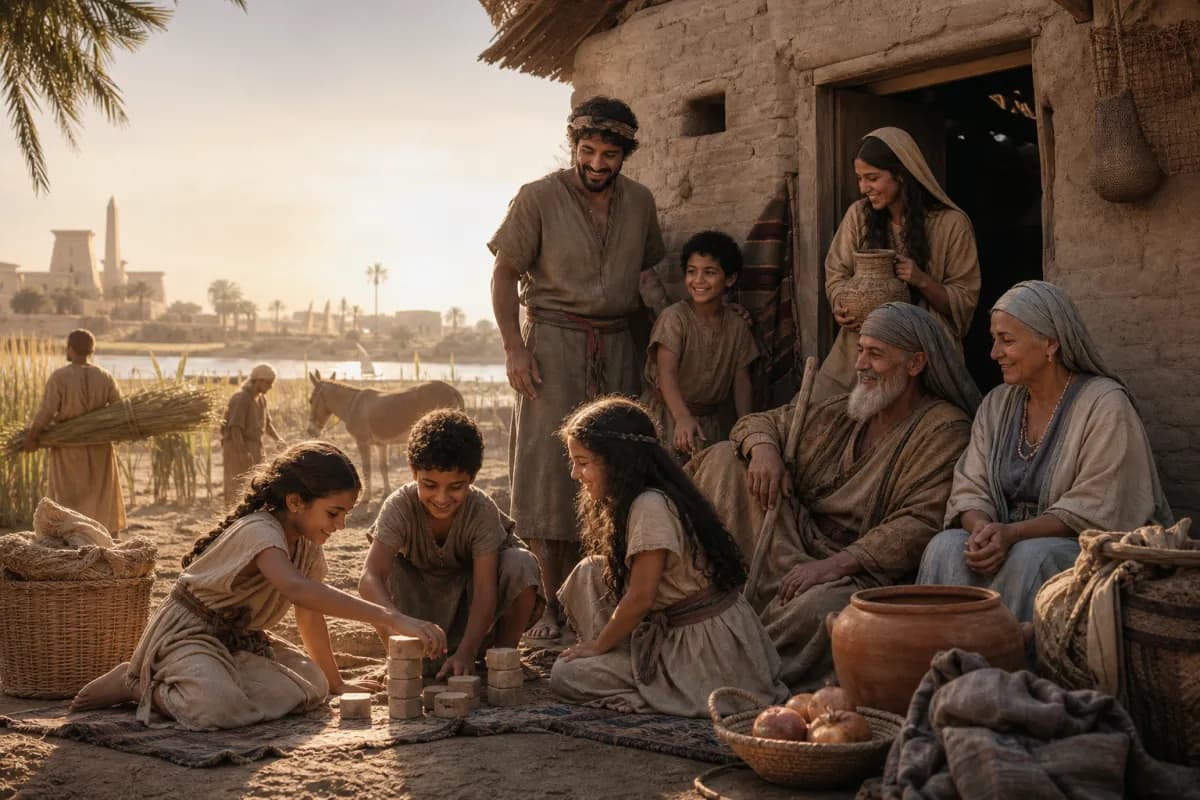
Exodus opens with Israel growing in the land of its refuge after Joseph’s death. The repeated language of fruitfulness shows that God is keeping His promise to Abraham even in a foreign land, while setting the stage for the conflict between Pharaoh’s fearful rule and the Lord’s saving purpose.
- In this study
- 7 verses · 5 movements
Exodus 1
1:1Now these are the names of the sons of Israel, who came into Egypt (every man and his household came with Jacob):
1:2Reuben, Simeon, Levi, and Judah,
1:3Issachar, Zebulun, and Benjamin,
1:4Dan and Naphtali, Gad and Asher.
1:5All the souls who came out of Jacob’s body were seventy souls, and Joseph was in Egypt already.
1:6Joseph died, as did all his brothers, and all that generation.
1:7The children of Israel were fruitful, and increased abundantly, and multiplied, and grew exceedingly mighty; and the land was filled with them.
CONTEXTUAL OVERVIEW
Exodus begins by looking back to the brothers named in Genesis, but its attention quickly shifts from one household to a people. Joseph and his generation have died, yet Israel has become fruitful, prolific, and strong. The phrase echoes God’s creation blessing and His covenant promise that Abraham’s descendants would become a great nation.
That growth is good news, but it is also the reason Pharaoh begins to fear. The opening scene therefore holds two realities together: God’s promise is advancing, and a powerful ruler is preparing to resist it. Israel’s safety in Egypt has become the setting from which God will bring them out.
HISTORICAL AND LITERARY CONTEXT
Literarily, Exodus 1 joins the Joseph story to the deliverance story. The name Israel can refer both to Jacob and to the descendants who now carry his covenant identity. The list of names preserves that continuity: the people endangered by Pharaoh are the family to whom God made promises in Genesis.
The text does not identify the new king by name or supply a date, so its main claim should not be made to rest on a disputed reconstruction of Egyptian chronology. It clearly presents a regime that no longer remembers Joseph’s service and sees a thriving immigrant population as a danger to be controlled.
Did you know?
Some ancient copies count Jacob’s family as seventy-five rather than seventy. The Greek version of Exodus 1:5 and two manuscripts from Qumran preserve the larger total, showing that the alternative count is ancient.
Why it matters: This helps explain why readers can encounter different totals while following the same family’s journey into Egypt.
SECTION-BY-SECTION ANALYSIS
- A remembered family · Exodus 1:1The names at the opening keep Exodus anchored in God’s earlier covenant with Abraham, Isaac, and Jacob.
- A visible blessing · Exodus 1:7Israel’s increase is described in expansive terms, making it a public sign that God has not abandoned His promise.
- A fearful throne · Exodus 1:2Pharaoh treats a people blessed by God as a problem to manage, introducing the false security of empire.
CHRIST IN THIS PASSAGE
This passage does not directly predict Jesus, but it establishes the covenant family through whom the promised blessing for the nations will come. Matthew opens his Gospel by locating Jesus in the line of Abraham and Israel’s kings, showing that the Messiah’s mission grows from promises God kept across generations and against hostile powers.
Pharaoh’s fear of a growing people also anticipates a recurring biblical conflict: earthly rulers resist God’s saving work when it threatens their control. Jesus enters that conflict as the faithful Son and true King. Through His death and resurrection, He gathers a people whom neither oppression nor death can finally extinguish and sends them as witnesses to every nation.
REFLECTION
The passage begins before the dramatic rescue, when God’s people may have looked like an exposed minority under a suspicious government. Their growth had not made them self-sufficient, and it had not removed danger. Still, God’s promise was alive in the ordinary births, households, and years that Pharaoh could not finally control.
Christians can receive this as a summons to trust God’s patient faithfulness when His work seems vulnerable. Jesus does not promise His people an easy path through hostile systems. He promises His presence and a kingdom that will endure. That hope frees the church to nurture life, tell the gospel, and refuse fear-driven measures of its own.
Original Hebrew Word Study
Exodus 1:7
פָּרוּ
paru · H6509
Usually translated: were fruitful
Parah describes fruitfulness that increases and spreads. Israel’s growth is presented as God-given life overflowing in the very place Pharaoh will try to contain it.
Follow the Scripture trail
Israel Multiplies in Egypt: God’s Promise Under Pressure in the larger story
The connection: Israel’s increase shows that God keeps His covenant word before the exodus begins. The promise moves toward Jesus, Abraham’s promised offspring, whose saving mission creates a people from every nation and secures their life through His resurrection.
Respond to the passage
Where have fear or pressure made God’s promises seem fragile? Bring that fear to Jesus. He carries forward the Father’s saving purpose even when opposition is real, and He calls His people to live as a hopeful community rather than as a people ruled by panic.
- Why does Exodus begin by naming Jacob’s sons instead of beginning immediately with Pharaoh?
- What does Israel’s growth reveal about God’s covenant faithfulness before any visible rescue happens?
- How does Christ’s promise to build His church reshape the way you think about a season of resistance or uncertainty?
Prayer
Faithful God, thank You that Your promises do not die with one generation or yield to powerful opposition. Fix my hope on Jesus, who gathers and keeps His people. Make me faithful in the ordinary work of love and witness while I wait for Your purposes to unfold. Amen.