Passage Study
The Hebrew Midwives Fear God Above Pharaoh
Exodus 1:15–1:22
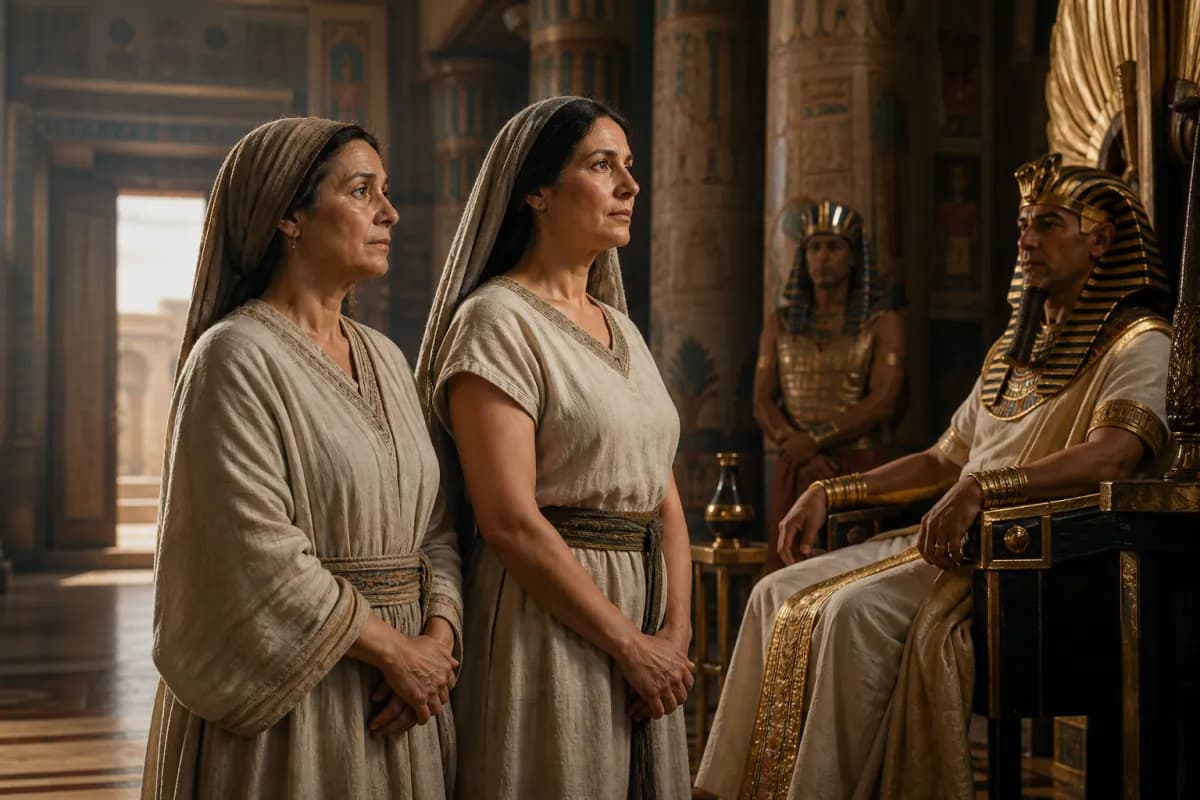
Exodus 1:15–22 places two midwives before Pharaoh’s command to kill Hebrew boys. Shiphrah and Puah fear God rather than the king, preserve life, and receive God’s kindness. Their courage reveals that reverence for God can resist evil commands even when the resistance is costly and the outcome is uncertain.
- In this study
- 8 verses · 5 movements
Exodus 1
1:15The king of Egypt spoke to the Hebrew midwives, of whom the name of the one was Shiphrah, and the name of the other Puah,
1:16and he said, “When you perform the duty of a midwife to the Hebrew women, and see them on the birth stool, if it is a son, then you shall kill him; but if it is a daughter, then she shall live.”
1:17But the midwives feared God, and didn’t do what the king of Egypt commanded them, but saved the baby boys alive.
1:18The king of Egypt called for the midwives, and said to them, “Why have you done this thing and saved the boys alive?”
1:19The midwives said to Pharaoh, “Because the Hebrew women aren’t like the Egyptian women; for they are vigorous and give birth before the midwife comes to them.”
1:20God dealt well with the midwives, and the people multiplied, and grew very mighty.
1:21Because the midwives feared God, he gave them families.
1:22Pharaoh commanded all his people, saying, “You shall cast every son who is born into the river, and every daughter you shall save alive.”
CONTEXTUAL OVERVIEW
Pharaoh’s policy now becomes more direct and more personal. Having failed to contain Israel through forced labor, he summons Shiphrah and Puah, whose names Exodus preserves while leaving Pharaoh unnamed. He tells them to watch the birthstools and kill boys at the moment of birth.
The midwives’ answer is introduced with the decisive phrase: they feared God. Their fear is not panic. It is settled allegiance to the One whose authority outweighs Pharaoh’s. The passage celebrates their preservation of life while refusing to make their situation morally easy or safe.
HISTORICAL AND LITERARY CONTEXT
This episode stands between Pharaoh’s system of forced labor and his public command for infanticide. It intensifies the exodus crisis while quietly showing that the king’s reach has limits. Two women with little social power become agents through whom God frustrates a royal death decree.
The precise arrangement of the midwives’ work and the wording of their explanation have prompted many questions, but the narrator’s stated evaluation remains clear: they do not do what Pharaoh commands because they fear God. The text commends their allegiance to God and His regard for them; it does not invite casual moralizing about every detail of their reply.
Did you know?
An Egyptian birth brick discovered at Abydos still carries a painted scene of a mother holding her newborn, attended by two women. Such bricks supported women during childbirth; this example dates to about 1750–1700 BCE.
Why it matters: This rare object helps us picture the intimate setting in which the midwives protected vulnerable newborns.
SECTION-BY-SECTION ANALYSIS
- Named faithfulness · Exodus 1:15Shiphrah and Puah are remembered by name because their obedience to God matters in the unfolding rescue of Israel.
- Reverence made visible · Exodus 1:16Fear of God is shown in protecting vulnerable children when obedience conflicts with a ruler’s command.
- Escalating evil · Exodus 1:22Pharaoh’s public Nile decree reveals that his fear has hardened into a campaign of death.
CHRIST IN THIS PASSAGE
The midwives do not save Israel by themselves, but their protection of threatened children belongs to the path by which God preserves the people from whom the Messiah will come. Matthew later recounts another ruler’s attempt to kill boys in order to eliminate a perceived rival king. The echo highlights a recurring opposition to God’s redemptive purpose without making Shiphrah and Puah direct stand-ins for Christ.
Jesus gives the fullest revelation of holy authority and costly obedience. He obeys the Father in the face of murderous powers, lays down His own life rather than taking another’s, and rises to defeat death. His saving mission creates a people who honor governing authority rightly while giving God the ultimate allegiance that belongs to Him alone.
REFLECTION
Shiphrah and Puah offer courage for situations where obedience to God is costly but clear. Their example does not make every public decision simple. It does teach that Christians must never treat an evil command as righteous merely because it comes with institutional power.
The passage also calls the church to notice vulnerable lives that powerful people can ignore. Following Jesus includes practical protection, truthful speech, and sacrificial care. Courage does not require confidence in ourselves; it grows from fearing God more than the consequences we cannot control.
Original Hebrew Word Study
Exodus 1:17
יָרֵא
yare · H3372
Usually translated: to fear
The midwives’ fear is reverent allegiance, not mere anxiety. Their courage before Pharaoh grows from treating God’s authority as weightier than the king’s command.
Follow the Scripture trail
The Hebrew Midwives Fear God Above Pharaoh in the larger story
The connection: God preserves life through the faithful courage of Shiphrah and Puah as Pharaoh tries to destroy Israel’s future. The story advances toward Jesus, the threatened child who becomes the crucified and risen Savior, and whose mission calls His people to protect the vulnerable under God’s authority.
Respond to the passage
Consider where you are tempted to keep quiet because an unjust demand comes from someone with more power. Ask Jesus for wisdom and courage to honor God without pretending that faithfulness is risk-free. Look for one concrete way to protect or serve a vulnerable person this week.
- Why does the narrator name the midwives while leaving Pharaoh unnamed?
- How does the phrase “feared God” explain the midwives’ action more fully than bravery alone?
- Where does allegiance to Jesus call you to protect life or speak truth with humble courage?
Prayer
God of life, give me the reverent courage of Shiphrah and Puah. Keep me from excusing evil because it is powerful or convenient. Through Jesus, make me faithful in protecting the vulnerable, speaking truth, and entrusting the cost to You. Amen.