Passage Study
The Plague of Locusts: Let God’s People Go
Exodus 10:1–10:20
Exodus 10:1–20 records the locust plague that consumes what the hail left behind after Pharaoh tries to control the terms of Israel’s worship. Moses insists that young and old, sons and daughters, flocks and herds must go because they do not yet know how the Lord will require them to serve. The passage exposes negotiated obedience and points to Jesus, who saves a whole people to belong to God without Pharaoh-like masters setting the boundaries of worship.
- In this study
- 20 verses · 5 movements
Exodus 10
10:1The LORD said to Moses, “Go in to Pharaoh, for I have hardened his heart and the heart of his servants, that I may show these my signs among them;
10:2and that you may tell in the hearing of your son, and of your son’s son, what things I have done to Egypt, and my signs which I have done among them; that you may know that I am the LORD.”
10:3Moses and Aaron went in to Pharaoh, and said to him, “This is what the LORD, the God of the Hebrews, says: ‘How long will you refuse to humble yourself before me? Let my people go, that they may serve me.
10:4Or else, if you refuse to let my people go, behold, tomorrow I will bring locusts into your country,
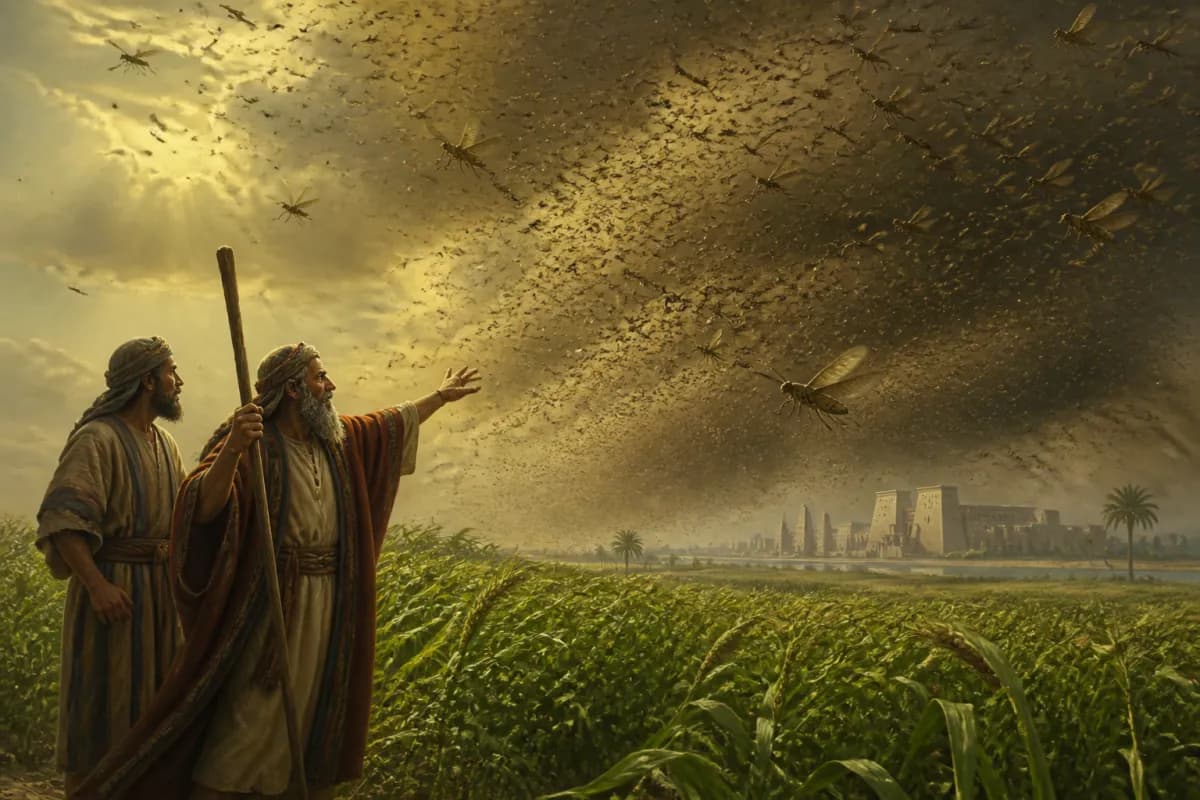
10:5and they shall cover the surface of the earth, so that one won’t be able to see the earth. They shall eat the residue of that which has escaped, which remains to you from the hail, and shall eat every tree which grows for you out of the field.
10:6Your houses shall be filled, and the houses of all your servants, and the houses of all the Egyptians, as neither your fathers nor your fathers’ fathers have seen, since the day that they were on the earth to this day.’” He turned, and went out from Pharaoh.
10:7Pharaoh’s servants said to him, “How long will this man be a snare to us? Let the men go, that they may serve the LORD, their God. Don’t you yet know that Egypt is destroyed?”
10:8Moses and Aaron were brought again to Pharaoh, and he said to them, “Go, serve the LORD your God; but who are those who will go?”
10:9Moses said, “We will go with our young and with our old. We will go with our sons and with our daughters, with our flocks and with our herds; for we must hold a feast to the LORD.”
10:10He said to them, “The LORD be with you if I let you go with your little ones! See, evil is clearly before your faces.
10:11Not so! Go now you who are men, and serve the LORD; for that is what you desire!” Then they were driven out from Pharaoh’s presence.
10:12The LORD said to Moses, “Stretch out your hand over the land of Egypt for the locusts, that they may come up on the land of Egypt, and eat every herb of the land, even all that the hail has left.”
10:13Moses stretched out his rod over the land of Egypt, and the LORD brought an east wind on the land all that day, and all night; and when it was morning, the east wind brought the locusts.
10:14The locusts went up over all the land of Egypt, and rested in all the borders of Egypt. They were very grievous. Before them there were no such locusts as they, nor will there ever be again.
10:15For they covered the surface of the whole earth, so that the land was darkened, and they ate every herb of the land, and all the fruit of the trees which the hail had left. There remained nothing green, either tree or herb of the field, through all the land of Egypt.
10:16Then Pharaoh called for Moses and Aaron in haste, and he said, “I have sinned against the LORD your God, and against you.
10:17Now therefore please forgive my sin again, and pray to the LORD your God, that he may also take away from me this death.”
10:18Moses went out from Pharaoh, and prayed to the LORD.
10:19The LORD sent an exceedingly strong west wind, which took up the locusts, and drove them into the Red Sea. There remained not one locust in all the borders of Egypt.
10:20But the LORD hardened Pharaoh’s heart, and he didn’t let the children of Israel go.
CONTEXTUAL OVERVIEW
After hail has ruined much of the land, Moses returns with a warning that locusts will finish what remains. The Lord tells Moses that Pharaoh’s hardness will become a story Israel’s children and grandchildren recount: Egypt’s king has not been able to resist the God who acts for His people. The plague therefore looks backward to what Pharaoh has done and forward to Israel’s memory of deliverance.
The confrontation turns on who may worship. Pharaoh proposes that only the men go, as though he can grant a narrowly managed religious excursion while retaining Israel’s families and economic life. Moses refuses because the feast belongs to the Lord, and Israel does not yet know which people or animals God will require for worship. Pharaoh cannot dictate the boundaries of the Lord’s claim.
HISTORICAL AND LITERARY CONTEXT
Locust swarms were a feared agricultural disaster in the ancient Near East because they could strip fields, trees, and gardens with astonishing speed. Within Exodus, their arrival after hail makes the judgment cumulative: Egypt’s land has already been damaged, and now what survived is consumed. The narrative’s point is not to offer a scientific account of every swarm but to declare the Lord’s authority over the land Pharaoh claims to rule.
The phrase “serve the Lord” carries the central conflict of Exodus. Pharaoh has used Israel for forced service; God commands their release for worshipful service to Him. Pharaoh’s selective offers reveal that he understands the loss of Israel’s households and livestock as a loss of control, not merely a scheduling dispute.
SECTION-BY-SECTION ANALYSIS
- A remembered rescue · Exodus 10:2Israel is commanded to tell future generations what the Lord did in Egypt and what His signs revealed.
- Whole-community worship · Exodus 10:15Moses rejects Pharaoh’s attempt to separate men from households, children, and livestock in the service of God.
- Relief without surrender · Exodus 10:3Pharaoh asks for the locusts to leave, yet does not yield the people the Lord commands him to release.
CHRIST IN THIS PASSAGE
Moses’ insistence that the whole people go to serve the Lord anticipates a gospel-shaped truth: salvation creates a people who belong to God. Jesus does not rescue sinners merely to leave the old master intact. He delivers them from sin’s dominion and gathers them into a worshiping community in which age, status, and background do not determine who may draw near to God.
The passage also cautions against offering Christ a controlled corner of life. Pharaoh is willing to negotiate, provided he remains the one who sets the terms. Jesus’ saving mission is gracious and costly; He calls people to trust Him as Lord, receiving His forgiveness and learning to bring households, work, resources, and hopes under His good reign.
REFLECTION
Pharaoh’s question, “Who are the ones that are to go?” exposes an instinct to make obedience smaller than God asks. We may offer Jesus our public religion while holding back our relationships, schedule, money, or habits. Moses’ answer calls for a more integrated faith: the Lord’s worship concerns the whole life of His people.
This does not mean that every family must look alike or that one person can force faith on another. It means Christians can pray and labor for homes, friendships, and churches where every generation hears the saving story of Jesus. Tell the story of His rescue clearly, and practice worship that does not leave hidden areas under a rival master.
Original Hebrew Word Study
Exodus 10:4
אַרְבֶּה
arbeh · H697
Usually translated: locust
Arbeh names the locust swarm that consumes what the hail left behind. The plague strips away the illusion that Pharaoh can negotiate the terms of obedience while keeping control.
Follow the Scripture trail
The Plague of Locusts: Let God’s People Go in the larger story
The connection: The locust plague exposes Pharaoh’s attempt to preserve control by limiting Israel’s worship. Jesus fulfills God’s saving mission by freeing people from sin’s rule and forming a whole people who belong to God and proclaim His rescue to the next generation.
Respond to the passage
Ask Jesus to reveal the area of life you have tried to place outside His claim. Receive His lordship as the freedom of belonging to a good Savior, then take one tangible step toward whole-life worship with your household or community.
- Why does Moses insist that children, elders, flocks, and herds all go to worship?
- What do Pharaoh’s servants understand about the danger that Pharaoh himself still refuses to face?
- Where can a desire for a controlled, limited faith resemble Pharaoh’s bargaining?
Prayer
Lord Jesus, forgive me for trying to negotiate the boundaries of Your rule. Thank You for bringing Your people out of bondage to belong to God. Teach me to worship You with my whole life and to tell Your saving story faithfully to those entrusted to me. Amen.