Passage Study
The Final Plague Announced: The Cost of Pharaoh’s Refusal
Exodus 11:1–11:10
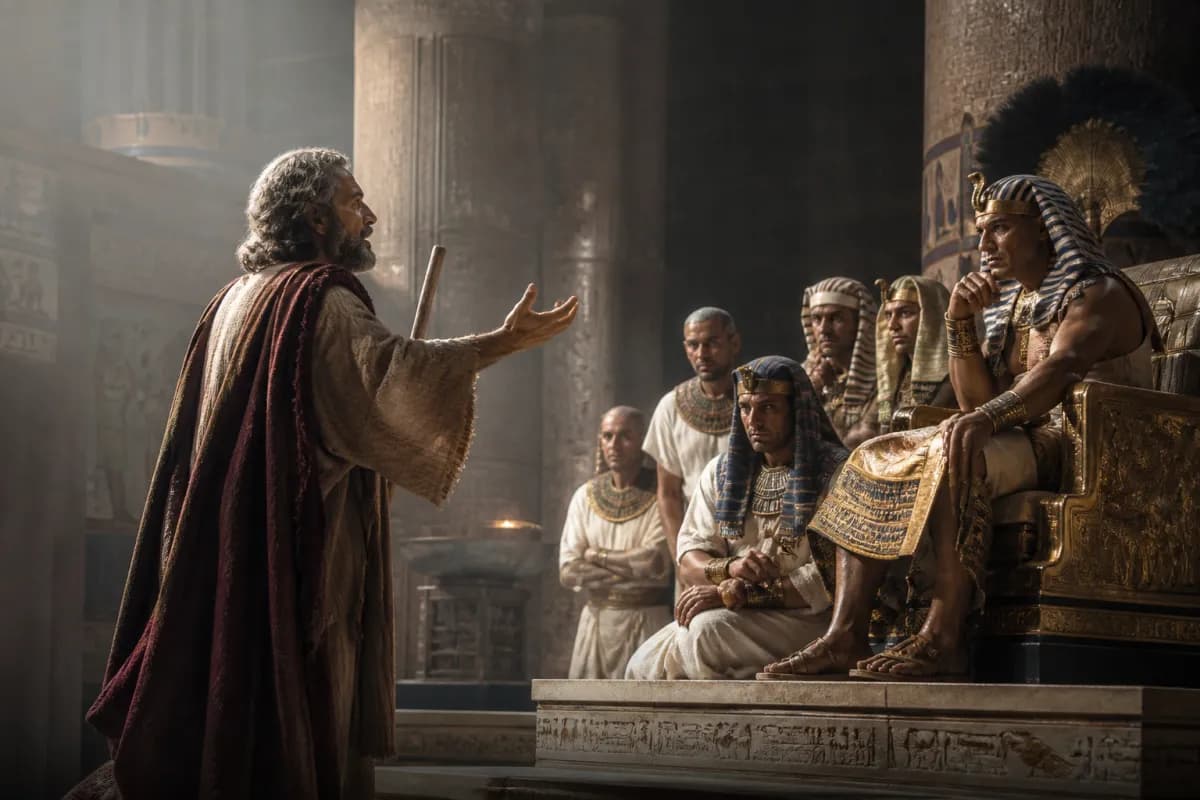
Exodus 11:1–10 announces one final blow after which Pharaoh will drive Israel out of Egypt. Moses tells Israel to ask the Egyptians for silver and gold, declares that Egypt’s firstborn will die, and insists that Israel will be visibly distinguished from Egypt. The severe announcement exposes the cost of a ruler’s hardened oppression and leads toward the Passover, where God provides rescue that ultimately points to Jesus, the Savior who bears judgment and brings His people out of slavery to sin.
- In this study
- 10 verses · 5 movements
Exodus 11
11:1The LORD said to Moses, “I will bring yet one more plague on Pharaoh, and on Egypt; afterwards he will let you go. When he lets you go, he will surely thrust you out altogether.
11:2Speak now in the ears of the people, and let every man ask of his neighbor, and every woman of her neighbor, jewels of silver, and jewels of gold.”
11:3The LORD gave the people favor in the sight of the Egyptians. Moreover, the man Moses was very great in the land of Egypt, in the sight of Pharaoh’s servants, and in the sight of the people.
11:4Moses said, “This is what the LORD says: ‘About midnight I will go out into the middle of Egypt,
11:5and all the firstborn in the land of Egypt shall die, from the firstborn of Pharaoh who sits on his throne, even to the firstborn of the female servant who is behind the mill, and all the firstborn of livestock.
11:6There will be a great cry throughout all the land of Egypt, such as there has not been, nor will be any more.
11:7But against any of the children of Israel a dog won’t even bark or move its tongue, against man or animal, that you may know that the LORD makes a distinction between the Egyptians and Israel.
11:8All these servants of yours will come down to me, and bow down themselves to me, saying, “Get out, with all the people who follow you;” and after that I will go out.’” He went out from Pharaoh in hot anger.
11:9The LORD said to Moses, “Pharaoh won’t listen to you, that my wonders may be multiplied in the land of Egypt.”
11:10Moses and Aaron did all these wonders before Pharaoh, but the LORD hardened Pharaoh’s heart, and he didn’t let the children of Israel go out of his land.
CONTEXTUAL OVERVIEW
After the darkness and Pharaoh’s death threat, the Lord tells Moses that one plague remains. This will not be another unsuccessful negotiation. Pharaoh will send Israel away with urgency, and the people who once served Egypt without pay will depart with silver and gold from their neighbors. The reversal names the moral weight of Israel’s long exploitation.
The coming judgment on the firstborn is the most sobering moment in the plague narrative. Exodus does not invite light treatment of death or suffering. It places the announcement after Pharaoh’s repeated violence, including his earlier attempt to destroy Hebrew sons, and before the Passover instructions that show God’s appointed provision for Israel’s households.
HISTORICAL AND LITERARY CONTEXT
Firstborn language concerns a household’s future, inheritance, and strength. The announced plague reaches from Pharaoh’s household to the most vulnerable laboring household, showing that Egypt’s social order cannot shield anyone from the consequences of the king’s defiance. The scale is deliberately universal within Egypt and deliberately distinguishes Israel, whose cries God first heard under Pharaoh’s regime.
The instruction to ask for silver and gold resumes the promise given to Moses before he returned to Egypt. The text presents the goods as a reversal of slavery, not an opportunistic raid. Israel leaves with material acknowledgment of the labor Egypt has taken, and the movement sets the stage for the later use of gifts in Israel’s worship and, tragically, the golden calf.
SECTION-BY-SECTION ANALYSIS
- A final blow · Exodus 11:1The Lord declares that Pharaoh’s stubbornness will end in an act that forces the release he has refused.
- A reversal of slavery · Exodus 11:2Israel’s departure with silver and gold acknowledges the wealth Egypt has extracted through oppressive labor.
- A made distinction · Exodus 11:7God’s protection of Israel displays His covenant commitment, not a license for pride over Egypt.
CHRIST IN THIS PASSAGE
The announcement of the firstborn judgment prepares directly for the Passover, where a lamb’s blood marks the households God spares. The New Testament later calls Christ our Passover, drawing on this deliverance pattern to proclaim that Jesus gives Himself for sinners. The connection must retain the severity of Exodus: rescue is costly because sin and oppression are not trivial.
Jesus is also called God’s beloved Son and the firstborn over all creation, not because He is a created being but because He possesses unique supremacy and inheritance. At the cross, the Father gives the Son who willingly lays down His life, so that those under sin’s death sentence may receive forgiveness, adoption, and a new exodus into God’s kingdom.
REFLECTION
This passage requires reverence. God hears the cry of the oppressed, and rulers are not free to build security on the suffering of others. It also warns every reader that repeated refusal of God’s word is not harmless. Hardness accumulates; it damages neighbors and narrows the soul’s capacity to receive mercy.
Jesus offers a different future to those who repent. He does not ask us to minimize evil or pretend judgment is unreal. He bears sin’s cost and calls His people to live as those delivered from bondage—telling the truth about injustice, receiving grace humbly, and using freedom to serve others rather than control them.
Original Hebrew Word Study
Exodus 11:1
נֶגַע
nega · H5061
Usually translated: blow, strike, or plague
Nega is a striking blow. The final plague is announced as the decisive act that will end Pharaoh’s resistance and force the release he has repeatedly refused.
Follow the Scripture trail
The Final Plague Announced: The Cost of Pharaoh’s Refusal in the larger story
The connection: The final plague announcement brings Pharaoh’s oppression to its terrible end and leads directly to the Passover provision. Jesus fulfills God’s saving mission as the Passover sacrifice and beloved Son who bears sin’s cost, frees people from bondage, and brings them into God’s family.
Respond to the passage
Let the seriousness of Pharaoh’s refusal move you toward honest repentance rather than fear-driven hiding. Thank Jesus for bearing the cost of rescue, then ask where you can use the freedom He gives to protect and serve someone who is vulnerable.
- How does Pharaoh’s earlier violence toward Hebrew sons shape the meaning of the final plague?
- Why does Exodus mention silver and gold just before the announcement of the firstborn judgment?
- How does the Passover connection help Christians speak about both God’s justice and Jesus’ saving mercy?
Prayer
Holy God, give me a sober heart before the reality of sin and judgment. Thank You for sending Jesus, Your beloved Son, to bear the cost of my rescue. Deliver me from hard-heartedness, teach me to value the vulnerable, and make my freedom serve Your purposes of mercy and justice. Amen.