Passage Study
The Feast of Unleavened Bread: Remembering a Hasty Rescue
Exodus 12:14–12:20
Exodus 12:14–20 commands Israel to remember its departure from Egypt by removing leaven and eating unleavened bread for seven days. The practice preserves the memory of a deliverance so urgent that there was no time for dough to rise, and it points to Jesus, whose saving death forms a people called to live in the freedom and integrity He gives.
- In this study
- 7 verses · 5 movements
Exodus 12
12:14This day shall be a memorial for you. You shall keep it as a feast to the LORD. You shall keep it as a feast throughout your generations by an ordinance forever.
12:15“‘Seven days you shall eat unleavened bread; even the first day you shall put away yeast out of your houses, for whoever eats leavened bread from the first day until the seventh day, that soul shall be cut off from Israel.
12:16In the first day there shall be to you a holy convocation, and in the seventh day a holy convocation; no kind of work shall be done in them, except that which every man must eat, only that may be done by you.
12:17You shall observe the feast of unleavened bread; for in this same day I have brought your armies out of the land of Egypt. Therefore you shall observe this day throughout your generations by an ordinance forever.
12:18In the first month, on the fourteenth day of the month at evening, you shall eat unleavened bread, until the twenty first day of the month at evening.
12:19There shall be no yeast found in your houses for seven days, for whoever eats that which is leavened, that soul shall be cut off from the congregation of Israel, whether he is a foreigner, or one who is born in the land.
12:20You shall eat nothing leavened. In all your habitations you shall eat unleavened bread.’”
CONTEXTUAL OVERVIEW
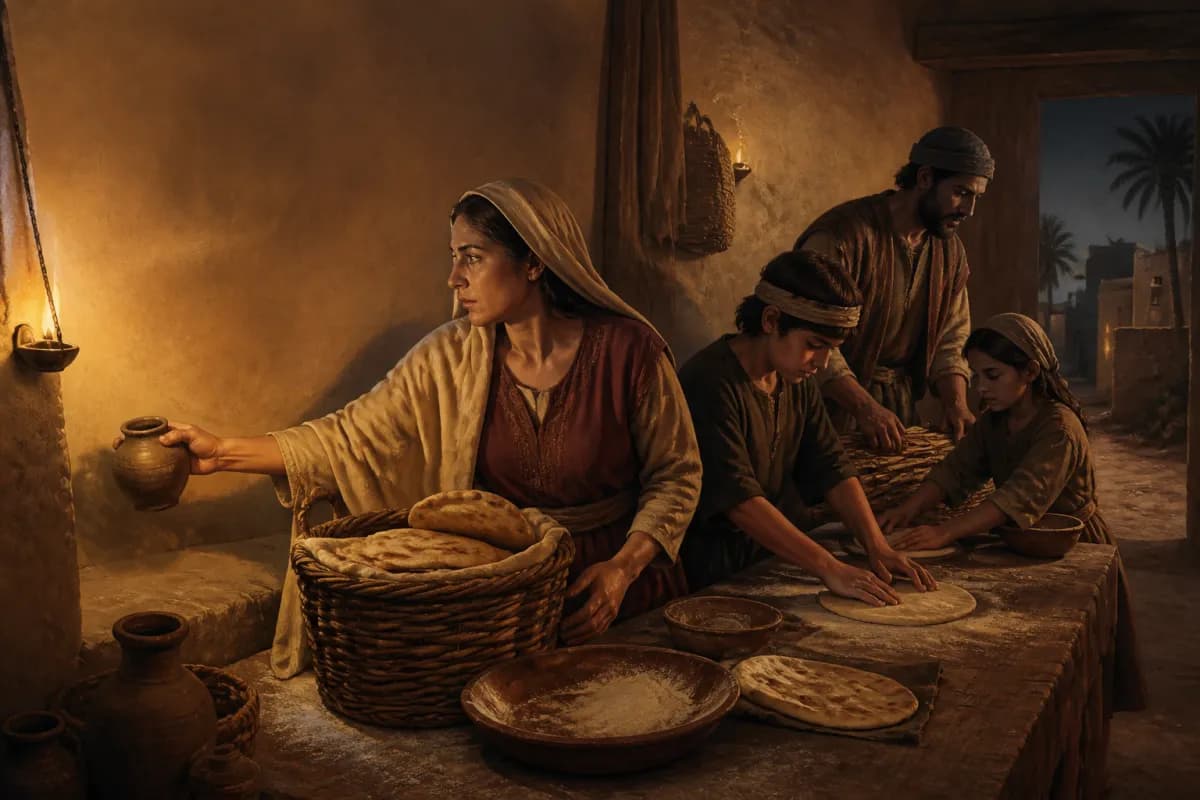
This instruction follows the Lord’s announcement of Passover and immediately precedes the night of departure. Israel is about to leave Egypt in such haste that its bread will not have time to rise. The meal turns that hurried fact into a yearly act of memory: each household will rehearse that its freedom came by God’s decisive intervention, not by a carefully managed escape.
The command reaches the household. For seven days, leaven is removed from every home, and the first and seventh days are marked as holy assemblies. Rescue is not left as an inward recollection or a national slogan; God gives His people a shared rhythm of eating, resting, gathering, and remembering.
HISTORICAL AND LITERARY CONTEXT
Unleavened bread is ordinary bread made without the agent that causes dough to rise. In this passage its primary meaning is historical: it is called the bread of the exodus because Israel leaves before its dough is leavened. Later biblical writers use leaven in several symbolic ways, but Exodus 12 first anchors the feast in the concrete speed of God’s rescue.
The command calls the feast a permanent ordinance for Israel’s generations. Biblical remembrance is active covenant formation. Children and adults alike learn that they belong to a people whom the Lord brought out of slavery, and ordinary meals become a setting in which that identity is guarded against forgetfulness.
SECTION-BY-SECTION ANALYSIS
- A memorial feast · Exodus 12:14The command turns a historical deliverance into a repeated communal remembrance.
- Leaven removed · Exodus 12:15The household practice makes the exodus story tangible in rooms, meals, and daily preparation.
- Holy time · Exodus 12:16The gathered days teach Israel that rescue reorders work, worship, and communal life.
CHRIST IN THIS PASSAGE
The Feast of Unleavened Bread does not by itself predict a specific episode in Jesus’ life, but it belongs to the Passover season in which Jesus gives Himself. The Gospels locate His death in that covenant calendar, and Paul explicitly calls Christ “our Passover lamb.” Jesus’ saving mission fulfills the deeper exodus pattern by delivering people from sin and death through His self-giving sacrifice.
Paul also draws a careful moral application from the feast’s imagery: believers are to celebrate with sincerity and truth rather than malice and evil. That does not erase Exodus 12’s original concern with hurried departure. It shows how Christ’s redemption creates a people whose new life is to match the freedom they have received.
REFLECTION
God knows how quickly people forget the story that gave them life. The feast places remembrance in the ordinary world of kitchens, tables, and calendars. Christians likewise need practices that return them to Jesus’ saving work: gathered worship, the Lord’s Supper, Scripture, prayer, and testimony that says plainly, “God brought me out.”
Remembering Christ is not sentimental nostalgia. It asks whether the patterns of a former bondage still occupy the house of the heart. Bring those patterns to Jesus without pretending you can free yourself. His grace forgives, renews, and teaches His people to live with the honesty and freedom that fit His rescue.
Original Hebrew Word Study
Exodus 12:17
מַצָּה
matsah · H4682
Usually translated: unleavened bread
Matsah is bread made without leaven. In Exodus it first marks the haste of a people leaving Egypt, before later biblical uses give leaven additional symbolic force.
Follow the Scripture trail
The Feast of Unleavened Bread: Remembering a Hasty Rescue in the larger story
The connection: Unleavened bread keeps Israel’s hasty exodus before every generation. Jesus fulfills the saving purpose of that exodus by giving Himself to deliver people from sin and by forming them into a community that remembers and lives from His grace.
Respond to the passage
Choose one concrete practice this week that will return your attention to Jesus’ rescue, then ask Him to expose any old pattern that does not belong in the freedom He has given.
- Why does Exodus connect unleavened bread so closely to haste and remembrance?
- How does the feast bring the exodus story into Israel’s household life?
- What does Paul’s use of the feast’s imagery teach about the kind of life Christ’s rescue produces?
Prayer
Lord Jesus, thank You for rescuing me when I could not rescue myself. Keep Your saving grace before my eyes in the ordinary rhythms of life. Clean out what belongs to my old bondage and form in me the sincerity and truth that honor You. Amen.