Passage Study
Passover at the Door: Trusting God’s Appointed Shelter
Exodus 12:21–12:28
Exodus 12:21–28 records Moses giving Israel its final Passover instructions: each household must kill the lamb, mark the doorway with its blood, stay inside until morning, and teach future generations what the rite means. The passage presents deliverance as God’s gift received through the shelter He appoints and directs readers to Jesus, the true Passover Lamb whose saving mission brings sinners safely to God.
- In this study
- 8 verses · 5 movements
Exodus 12
12:21Then Moses called for all the elders of Israel, and said to them, “Draw out, and take lambs according to your families, and kill the Passover.
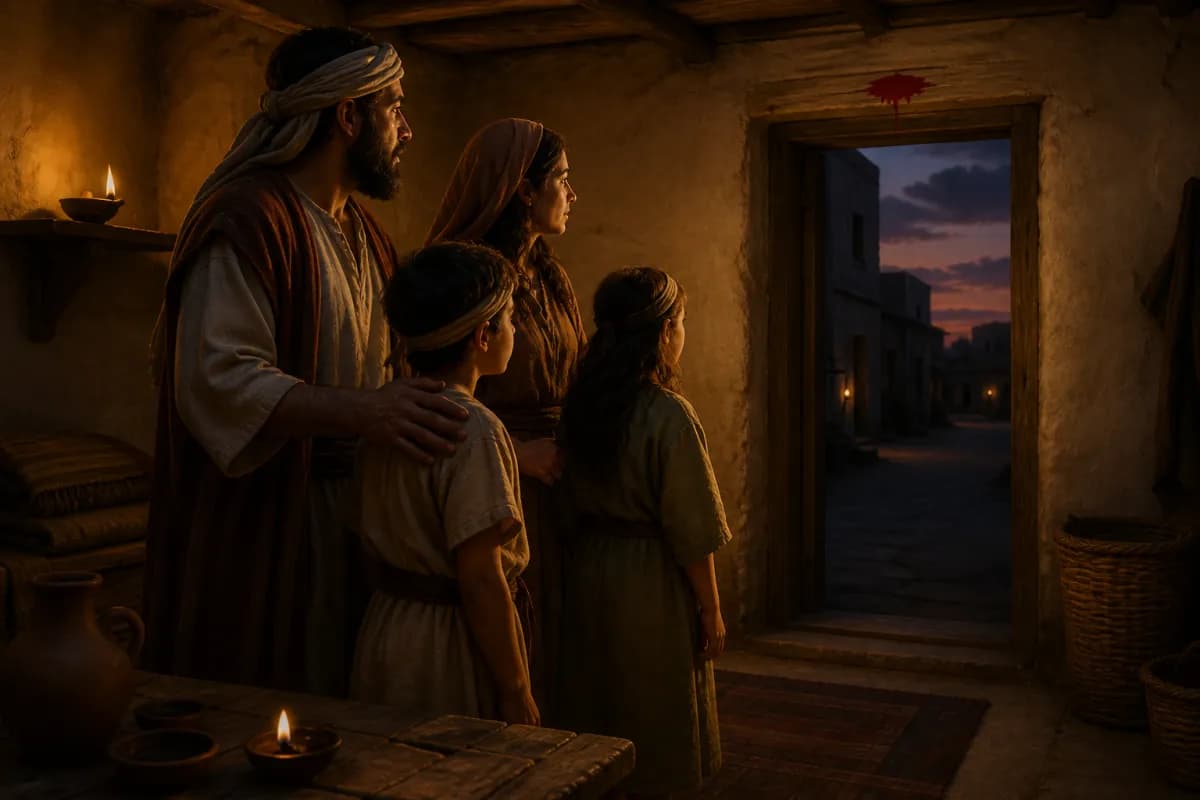
12:22You shall take a bunch of hyssop, and dip it in the blood that is in the basin, and strike the lintel and the two door posts with the blood that is in the basin. None of you shall go out of the door of his house until the morning.
12:23For the LORD will pass through to strike the Egyptians; and when he sees the blood on the lintel, and on the two door posts, the LORD will pass over the door, and will not allow the destroyer to come in to your houses to strike you.
12:24You shall observe this thing for an ordinance to you and to your sons forever.
12:25It shall happen when you have come to the land which the LORD will give you, as he has promised, that you shall keep this service.
12:26It will happen, when your children ask you, ‘What do you mean by this service?’
12:27that you shall say, ‘It is the sacrifice of the LORD’s Passover, who passed over the houses of the children of Israel in Egypt, when he struck the Egyptians, and spared our houses.’” The people bowed their heads and worshiped.
12:28The children of Israel went and did so; as the LORD had commanded Moses and Aaron, so they did.
CONTEXTUAL OVERVIEW
The night of the final plague has arrived. Moses does not call Israel to organize a defense, fight Pharaoh, or find a secret route out of Egypt. He gives households a command centered on a lamb, blood at the doorposts, and remaining under the shelter God designates until morning.
The elders receive these instructions so that every family may act. The passage moves quickly from Moses’ speech to Israel’s worship and obedience: the people bow down, then do as the Lord commanded. Before Egypt’s firstborn are struck and Israel departs, the narrative fixes attention on God’s provision and Israel’s trusting response.
HISTORICAL AND LITERARY CONTEXT
This paragraph restates and applies the instructions announced in Exodus 12:1–13. The blood is not presented as a magical substance or a human technique for controlling God. It is the sign God Himself appoints, identifying homes that receive His promised protection amid the judgment passing through Egypt.
Hyssop is used to apply the blood to the lintel and doorposts. The text gives no extended explanation of the plant here; its narrative function is practical and visible. The central emphasis falls on the Lord who passes through, the household that stays under His provision, and the teaching of children who later ask what this service means.
SECTION-BY-SECTION ANALYSIS
- God-appointed shelter · Exodus 12:23The marked doorway receives the protection God promises; deliverance is not improvised by the household.
- Remain inside · Exodus 12:25Trust is concrete: Israel stays where the Lord has placed it until the danger has passed.
- Tell the next generation · Exodus 12:27The ritual is preserved so that later children learn that their people live because God delivered them.
CHRIST IN THIS PASSAGE
The New Testament makes the Passover connection to Jesus explicit. John introduces Jesus as the Lamb of God, and Paul names Him the Passover lamb who has been sacrificed. Those later texts do not turn every feature of Exodus 12 into a coded prediction; they identify the central sacrificial and deliverance pattern fulfilled in Christ’s death.
Jesus’ blood does not protect only one ethnic household for one night. Through His saving mission, those who trust Him are reconciled to God and delivered from the judgment sin deserves. The gospel invitation is not self-rescue. It is faith in the crucified and risen Christ, who is God’s provision for sinners.
REFLECTION
The elders could not improve on God’s instructions by adding a stronger lock, a braver guard, or a different sign. In the same way, the heart of Christian assurance rests in what Jesus has done, not in a person’s ability to make herself impressive enough for God. Trust receives the shelter God has given.
The children’s question belongs in every faithful community. Explain the gospel plainly in homes and friendships: Jesus gave Himself for sinners; His resurrection declares His victory; and all who come to Him receive forgiveness and new life. Let that story produce humility rather than superiority, because every believer stands under mercy.
Original Hebrew Word Study
Exodus 12:21
זָבַח
zavach · H2076
Usually translated: to sacrifice or slaughter
Zavach is the verb for sacrificing or slaughtering an animal. Passover is therefore both a family meal and a sacrifice: deliverance is received through the life God appoints in the place of the household.
Follow the Scripture trail
Passover at the Door: Trusting God’s Appointed Shelter in the larger story
The connection: Passover teaches Israel to receive God’s shelter through the sacrifice He appoints. Jesus fulfills this rescue pattern as the Lamb of God, whose death opens forgiveness and reconciliation for all who trust Him.
Respond to the passage
Stop measuring your safety with God by your own performance. Put your trust afresh in Jesus’ finished sacrifice, then tell one person this week why His mercy is your hope.
- Why does the command to remain inside the house matter to the passage’s meaning?
- What does the children’s question show about how Passover was meant to shape Israel?
- How does Jesus fulfill the central Passover pattern without making every detail of the ritual allegorical?
Prayer
Lord Jesus, You are God’s provision for sinners. Thank You that my hope rests in Your sacrifice, not my self-rescue. Teach me to remain in faith, to speak Your gospel clearly, and to live with the humility of one delivered by mercy. Amen.