Passage Study
Israel Departs: A People Carried Out by God
Exodus 12:33–12:42
Exodus 12:33–42 describes Egypt urging Israel to leave, Israel carrying unleavened dough, receiving silver and gold from Egyptians, and departing in a vast company after 430 years. The passage celebrates a liberation the Lord Himself brings about and points to Jesus, who leads a greater exodus by freeing people from sin for a life of worship and belonging to God.
- In this study
- 10 verses · 5 movements
Exodus 12
12:33The Egyptians were urgent with the people, to send them out of the land in haste, for they said, “We are all dead men.”
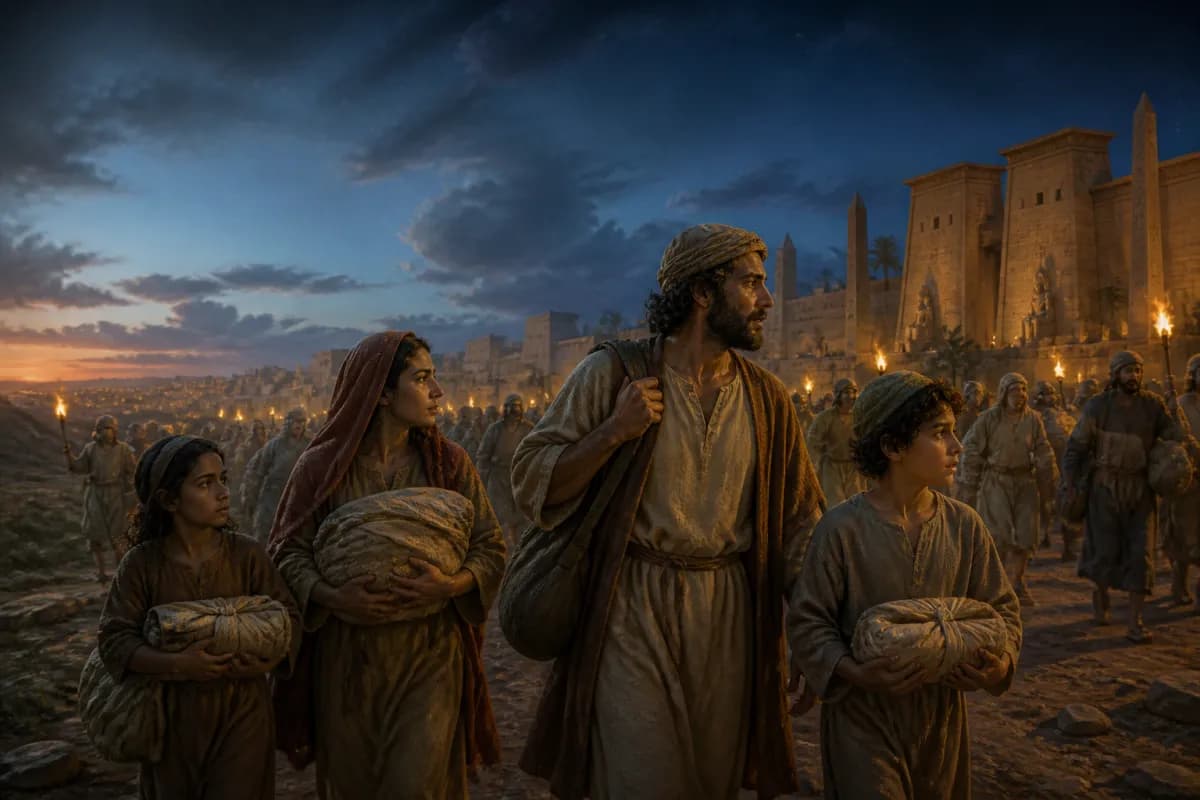
12:34The people took their dough before it was leavened, their kneading troughs being bound up in their clothes on their shoulders.
12:35The children of Israel did according to the word of Moses; and they asked of the Egyptians jewels of silver, and jewels of gold, and clothing.
12:36The LORD gave the people favor in the sight of the Egyptians, so that they let them have what they asked. They plundered the Egyptians.
12:37The children of Israel traveled from Rameses to Succoth, about six hundred thousand on foot who were men, in addition to children.
12:38A mixed multitude went up also with them, with flocks, herds, and even very much livestock.
12:39They baked unleavened cakes of the dough which they brought out of Egypt; for it wasn’t leavened, because they were thrust out of Egypt, and couldn’t wait, and they had not prepared any food for themselves.
12:40Now the time that the children of Israel lived in Egypt was four hundred thirty years.
12:41At the end of four hundred thirty years, to the day, all of the LORD’s armies went out from the land of Egypt.
12:42It is a night to be much observed to the LORD for bringing them out from the land of Egypt. This is that night of the LORD, to be much observed by all the children of Israel throughout their generations.
CONTEXTUAL OVERVIEW
The cry in Egypt becomes an urgent command: “Get up, go away from my people.” Israel does not slip quietly out in a secret escape; Egypt presses it to depart because the final plague has made Pharaoh’s former control impossible. The people leave with dough not yet leavened, visibly carrying the haste that the Feast of Unleavened Bread will preserve.
The account widens from individual households to a people on the move. Six hundred thousand men on foot, besides children, are named, along with a mixed crowd and extensive livestock. Whatever questions readers may have about how the large number functions in ancient military-style reckoning, Exodus’s narrative point is certain: God brings out a substantial, vulnerable people and all that they need to begin the journey.
HISTORICAL AND LITERARY CONTEXT
The instruction to ask Egyptians for silver, gold, and clothing has appeared earlier in Exodus. Here it is fulfilled as Egypt gives the departing Israelites what they request. The narrative calls this a plundering of Egypt, a reversal of the economic order in which Egypt had extracted Israel’s labor without just return.
Verse 40’s figure of 430 years is part of the Bible’s chronological memory of the sojourn, while other biblical texts summarize the ancestral period differently. The passage’s immediate theological concern is not to invite a modern reconstruction of every date. It marks the exodus as the fulfillment of a long period in which God’s covenant promise seemed delayed but was never forgotten.
SECTION-BY-SECTION ANALYSIS
- Hasty departure · Exodus 12:39Unleavened dough makes the urgency of God’s rescue visible in the first possessions Israel carries.
- Reversed exploitation · Exodus 12:35Egypt’s silver, gold, and clothing acknowledge in narrative form the wealth it had accumulated while Israel was enslaved.
- A night of vigil · Exodus 12:42Israel remembers that the Lord kept watch to bring it out, and its own generations keep the night in remembrance.
CHRIST IN THIS PASSAGE
Israel’s departure is a historical liberation from Pharaoh, and Jesus does not simply repeat its geography. He fulfills its redemptive direction. At the Transfiguration, His coming death in Jerusalem is called an exodus, because through His death and resurrection He accomplishes deliverance from the deeper bondage of sin and death.
Christ’s mission also forms a new people from many backgrounds. The mixed crowd in Exodus should not be turned into a direct prediction of the church, yet it sits naturally beside the Bible’s unfolding promise that God’s blessing reaches the nations. In Jesus, people from every people are invited into one redeemed family by grace.
REFLECTION
God’s deliverance often asks His people to move before every practical question feels settled. Israel leaves with dough in a bowl and a road ahead, not a completed map of the wilderness. Faith does not deny wise planning; it refuses to make total control the condition for obeying the God who has spoken.
Jesus frees people for a journey, not merely from a past. Remember the concrete ways He has carried you, and let that memory strengthen hospitality toward those who are still seeking a place among God’s people. The church should be a community that remembers rescue and makes room for those being drawn to Christ.
Original Hebrew Word Study
Exodus 12:35
שָׁאַל
shaal · H7592
Usually translated: to ask or request
Shaal means to ask or request. Israel receives silver, gold, and clothing as they leave, a concrete reversal of slavery in which Egypt’s wealth acknowledges the cost of the labor it took from them.
Follow the Scripture trail
Israel Departs: A People Carried Out by God in the larger story
The connection: The Lord carries Israel out of Egypt after generations of bondage and keeps the rescue in its memory. Jesus accomplishes the greater exodus through His death and resurrection, freeing people from sin and gathering them into God’s family.
Respond to the passage
Recall one concrete way Jesus has carried you when you could not make your own way forward. Thank Him, then take the next obedient step without waiting for every detail of the road to be visible.
- What do the bowls of unleavened dough contribute to the story of Israel’s departure?
- How does the transfer of silver, gold, and clothing reverse the realities of slavery?
- Why does Luke’s description of Jesus’ death as an exodus deepen the meaning of Christian freedom?
Prayer
Lord Jesus, You have carried Your people out of bondage and into new life. Thank You for the ways You have sustained me when the road was unclear. Give me courage to obey, gratitude to remember, and a welcoming heart toward those You are drawing into Your family. Amen.