Passage Study
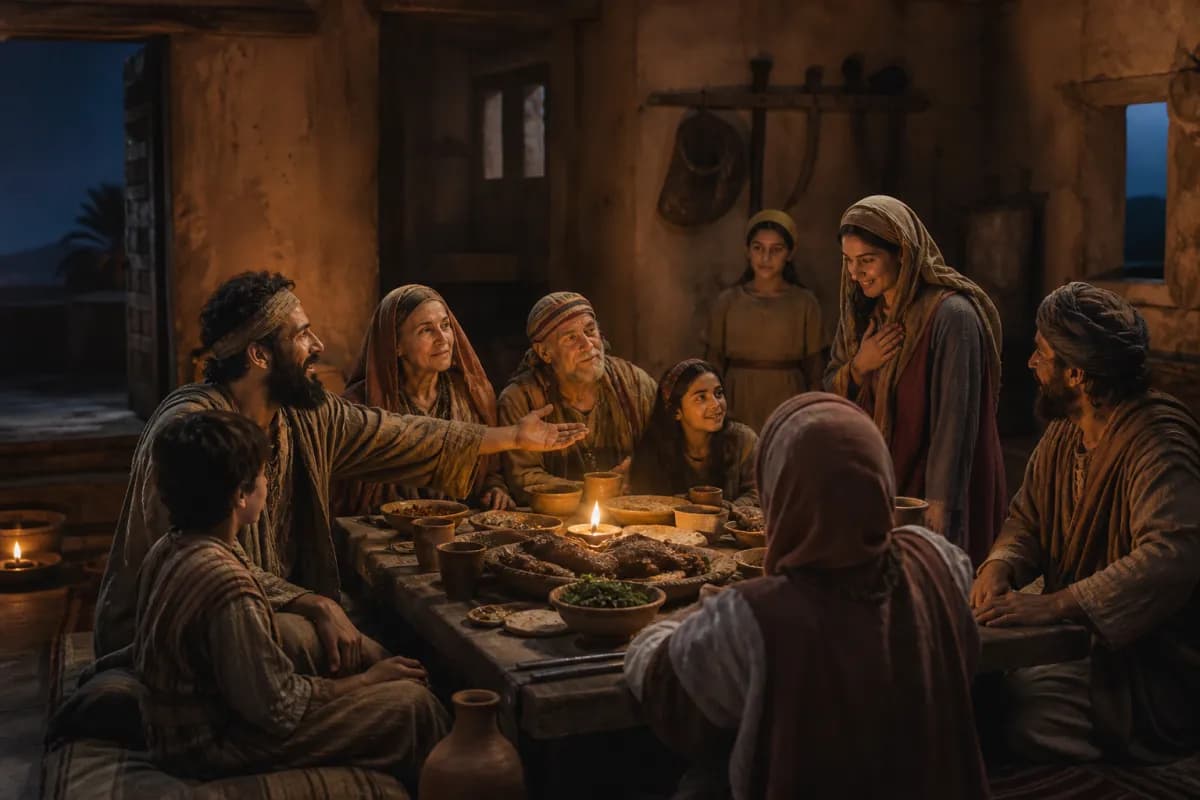
The Passover Meal: A Covenant Table with an Open Door
Exodus 12:43–12:51
Exodus 12:43–13:16 defines who may eat the Passover, makes a path for resident aliens to join through covenant belonging, consecrates Israel’s firstborn, and commands parents to tell the exodus story. The passage holds together the holiness of God’s covenant and His purpose to form a people, pointing to Jesus, who fulfills Passover and brings Jews and Gentiles near through faith in Him.
- In this study
- 9 verses · 5 movements
Exodus 12
12:43The LORD said to Moses and Aaron, “This is the ordinance of the Passover. No foreigner shall eat of it,
12:44but every man’s servant who is bought for money, when you have circumcised him, then shall he eat of it.
12:45A foreigner and a hired servant shall not eat of it.
12:46It must be eaten in one house. You shall not carry any of the meat outside of the house. Do not break any of its bones.
12:47All the congregation of Israel shall keep it.
12:48When a stranger lives as a foreigner with you, and would like to keep the Passover to the LORD, let all his males be circumcised, and then let him come near and keep it. He shall be as one who is born in the land; but no uncircumcised person shall eat of it.
12:49One law shall be to him who is born at home, and to the stranger who lives as a foreigner among you.”
12:50All the children of Israel did so. As the LORD commanded Moses and Aaron, so they did.
12:51That same day, the LORD brought the children of Israel out of the land of Egypt by their armies.
CONTEXTUAL OVERVIEW
Israel has left Egypt, but the Passover remains the meal by which its identity will be remembered. This passage refuses two opposite errors. The meal cannot be treated as a casual civic festival open without covenant commitment, and neither is God’s people a closed bloodline with no way for an outsider to belong. A resident alien who joins the covenant may eat as one born in the land.
The passage then turns from the table to the firstborn. Israel’s firstborn males belong to the Lord because He spared them on the night when Egypt’s firstborn died. The redemption of a firstborn son and the consecration of a firstborn animal keep the people from treating the exodus as an old story with no claim on their present lives.
HISTORICAL AND LITERARY CONTEXT
Circumcision functions here as the covenant sign given to Abraham’s household. The text does not say that ethnicity alone grants access to Passover; it distinguishes a foreigner who remains outside the covenant from a resident alien who receives its sign and is counted within the community. The same law applies to native-born and resident alien, joining holiness and incorporation.
The firstborn laws continue the logic of Passover. Israel’s firstborn are not sacrificed; they are set apart and redeemed. The Lord’s claim is rooted in rescue: “When Pharaoh stubbornly refused to let us go, the Lord killed all the firstborn in the land of Egypt.” Memory of mercy becomes consecrated belonging.
SECTION-BY-SECTION ANALYSIS
- Covenant participation · Exodus 12:43Passover belongs to a people joined to the Lord’s covenant, not to casual spectators.
- One law · Exodus 12:49Resident aliens who enter the covenant are treated as belonging to the same redeemed community.
- Firstborn redeemed · Exodus 12:47Israel’s firstborn remain alive because God spared them, so their lives are publicly acknowledged as His gift.
CHRIST IN THIS PASSAGE
The Passover boundaries preserve the holiness of a covenant meal, while the inclusion of the resident alien anticipates the Bible’s wider purpose that the nations will be blessed through God’s saving work. This is an unfolding theme, not a claim that Exodus abolishes its own covenant sign. In Christ, Gentiles who were far off are brought near and made fellow members of God’s household through faith.
Jesus fulfills the Passover sacrifice and gives His people a covenant meal that proclaims His death. His saving mission creates a family defined by union with Him rather than ethnic status, social position, or moral achievement. Those who come to Him are received by grace and then taught to live as people who belong wholly to God.
REFLECTION
This passage gives a healthy picture of belonging. God’s welcome is neither vague nor earned. He names the covenant by which people draw near, and He makes room for outsiders who receive that covenant gift. Churches should therefore speak clearly about the gospel while practicing the warm hospitality of a people who know they themselves were brought near by mercy.
The firstborn laws ask a searching question: do we treat our lives, children, possessions, and futures as self-owned? Jesus does not take from His people in order to diminish them. He redeems them so that every part of life may become grateful service. Tell the story of His rescue often enough that it shapes what your hands do and what your eyes look toward.
Original Hebrew Word Study
Exodus 12:43
נֵכָר
nekar · H5236
Usually translated: foreigner or outsider
Nekar names one who remains outside the covenant community. The meal has boundaries because it is a covenant sign, while the following instructions also make a path for a resident alien to join Israel through the covenant mark.
Follow the Scripture trail
The Passover Meal: A Covenant Table with an Open Door in the larger story
The connection: Passover is a holy covenant meal that gives outsiders a real way to belong and reminds Israel that its life is God’s gift. Jesus fulfills this saving pattern by bringing people from every background into God’s household through His sacrifice and teaching them to live as His redeemed people.
Respond to the passage
Thank Jesus that He has brought you near by grace. Consider one person who may feel outside God’s people, and make a clear, hospitable invitation to hear the gospel and see how Christ welcomes those who trust Him.
- How does the passage hold together covenant boundaries and a path for a resident alien to belong?
- Why does the redemption of the firstborn follow the Passover instructions?
- How does Christ create a people that is both clearly defined by the gospel and genuinely welcoming to outsiders?
Prayer
Lord Jesus, thank You for bringing me near to God by Your sacrifice. Teach me to honor the holiness of Your grace and to welcome others with the hospitality You have shown me. Help my whole life belong to You and make Your saving mission known. Amen.