Passage Study
The Firstborn Belong to the Lord: Freedom Remembered as Worship
Exodus 13:1–13:16
Exodus 13:1–16 consecrates Israel’s firstborn because the Lord spared them on Passover night. The command turns deliverance into lasting worship and teaching, pointing to Jesus, God’s unique Son, who gives Himself so that those under death may be redeemed.
- In this study
- 16 verses · 5 movements
Exodus 13
13:1The LORD spoke to Moses, saying,
13:2“Sanctify to me all the firstborn, whatever opens the womb among the children of Israel, both of man and of animal. It is mine.”
13:3Moses said to the people, “Remember this day, in which you came out of Egypt, out of the house of bondage; for by strength of hand the LORD brought you out from this place. No leavened bread shall be eaten.
13:4Today you go out in the month Abib.
13:5It shall be, when the LORD brings you into the land of the Canaanite, and the Hittite, and the Amorite, and the Hivite, and the Jebusite, which he swore to your fathers to give you, a land flowing with milk and honey, that you shall keep this service in this month.
13:6Seven days you shall eat unleavened bread, and in the seventh day shall be a feast to the LORD.
13:7Unleavened bread shall be eaten throughout the seven days; and no leavened bread shall be seen with you. No yeast shall be seen with you, within all your borders.
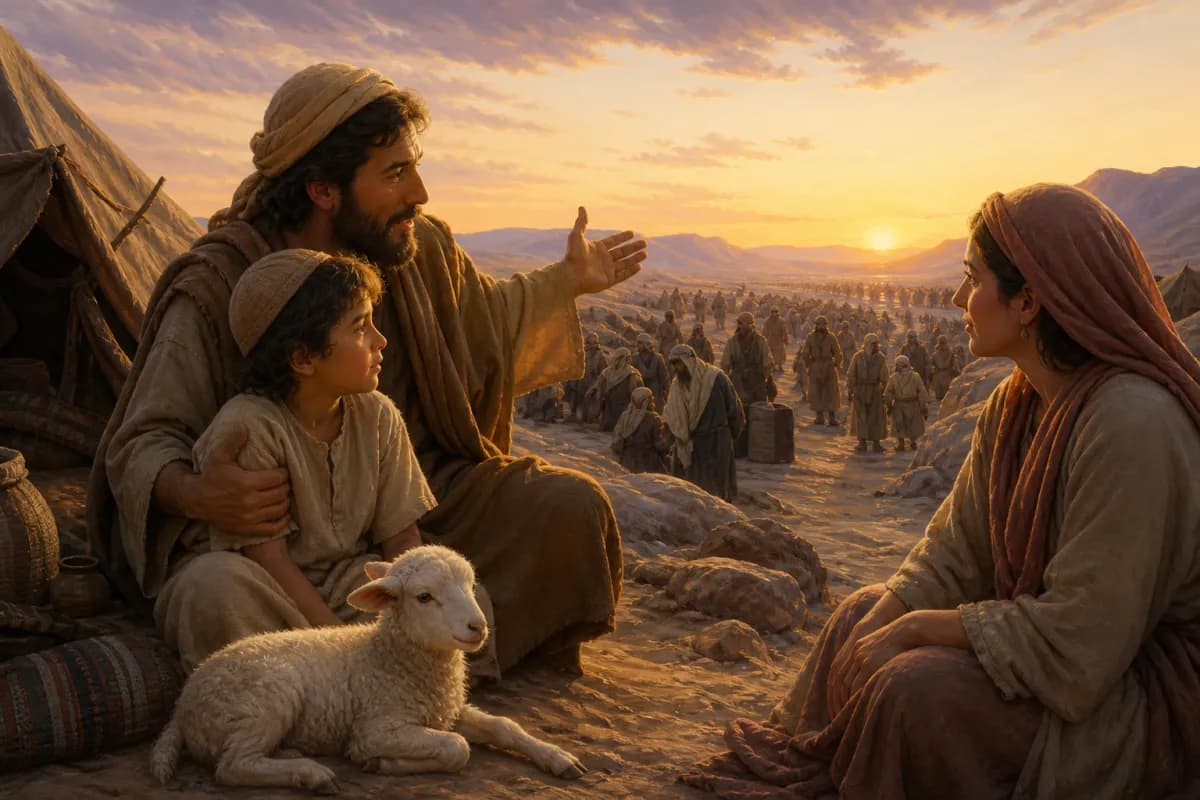
13:8You shall tell your son in that day, saying, ‘It is because of that which the LORD did for me when I came out of Egypt.’
13:9It shall be for a sign to you on your hand, and for a memorial between your eyes, that the LORD’s law may be in your mouth; for with a strong hand the LORD has brought you out of Egypt.
13:10You shall therefore keep this ordinance in its season from year to year.
13:11“It shall be, when the LORD brings you into the land of the Canaanite, as he swore to you and to your fathers, and will give it to you,
13:12that you shall set apart to the LORD all that opens the womb, and every firstborn that comes from an animal which you have. The males shall be the LORD’s.
13:13Every firstborn of a donkey you shall redeem with a lamb; and if you will not redeem it, then you shall break its neck; and you shall redeem all the firstborn of man among your sons.
13:14It shall be, when your son asks you in time to come, saying, ‘What is this?’ that you shall tell him, ‘By strength of hand the LORD brought us out from Egypt, from the house of bondage.
13:15When Pharaoh stubbornly refused to let us go, the LORD killed all the firstborn in the land of Egypt, both the firstborn of man, and the firstborn of livestock. Therefore I sacrifice to the LORD all that opens the womb, being males; but all the firstborn of my sons I redeem.’
13:16It shall be for a sign on your hand, and for symbols between your eyes; for by strength of hand the LORD brought us out of Egypt.”
CONTEXTUAL OVERVIEW
The first command after Israel’s departure is not about route planning or military preparation. The Lord says, “Consecrate to me all the firstborn.” The Israelites’ firstborn lived through the night when Egypt’s firstborn died; their lives therefore bear a visible claim of grace. What God spared belongs to Him.
Moses joins this claim to the Feast of Unleavened Bread and to the questions children will ask. Israel is to keep the exodus from becoming distant history. Its homes, animals, meals, and conversations are ordered around the confession that the Lord brought a slave people out with a strong hand.
HISTORICAL AND LITERARY CONTEXT
In the ancient household, the firstborn son held a distinctive place in inheritance and family continuity. Exodus does not treat that status as a possession to be celebrated apart from God. The firstborn is consecrated because life itself has been received through the Lord’s mercy in the Passover judgment.
The redemption of a firstborn donkey by a lamb, or its breaking if it is not redeemed, makes the logic physical and costly. Israel cannot treat its animals or children as naturally autonomous. A substitute is required for what is spared, and the family’s explanation keeps that costly mercy before the next generation.
SECTION-BY-SECTION ANALYSIS
- Consecrated life · Exodus 13:8The firstborn is set apart because the Lord spared Israel when judgment passed through Egypt.
- A child’s question · Exodus 13:14The command expects the next generation to ask what these practices mean and to hear the exodus story.
- Redemption by substitute · Exodus 13:13The lamb for the donkey makes clear that what is spared is not treated as self-owned or self-secured.
CHRIST IN THIS PASSAGE
This passage establishes a redemption pattern rather than predicting every detail of Jesus’ life. Luke deliberately notes that Mary and Joseph present Jesus in the temple in obedience to this firstborn command. Jesus enters Israel’s covenant story fully, yet He is also uniquely the Son whom the Father sends for the life of the world.
The New Testament calls Christ the firstborn over all creation and the firstborn from the dead. Those titles do not mean He is a created being; they declare His supremacy and His place as the risen head of God’s new people. His saving mission brings the redemption Exodus foreshadows: He gives His life so that people under sin and death may belong to God as adopted sons and daughters.
REFLECTION
The firstborn command asks a searching question: do we see our lives, families, time, and resources as self-made possessions, or as gifts sustained by God’s mercy? Christian gratitude is more than a feeling. It treats every good gift as an opportunity for worship, generosity, and truthful testimony about the One who gives life.
Teach the gospel in answer to real questions. Tell children and friends why Jesus matters: God has acted to redeem people who could not rescue themselves. The church does not preserve a private religious custom; it bears witness to the Son who gave Himself so that a redeemed people might live for the Father.
Original Hebrew Word Study
Exodus 13:2
קָדַשׁ
qadash · H6942
Usually translated: to consecrate or set apart as holy
Qadash means to set apart for God. Israel’s firstborn belong to the Lord because He spared them; their consecration keeps the Passover rescue from becoming a past event with no claim on the people He redeemed.
Follow the Scripture trail
The Firstborn Belong to the Lord: Freedom Remembered as Worship in the larger story
The connection: Israel’s spared firstborn are set apart to remember that life comes through God’s mercy. Jesus, the eternal Son and risen firstborn, fulfills the saving purpose of this pattern by giving Himself to redeem people and bring them into the Father’s family.
Respond to the passage
Thank Jesus for the life you have received through His mercy. Identify one ordinary gift you have treated as self-owned, and offer it back to God in concrete worship, generosity, or service.
- Why does Exodus connect the firstborn command so directly to Passover?
- What does the redemption of the firstborn teach about receiving life as a gift?
- How do Jesus’ firstborn titles deepen the hope of redeemed belonging to God?
Prayer
Father, every life and good gift comes from Your mercy. Thank You for sending Your Son to redeem me from sin and death. Teach me to live as one who belongs to You, to tell Your saving story clearly, and to use Your gifts for Your glory. Amen.