Passage Study
Led by Cloud and Fire: God’s Wise Presence on the Wilderness Road
Exodus 13:17–13:22
Exodus 13:17–22 explains why God leads Israel away from the nearer Philistine road and goes before it in a pillar of cloud by day and fire by night. The route reveals a Shepherd who knows His people’s fear and stays visibly with them, preparing readers to trust Jesus, who leads His people through suffering toward the Father.
- In this study
- 6 verses · 5 movements
Exodus 13
13:17When Pharaoh had let the people go, God didn’t lead them by the way of the land of the Philistines, although that was near; for God said, “Lest perhaps the people change their minds when they see war, and they return to Egypt”;
13:18but God led the people around by the way of the wilderness by the Red Sea; and the children of Israel went up armed out of the land of Egypt.
13:19Moses took the bones of Joseph with him, for he had made the children of Israel swear, saying, “God will surely visit you, and you shall carry up my bones away from here with you.”
13:20They took their journey from Succoth, and encamped in Etham, in the edge of the wilderness.
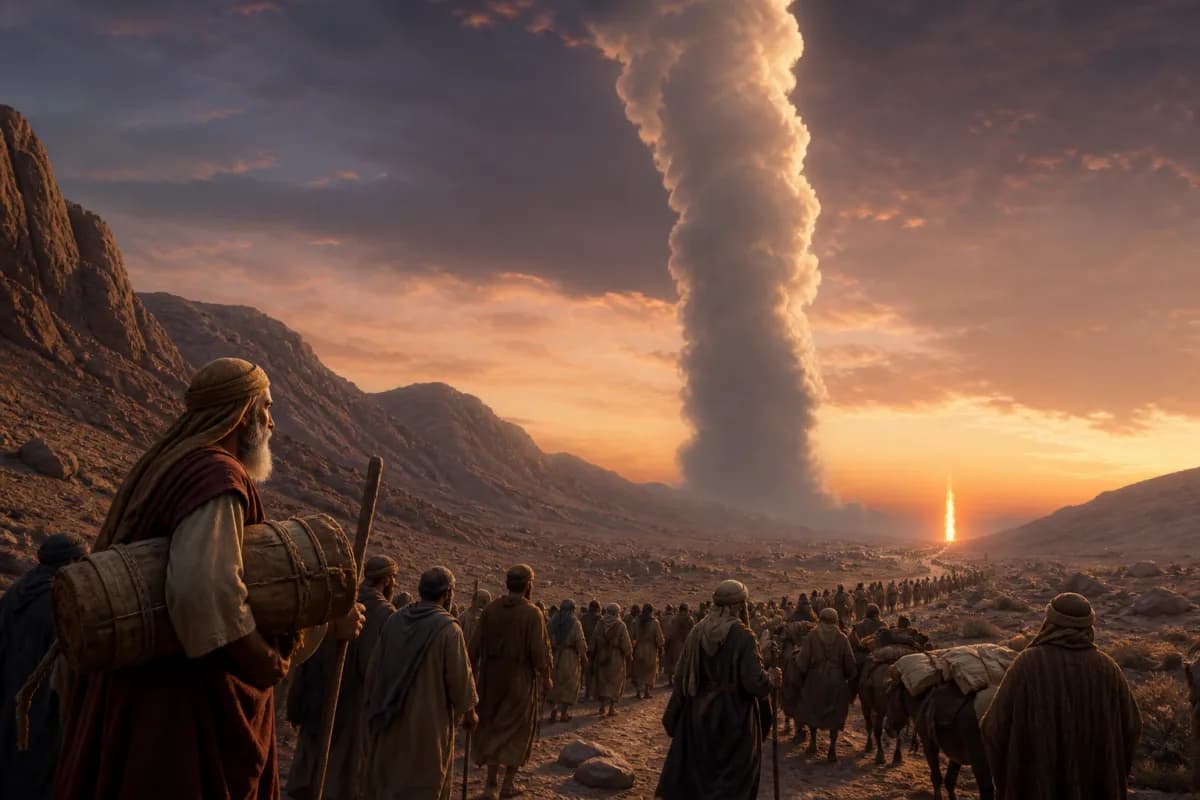
13:21The LORD went before them by day in a pillar of cloud, to lead them on their way, and by night in a pillar of fire, to give them light, that they might go by day and by night:
13:22the pillar of cloud by day, and the pillar of fire by night, didn’t depart from before the people.
CONTEXTUAL OVERVIEW
Pharaoh has sent Israel away, but Exodus immediately clarifies that Pharaoh’s permission is not the real guide of the journey. The Lord chooses the road. He does not take the people through Philistine territory, even though that route is nearer, because He knows that the sight of war may make a newly freed people return to Egypt.
The detour is not abandonment. The Lord goes before Israel in a pillar of cloud in daylight and a pillar of fire at night. Guidance and presence are joined: the God who chooses the route also gives light, direction, and the assurance that He has not left His people alone.
HISTORICAL AND LITERARY CONTEXT
The way of the Philistines ran along Egypt’s northeastern coastal corridor and was associated with Egyptian military control. The wilderness route may look inefficient to a reader with a map, but the passage gives its own reason: God takes account of Israel’s fragile faith after generations of slavery.
Joseph’s bones form a quiet bridge to Genesis. Before dying, Joseph made Israel swear to carry his remains when God brought them out of Egypt. Moses’ act honors a promise made long before the exodus and shows that the present journey unfolds under a covenant memory older than Pharaoh’s oppression.
SECTION-BY-SECTION ANALYSIS
- A longer road · Exodus 13:18The wilderness route is chosen by God’s wise care, not by ignorance of the shorter path.
- Joseph’s bones · Exodus 13:19The carried remains make an old promise tangible as Israel walks toward its fulfillment.
- Undeparting presence · Exodus 13:21Cloud and fire assure Israel that the Lord who delivers also accompanies.
CHRIST IN THIS PASSAGE
The pillar is not simply an image to be flattened into a one-to-one prediction of Jesus. It establishes a lasting biblical pattern: God does not redeem His people and then leave them to find the way alone. Jesus calls Himself the light of the world and promises His presence with disciples as they carry His gospel to the nations.
Jesus also leads by a path that does not look like immediate triumph. He sets His face toward Jerusalem and bears the cross before resurrection glory. His saving mission does not promise a painless route, but it gives a trustworthy Guide whose presence and final destination are secure.
REFLECTION
A shorter route is not always the faithful route. Some disappointments feel like God has ignored the obvious path, but Exodus 13 invites Christians to bring that conclusion into the presence of the God who sees more than they do. Wisdom may require patient obedience while He strengthens a person for burdens not yet visible.
Do not confuse a difficult road with an absent Savior. Jesus meets His people in Scripture, prayer, gathered worship, and the fellowship of His church. Ask for enough light to obey the next clear command, and let His promise of presence keep you from returning to a bondage He has already broken.
Original Hebrew Word Study
Exodus 13:17
נָחָה
nachah · H5148
Usually translated: to lead or guide
Nachah is purposeful guidance. God does not take Israel by the shortest road, because He is leading a newly freed people according to His wisdom rather than their immediate preference.
Follow the Scripture trail
Led by Cloud and Fire: God’s Wise Presence on the Wilderness Road in the larger story
The connection: The Lord leads Israel by a road shaped by His knowledge and accompanies it in cloud and fire. Jesus fulfills this shepherding pattern as the light and present Lord who leads redeemed people through costly obedience and sends them on His mission.
Respond to the passage
Name the place where you are tempted to call God’s slower path a mistake. Ask Jesus for trust and for the next obedient step, then resist the pull to return to an old bondage simply because it feels familiar.
- Why does the passage explain God’s choice of a longer route?
- How do Joseph’s bones connect this journey to God’s older promises?
- What does Jesus’ presence promise to believers facing an uncertain path?
Prayer
Lord Jesus, You see the roads I cannot see and You do not abandon those You redeem. Keep me from turning back in fear. Give me light for faithful obedience, patience for Your timing, and courage to follow You wherever Your mission leads. Amen.