Passage Study
Trapped at the Sea: Learning to Stand Before the Lord’s Rescue
Exodus 14:1–14:14
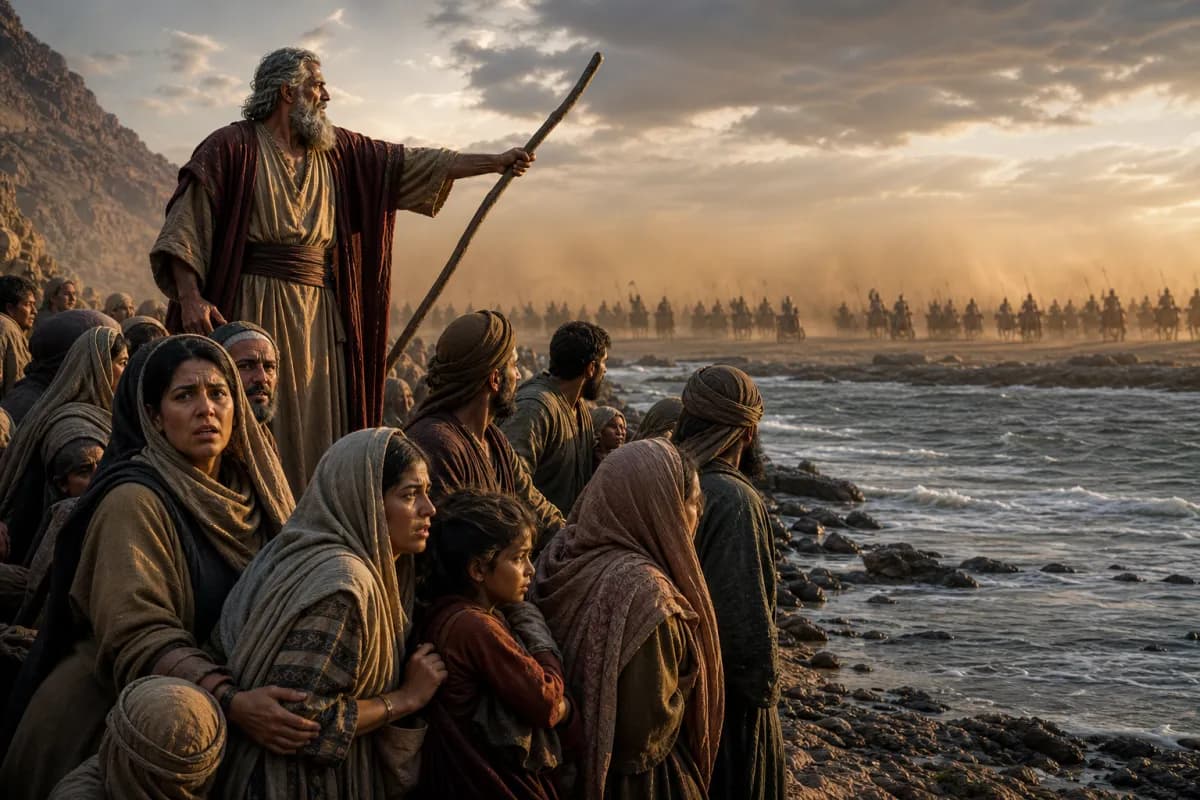
Exodus 14:1–14 places Israel between Pharaoh’s approaching army and the sea, where fear turns quickly into accusation. God deliberately brings His people into an impossible-looking place in order to reveal His glory, and Moses calls them to stand firm and see the Lord’s salvation—a pattern fulfilled in Jesus, whose victory is received by faith rather than manufactured by human strength.
- In this study
- 14 verses · 5 movements
Exodus 14
14:1The LORD spoke to Moses, saying,
14:2“Speak to the children of Israel, that they turn back and encamp before Pihahiroth, between Migdol and the sea, before Baal Zephon. You shall encamp opposite it by the sea.
14:3Pharaoh will say of the children of Israel, ‘They are entangled in the land. The wilderness has shut them in.’
14:4I will harden Pharaoh’s heart, and he will follow after them; and I will get honor over Pharaoh, and over all his armies; and the Egyptians shall know that I am the LORD.” They did so.
14:5The king of Egypt was told that the people had fled; and the heart of Pharaoh and of his servants was changed toward the people, and they said, “What is this we have done, that we have let Israel go from serving us?”
14:6He prepared his chariot, and took his army with him;
14:7and he took six hundred chosen chariots, and all the chariots of Egypt, with captains over all of them.
14:8The LORD hardened the heart of Pharaoh king of Egypt, and he pursued the children of Israel; for the children of Israel went out with a high hand.
14:9The Egyptians pursued them. All the horses and chariots of Pharaoh, his horsemen, and his army overtook them encamping by the sea, beside Pihahiroth, before Baal Zephon.
14:10When Pharaoh came near, the children of Israel lifted up their eyes, and behold, the Egyptians were marching after them; and they were very afraid. The children of Israel cried out to the LORD.
14:11They said to Moses, “Because there were no graves in Egypt, have you taken us away to die in the wilderness? Why have you treated us this way, to bring us out of Egypt?
14:12Isn’t this the word that we spoke to you in Egypt, saying, ‘Leave us alone, that we may serve the Egyptians’? For it would have been better for us to serve the Egyptians than to die in the wilderness.”
14:13Moses said to the people, “Don’t be afraid. Stand still, and see the salvation of the LORD, which he will work for you today; for you will never again see the Egyptians whom you have seen today.
14:14The LORD will fight for you, and you shall be still.”
CONTEXTUAL OVERVIEW
Israel has barely begun its journey when God tells it to camp beside the sea. The location will make the people appear vulnerable to Pharaoh, who imagines that the wilderness has trapped them. The narrative does not say the crisis is an accident. The Lord places Israel where His power over Egypt’s king will be seen openly.
When Israel sees Pharaoh’s chariots, memory collapses under fear. The people who had just left Egypt with a high hand accuse Moses of bringing them out to die. Their complaint uses the language of graves and slavery, exposing how quickly terror can make oppression sound safer than freedom.
HISTORICAL AND LITERARY CONTEXT
Chariots were a feared instrument of ancient warfare, especially on open ground. Exodus names six hundred chosen chariots along with the rest, giving the scene military weight without inviting readers to treat it as a battle Israel could win by courage or numbers. Former slaves have no army prepared to meet Pharaoh’s force.
The Lord’s stated purpose is to gain glory over Pharaoh and Egypt so that Egypt will know that He is the Lord. In Exodus, glory is not divine vanity. It is the public disclosure that the God Pharaoh dismissed has authority over kings, armies, land, and sea, and that His covenant people are not beyond His reach.
SECTION-BY-SECTION ANALYSIS
- A commanded campsite · Exodus 14:2Israel’s vulnerable position is chosen by God for the revelation of His saving power.
- Pharaoh’s reversal · Exodus 14:5The king’s pursuit exposes his continuing claim to possess the people God has liberated.
- Stand firm · Exodus 14:13Moses calls fearful people to receive the Lord’s salvation instead of imagining they can win it themselves.
CHRIST IN THIS PASSAGE
Moses’ command is not a universal instruction to passivity in every danger. In this specific crisis, Israel cannot defeat Pharaoh and must receive the salvation God acts to provide. That dependence anticipates the gospel: sinners do not defeat sin, death, and judgment by moral effort; Jesus accomplishes the victory they receive by faith.
At the cross, Jesus confronts the powers that enslave and accuse. Colossians says He disarms hostile rulers and authorities through His self-giving death. His saving mission frees people for faithful obedience, but the foundation is His work for them, not their ability to create their own escape.
REFLECTION
Fear often narrows the past until bondage seems safer than a difficult present. Israel’s complaint is recognizable: when a new obedience becomes costly, the old life can appear simpler than it really was. Name the fear honestly before God, but do not let it rewrite the story of His mercy.
There are moments for action, and the next verses will call Israel to move. This moment begins with surrendering the fantasy of self-rescue. Bring your impossible place to Jesus. Stand on His finished work, ask for the courage to obey His next command, and remember that His mission is stronger than the power that pursues you.
Original Hebrew Word Study
Exodus 14:2
חָנָה
chanah · H2583
Usually translated: to camp or encamp
Chanah describes Israel’s deliberate camp by the sea. The place that looks like a trap is also the place the Lord told them to stand, preparing the scene where His rescue will be unmistakable.
Follow the Scripture trail
Trapped at the Sea: Learning to Stand Before the Lord’s Rescue in the larger story
The connection: Israel stands helpless before the sea while the Lord prepares to defeat the power that claims it. Jesus fulfills this rescue pattern by accomplishing the salvation sinners cannot achieve and freeing them to follow Him in His mission.
Respond to the passage
Where has fear made an old bondage look safer than obedience to Christ? Tell Jesus the truth about that fear, receive His grace rather than trying to rescue yourself, and take the next faithful action He makes clear.
- Why does God lead Israel to a place that looks trapped?
- What does Israel’s complaint reveal about the spiritual power of fear?
- How does the gospel change the difference between receiving salvation and avoiding faithful action?
Prayer
Lord Jesus, when fear makes me forget Your mercy, steady me in Your salvation. Forgive my desire to return to old bondage for the sake of temporary safety. Teach me to stand on Your finished work and to obey You with quiet courage. Amen.