Passage Study
Through the Sea: The Lord Makes a Way Where There Is None
Exodus 14:15–14:31
Exodus 14:15–31 tells how the Lord divides the sea, brings Israel through on dry ground, and overwhelms Pharaoh’s pursuing army. The crossing reveals God as the warrior who saves His helpless people and judges the power that enslaves them, pointing to Jesus’ death and resurrection, through which He defeats sin and death and brings believers into new life.
- In this study
- 17 verses · 5 movements
Exodus 14
14:15The LORD said to Moses, “Why do you cry to me? Speak to the children of Israel, that they go forward.
14:16Lift up your rod, and stretch out your hand over the sea and divide it. Then the children of Israel shall go into the middle of the sea on dry ground.
14:17Behold, I myself will harden the hearts of the Egyptians, and they will go in after them. I will get myself honor over Pharaoh, and over all his armies, over his chariots, and over his horsemen.
14:18The Egyptians shall know that I am the LORD when I have gotten myself honor over Pharaoh, over his chariots, and over his horsemen.”
14:19The angel of God, who went before the camp of Israel, moved and went behind them; and the pillar of cloud moved from before them, and stood behind them.
14:20It came between the camp of Egypt and the camp of Israel. There was the cloud and the darkness, yet it gave light by night. One didn’t come near the other all night.
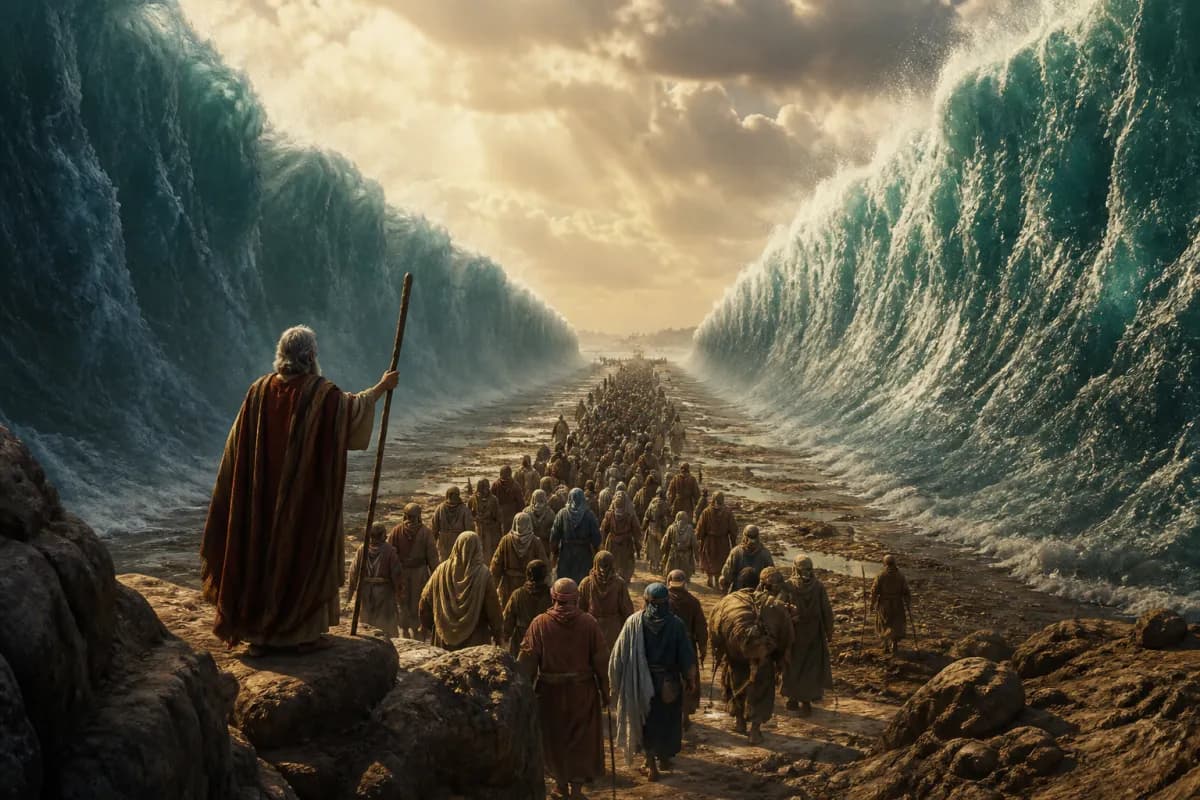
14:21Moses stretched out his hand over the sea, and the LORD caused the sea to go back by a strong east wind all night, and made the sea dry land, and the waters were divided.
14:22The children of Israel went into the middle of the sea on the dry ground; and the waters were a wall to them on their right hand and on their left.
14:23The Egyptians pursued, and went in after them into the middle of the sea: all of Pharaoh’s horses, his chariots, and his horsemen.
14:24In the morning watch, the LORD looked out on the Egyptian army through the pillar of fire and of cloud, and confused the Egyptian army.
14:25He took off their chariot wheels, and they drove them heavily; so that the Egyptians said, “Let’s flee from the face of Israel, for the LORD fights for them against the Egyptians!”
14:26The LORD said to Moses, “Stretch out your hand over the sea, that the waters may come again on the Egyptians, on their chariots, and on their horsemen.”
14:27Moses stretched out his hand over the sea, and the sea returned to its strength when the morning appeared; and the Egyptians fled against it. The LORD overthrew the Egyptians in the middle of the sea.
14:28The waters returned, and covered the chariots and the horsemen, even all Pharaoh’s army that went in after them into the sea. There remained not so much as one of them.
14:29But the children of Israel walked on dry land in the middle of the sea, and the waters were a wall to them on their right hand and on their left.
14:30Thus the LORD saved Israel that day out of the hand of the Egyptians; and Israel saw the Egyptians dead on the seashore.
14:31Israel saw the great work which the LORD did to the Egyptians, and the people feared the LORD; and they believed in the LORD and in his servant Moses.
CONTEXTUAL OVERVIEW
Moses has told Israel to stand firm, but the Lord now speaks a command that requires movement: “Tell the Israelites to go forward.” The people cannot see a road, yet God makes one through the sea. The rescue belongs entirely to Him, while Israel’s faith takes the form of walking the way He opens.
The passage gives both sides of the event. Israel passes through on dry ground; Pharaoh’s army enters the same path in pursuit; and the waters return over chariots, horses, and riders. The sea becomes the place where God decisively separates the people He has redeemed from the empire that sought to reclaim them.
HISTORICAL AND LITERARY CONTEXT
Exodus’s description deliberately echoes creation. Dry ground appears amid gathered waters, and Israel emerges as a people whose life begins beyond the reach of Egypt. The narrative does not provide enough information to settle every modern proposal about the precise body of water or mechanism. Its own emphasis is the Lord’s commanded action and the reality of a rescue no military strength could explain.
The angel of God and the pillar of cloud move behind Israel, placing darkness between the Egyptian force and the Israelite camp through the night. The Lord’s presence does not merely point the way; it protects the vulnerable while He prepares the path of deliverance.
SECTION-BY-SECTION ANALYSIS
- Go forward · Exodus 14:15Israel moves because God has opened a path, not because the people have mastered the sea.
- Protected presence · Exodus 14:20The cloud stands between Israel and Egypt while the Lord makes the way through.
- A decisive separation · Exodus 14:18The returning waters end Pharaoh’s claim and leave Israel free to begin life under the Lord’s rule.
CHRIST IN THIS PASSAGE
The New Testament treats the crossing as a foundational salvation event and sees it as a pattern for belonging to God’s redeemed people. Paul speaks of Israel being baptized into Moses in the cloud and sea; Peter uses flood waters to discuss baptism carefully. Neither text says water itself saves by ritual power. Both connect passage through judgment waters with God’s act of bringing a people into a new allegiance.
Jesus fulfills the greater exodus through His death and resurrection. He enters death and rises victorious, breaking the enslaving rule of sin and death. Christians are united to Him in baptism as a sign of that new life: the old master’s claim is broken, and believers are called to walk in the freedom of their risen Lord.
REFLECTION
God’s deliverance does not always remove danger before He calls His people to move. Israel walks only because the Lord has made a way and stands between it and its enemy. Christian courage has the same source: Jesus has gone before His people through death, and no hostile power can finally reclaim those who belong to Him.
Remembering this rescue should make believers both grateful and steady. The former master may still make noise, but Christ’s victory is not fragile. Turn from patterns that belong to the old bondage, encourage another believer who feels pursued, and speak of Jesus as the One who makes a real way from death into life.
Original Hebrew Word Study
Exodus 14:16
בָּקַע
baqa · H1234
Usually translated: to split or cleave open
Baqa means to split open. The sea is not merely made shallow; God opens a way where no way exists, turning the boundary of death into the path of His people’s deliverance.
Follow the Scripture trail
Through the Sea: The Lord Makes a Way Where There Is None in the larger story
The connection: The Lord makes a way through the sea, ending Pharaoh’s claim over the people He has redeemed. Jesus accomplishes the greater exodus through death and resurrection, breaking sin’s dominion and leading believers into new life with God.
Respond to the passage
Remember that Jesus’ victory, not your willpower, is the ground of freedom. Identify one habit that still speaks with the voice of an old master, bring it into His light, and ask a trusted believer to walk with you in obedience.
- How does the command to go forward fit with the truth that the Lord alone saves Israel?
- Why does the passage give so much attention to the cloud’s protection?
- How does union with Christ help Christians understand freedom from sin without reducing baptism to magic?
Prayer
Lord Jesus, You have made a way from death to life through Your cross and resurrection. Thank You that sin and death do not have the final claim over me. Lead me in the freedom You have won, and make my life a witness to Your saving power. Amen.