Passage Study
The Song at the Sea: Praise for the Lord Who Saves
Exodus 15:1–15:21
Exodus 15:1–21 is Israel’s first great song after the sea crossing, celebrating the Lord’s unmatched power, holy character, and faithfulness to lead His redeemed people to His dwelling. The song trains a rescued community to praise before it plans, and it reaches its fullest horizon in Jesus, whose resurrection victory gathers people from every nation into worship and mission.
- In this study
- 21 verses · 5 movements
Exodus 15
15:1Then Moses and the children of Israel sang this song to the LORD, and said, “I will sing to the LORD, for he has triumphed gloriously. He has thrown the horse and his rider into the sea.
15:2The LORD is my strength and song. He has become my salvation. This is my God, and I will praise him; my father’s God, and I will exalt him.
15:3The LORD is a man of war. The LORD is his name.
15:4He has cast Pharaoh’s chariots and his army into the sea. His chosen captains are sunk in the Red Sea.
15:5The deeps cover them. They went down into the depths like a stone.
15:6Your right hand, LORD, is glorious in power. Your right hand, LORD, dashes the enemy in pieces.
15:7In the greatness of your excellency, you overthrow those who rise up against you. You send out your wrath. It consumes them as stubble.
15:8With the blast of your nostrils, the waters were piled up. The floods stood upright as a heap. The deeps were congealed in the heart of the sea.
15:9The enemy said, ‘I will pursue. I will overtake. I will divide the plunder. My desire will be satisfied on them. I will draw my sword. My hand will destroy them.’
15:10You blew with your wind. The sea covered them. They sank like lead in the mighty waters.
15:11Who is like you, LORD, among the gods? Who is like you, glorious in holiness, fearful in praises, doing wonders?
15:12You stretched out your right hand. The earth swallowed them.
15:13“You, in your loving kindness, have led the people that you have redeemed. You have guided them in your strength to your holy habitation.
15:14The peoples have heard. They tremble. Pangs have taken hold of the inhabitants of Philistia.
15:15Then the chiefs of Edom were dismayed. Trembling takes hold of the mighty men of Moab. All the inhabitants of Canaan have melted away.
15:16Terror and dread falls on them. By the greatness of your arm they are as still as a stone, until your people pass over, LORD, until the people you have purchased pass over.
15:17You will bring them in, and plant them in the mountain of your inheritance, the place, LORD, which you have made for yourself to dwell in: the sanctuary, Lord, which your hands have established.
15:18The LORD will reign forever and ever.”
15:19For the horses of Pharaoh went in with his chariots and with his horsemen into the sea, and the LORD brought back the waters of the sea on them; but the children of Israel walked on dry land in the middle of the sea.
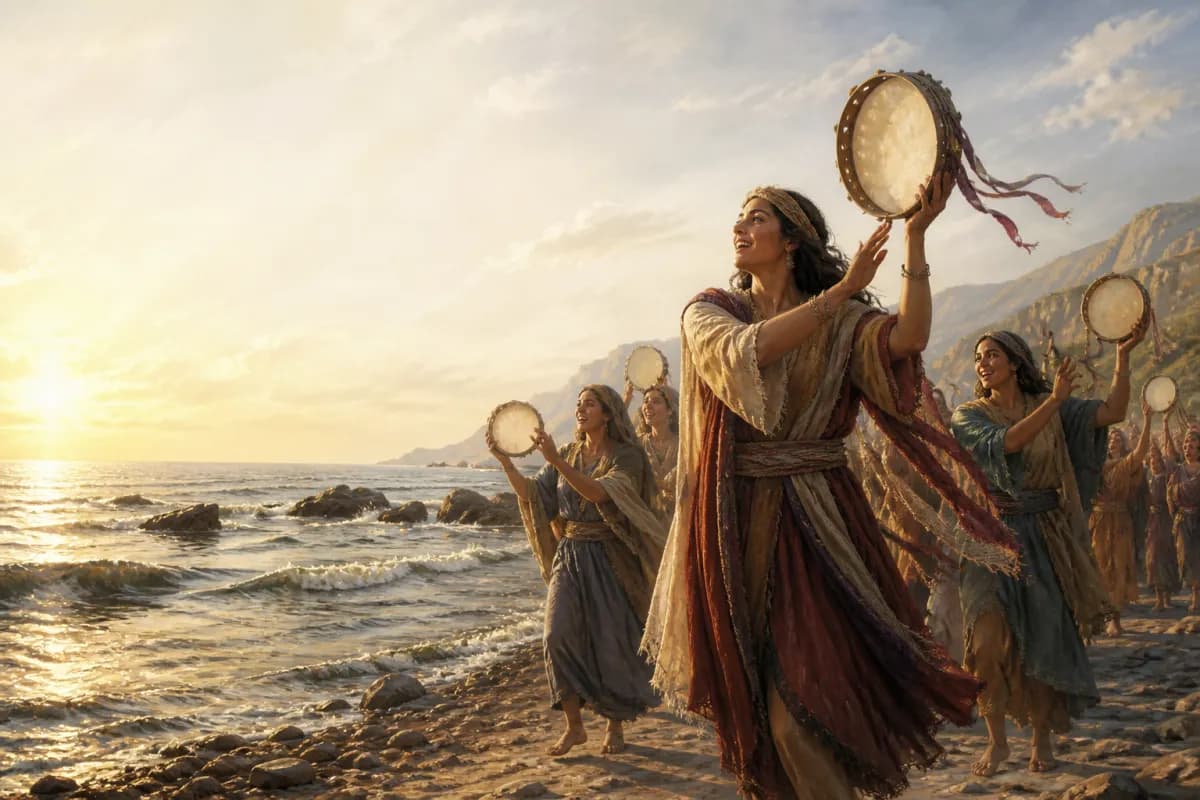
15:20Miriam the prophetess, the sister of Aaron, took a tambourine in her hand; and all the women went out after her with tambourines and with dances.
15:21Miriam answered them, “Sing to the LORD, for he has triumphed gloriously. He has thrown the horse and his rider into the sea.”
CONTEXTUAL OVERVIEW
Israel’s first response on the far shore is song. The people do not celebrate their courage, military skill, or clever escape. “I will sing to the Lord” is the song’s center because the Lord has triumphed gloriously, throwing horse and rider into the sea. Worship tells the truth about who acted.
The poem is not a detached hymn. It rises from bodies that have just walked through the sea and watched Pharaoh’s army disappear. It gives words to fear transformed into trust, grief transformed into praise, and a former slave people’s first public confession that the Lord is their strength, song, and salvation.
HISTORICAL AND LITERARY CONTEXT
Hebrew poetry often works by parallel lines and vivid images rather than by modern narrative sequence. The song revisits the sea’s events in several ways: the Lord’s right hand shatters the enemy, His blast piles up waters, and His breath covers the pursuers. These are poetic declarations of God’s sovereign action, not a second, competing account of the crossing.
The song looks forward as well as back. It speaks of the peoples of Philistia, Edom, Moab, and Canaan trembling as the Lord leads His redeemed people toward the mountain of His inheritance. The movement from rescue to dwelling matters: God saves Israel so that it may live in His presence and worship under His reign.
SECTION-BY-SECTION ANALYSIS
- The Lord’s victory · Exodus 15:2Praise begins by naming God, not Israel, as the decisive actor in the rescue.
- The Lord’s holiness · Exodus 15:11His incomparable character is seen in both judgment on oppression and mercy toward the redeemed.
- The Lord’s reign · Exodus 15:18Deliverance has a destination: a people living under God’s enduring kingship in His presence.
CHRIST IN THIS PASSAGE
The song does not directly predict the resurrection, but its pattern of deliverance leading to worship finds its fullest expression in Jesus. Through His cross and resurrection, He defeats the deeper enemies of sin and death and gathers a redeemed people who praise God for salvation they did not achieve.
Revelation deliberately echoes this song when it describes the song of Moses and of the Lamb. The connection is canonical and strong: the God who delivered Israel at the sea completes His saving purpose through the Lamb, whose victory brings people from the nations to worship the righteous King.
REFLECTION
Praise is not denial of hard circumstances. Israel sings before it encounters bitter water, hunger, conflict, and unbelief in the wilderness. The song gives it a durable memory before those pressures arrive: the Lord has already acted, and His reign is not threatened by the next difficulty.
Let Christ’s resurrection teach your speech. Name His saving work before rehearsing your anxiety. Gather with the church to sing, tell someone how Jesus has met you, and let worship become fuel for mission rather than an escape from the world. A rescued people praises so that others may know who the true King is.
Original Hebrew Word Study
Exodus 15:1
גָּאָה
gaah · H1342
Usually translated: to rise in majesty or triumph
Gaah speaks of majestic triumph. Israel’s song gives the victory to the Lord rather than to Moses, the sea, or Israel’s courage; His exalted power is the reason Pharaoh’s army falls.
Follow the Scripture trail
The Song at the Sea: Praise for the Lord Who Saves in the larger story
The connection: Israel sings because the Lord has defeated the empire that enslaved it and is leading it toward His dwelling. Jesus fulfills this saving movement by overcoming sin and death, gathering a worshiping people from the nations, and sending them to announce His reign.
Respond to the passage
Begin your next prayer by naming one specific act of Christ’s mercy before bringing your requests. Then share that mercy with someone who needs to hear that Jesus saves and reigns.
- Why does Israel’s song focus so consistently on the Lord rather than on Israel’s actions?
- How does the song connect rescue at the sea with life in God’s dwelling?
- What does Revelation’s echo of this song add to Christian hope and mission?
Prayer
Lord Jesus, You have defeated sin and death through Your cross and resurrection. Put Your praise in my mouth when fear returns, and make my worship truthful, grateful, and outward-facing. Let my life join the song that declares Your saving reign. Amen.