Passage Study
Bitter Water and the God Who Heals
Exodus 15:22–15:27
Exodus 15:22–27 brings Israel from the song at the sea to undrinkable water at Marah. The Lord answers their complaint by making the water sweet, then calls them to listen and trust Him as their healer; the scene teaches a newly redeemed people that freedom includes learning dependence on God in the wilderness.
- In this study
- 6 verses · 5 movements
Exodus 15
15:22Moses led Israel onward from the Red Sea, and they went out into the wilderness of Shur; and they went three days in the wilderness, and found no water.
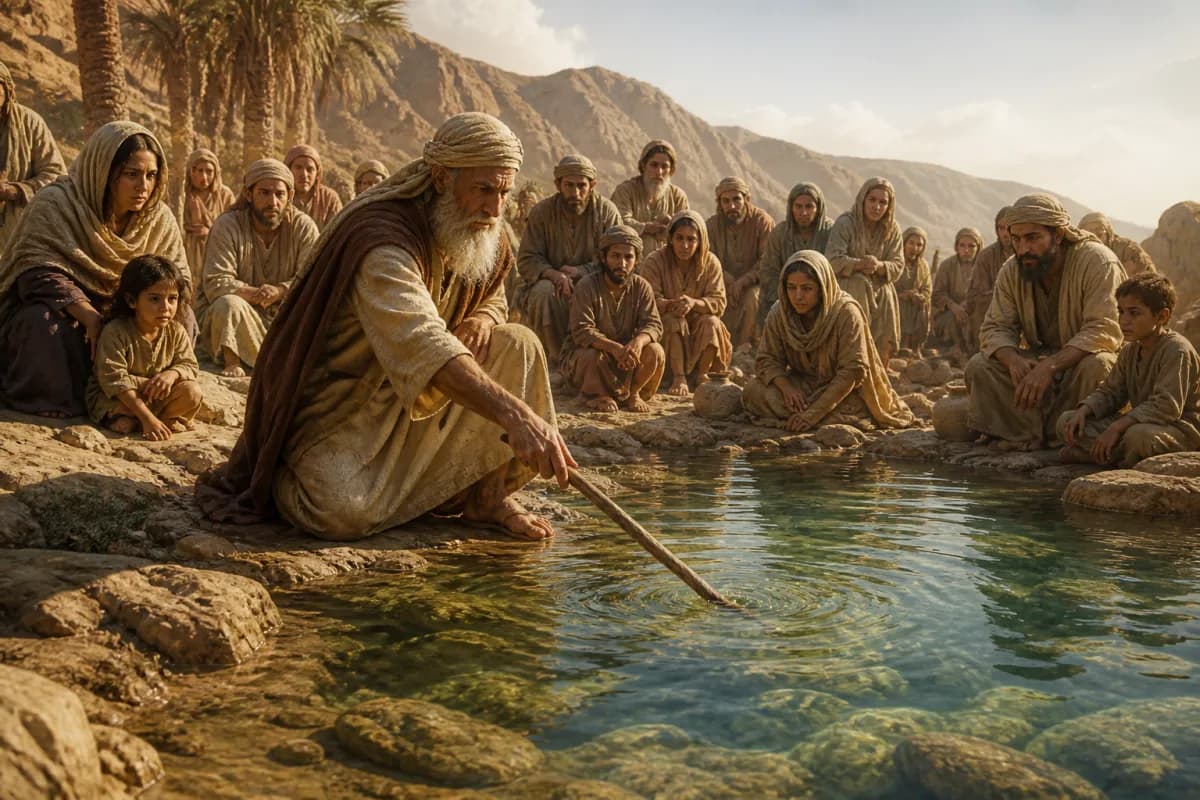
15:23When they came to Marah, they couldn’t drink from the waters of Marah, for they were bitter. Therefore its name was called Marah.
15:24The people murmured against Moses, saying, “What shall we drink?”
15:25Then he cried to the LORD. The LORD showed him a tree, and he threw it into the waters, and the waters were made sweet. There he made a statute and an ordinance for them, and there he tested them.
15:26He said, “If you will diligently listen to the LORD your God’s voice, and will do that which is right in his eyes, and will pay attention to his commandments, and keep all his statutes, I will put none of the diseases on you which I have put on the Egyptians; for I am the LORD who heals you.”
15:27They came to Elim, where there were twelve springs of water and seventy palm trees. They encamped there by the waters.
CONTEXTUAL OVERVIEW
The song of Exodus 15 has barely ended when thirst tests Israel. Marah means bitterness, and the people’s disappointment is painfully concrete: water is visible but cannot sustain them. The passage refuses a romantic picture of redemption; the God who has defeated Pharaoh now meets His people in ordinary physical need.
The Lord does not ignore the need or excuse the people’s grumbling. He shows Moses a piece of wood, makes the water drinkable, and gives Israel a statute that joins hearing, obedience, and trust. The promise that He is their healer is spoken into a wilderness where they must learn that His care reaches both body and covenant life.
HISTORICAL AND LITERARY CONTEXT
This is the first of several wilderness-testing scenes. The sequence matters: rescue at the sea is followed by a place where Israel cannot survive by its own resources. Exodus repeatedly uses such moments to reveal what is in the people’s hearts and to show the character of the God who remains with them.
The text calls the event a test, but it does not say that every illness or hardship is a direct consequence of individual disobedience. Its immediate concern is covenant formation: Israel is to trust the Lord’s word instead of treating Him as absent when the way becomes hard. Elim’s twelve springs and seventy palms close the scene with a reminder that God’s provision can be abundant as well as timely.
SECTION-BY-SECTION ANALYSIS
- Marah · Exodus 15:23Bitter water makes Israel’s need undeniable and turns a location into a test of trust.
- The Lord’s instruction · Exodus 15:26God supplies water and also forms a people who learn to hear Him.
- Elim · Exodus 15:27The springs and palms show that the wilderness is not outside God’s attentive care.
CHRIST IN THIS PASSAGE
The piece of wood is not identified by Exodus as a direct prediction of the cross, so it should not be made into a detailed allegory. The stronger canonical connection is the pattern: God meets a helpless people’s bitter need and makes life possible where they cannot make it for themselves.
Jesus fulfills God’s healing mercy at a deeper level. He receives the world’s brokenness, calls people to trust Him, and through His death and resurrection opens reconciliation with God. His mission includes final healing, while Christians still pray and act faithfully in a world where suffering has not yet disappeared.
REFLECTION
A hard providence can make recent mercy seem far away. Marah gives believers honest language for real need without granting unbelief the final word. Bring the bitter place to the Lord plainly, as Moses does, and resist turning disappointment into the conclusion that He has stopped caring.
Jesus does not promise a pain-free wilderness, but He is present in it and leads His people toward the life He has secured. Let a current need become an occasion for prayer, practical care for another thirsty person, and a gospel-shaped witness that Christ meets people where their resources end.
Original Hebrew Word Study
Exodus 15:23
מָר
mar · H4751
Usually translated: bitter
Mar means bitter. The water at Marah names Israel’s immediate disappointment, and the Lord’s provision there begins to teach a rescued people that He remains their healer in the wilderness.
Follow the Scripture trail
Bitter Water and the God Who Heals in the larger story
The connection: At Marah, God makes bitter water life-giving for a people He has redeemed. Jesus carries God’s healing mission to its climax by reconciling sinners to God and promising the final renewal of all who belong to Him.
Respond to the passage
Name one bitter circumstance to Jesus without pretending it is easy. Ask Him for the next obedient step, and offer practical refreshment to someone whose burden you can help carry.
- Why does Exodus place Marah immediately after the song at the sea?
- What does the Lord provide besides drinkable water?
- How can Christians speak of Christ’s healing without denying present suffering?
Prayer
Lord Jesus, meet me in the places that feel bitter and beyond my strength. Teach me to remember Your mercy, to hear Your word, and to trust Your healing purpose while I wait for its fullness. Amen.