Passage Study
Bread from Heaven and the Gift of Sabbath
Exodus 16:1–16:36
Exodus 16:1–36 records God feeding Israel with manna and quail in the wilderness and teaching them to gather according to His word. The daily bread and sixth-day provision form a people who depend on God rather than hoarding, and they prepare the way for Jesus, the true bread who gives life to the world.
- In this study
- 36 verses · 5 movements
Exodus 16
16:1They took their journey from Elim, and all the congregation of the children of Israel came to the wilderness of Sin, which is between Elim and Sinai, on the fifteenth day of the second month after their departing out of the land of Egypt.
16:2The whole congregation of the children of Israel murmured against Moses and against Aaron in the wilderness;
16:3and the children of Israel said to them, “We wish that we had died by the LORD’s hand in the land of Egypt, when we sat by the meat pots, when we ate our fill of bread, for you have brought us out into this wilderness to kill this whole assembly with hunger.”
16:4Then the LORD said to Moses, “Behold, I will rain bread from the sky for you, and the people shall go out and gather a day’s portion every day, that I may test them, whether they will walk in my law or not.
16:5It shall come to pass on the sixth day, that they shall prepare that which they bring in, and it shall be twice as much as they gather daily.”
16:6Moses and Aaron said to all the children of Israel, “At evening, you shall know that the LORD has brought you out from the land of Egypt.
16:7In the morning, you shall see the LORD’s glory; because he hears your murmurings against the LORD. Who are we, that you murmur against us?”
16:8Moses said, “Now the LORD will give you meat to eat in the evening, and in the morning bread to satisfy you, because the LORD hears your murmurings which you murmur against him. And who are we? Your murmurings are not against us, but against the LORD.”
16:9Moses said to Aaron, “Tell all the congregation of the children of Israel, ‘Come close to the LORD, for he has heard your murmurings.’”
16:10As Aaron spoke to the whole congregation of the children of Israel, they looked toward the wilderness, and behold, the LORD’s glory appeared in the cloud.
16:11The LORD spoke to Moses, saying,
16:12“I have heard the murmurings of the children of Israel. Speak to them, saying, ‘At evening you shall eat meat, and in the morning you shall be filled with bread. Then you will know that I am the LORD your God.’”
16:13In the evening, quail came up and covered the camp; and in the morning the dew lay around the camp.
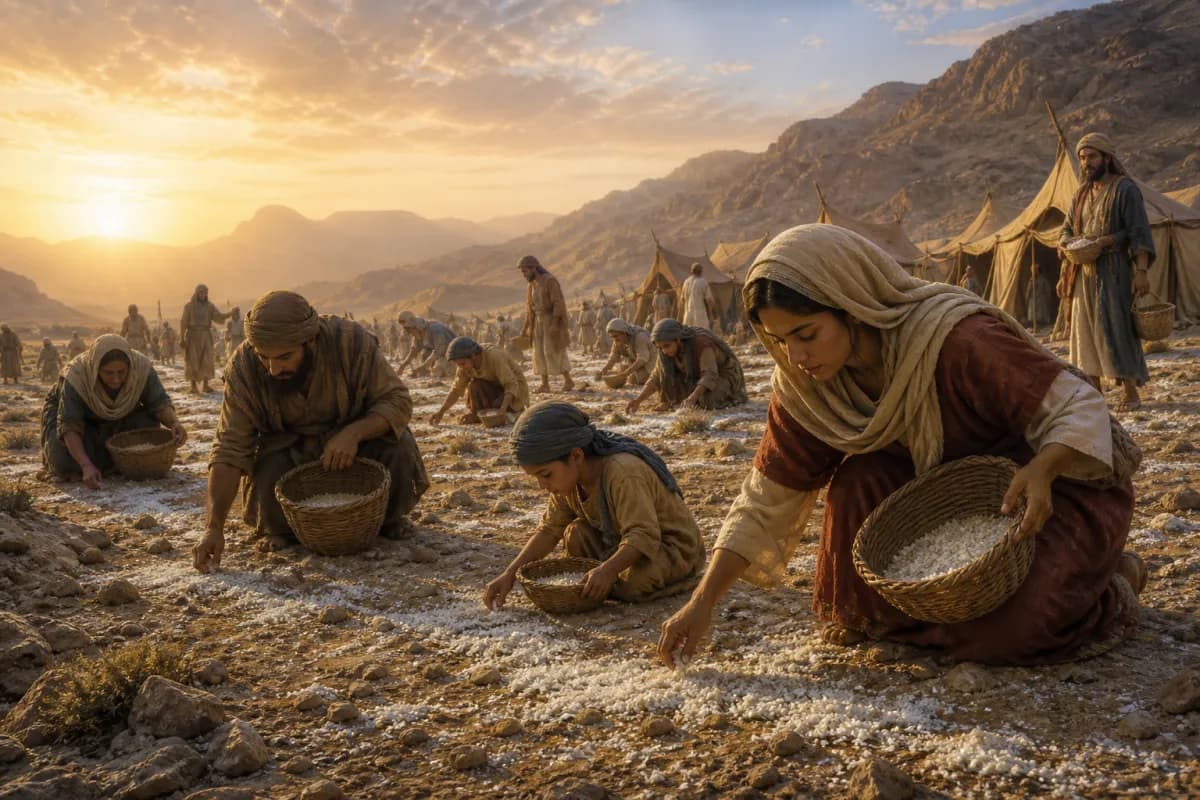
16:14When the dew that lay had gone, behold, on the surface of the wilderness was a small round thing, small as the frost on the ground.
16:15When the children of Israel saw it, they said to one another, “What is it?” For they didn’t know what it was. Moses said to them, “It is the bread which the LORD has given you to eat.
16:16This is the thing which the LORD has commanded: ‘Gather of it everyone according to his eating; an omer a head, according to the number of your persons, you shall take it, every man for those who are in his tent.’”
16:17The children of Israel did so, and some gathered more, some less.
16:18When they measured it with an omer, he who gathered much had nothing over, and he who gathered little had no lack. They each gathered according to his eating.
16:19Moses said to them, “Let no one leave of it until the morning.”
16:20Notwithstanding they didn’t listen to Moses, but some of them left of it until the morning, so it bred worms and became foul; and Moses was angry with them.
16:21They gathered it morning by morning, everyone according to his eating. When the sun grew hot, it melted.
16:22On the sixth day, they gathered twice as much bread, two omers for each one; and all the rulers of the congregation came and told Moses.
16:23He said to them, “This is that which the LORD has spoken, ‘Tomorrow is a solemn rest, a holy Sabbath to the LORD. Bake that which you want to bake, and boil that which you want to boil; and all that remains over lay up for yourselves to be kept until the morning.’”
16:24They laid it up until the morning, as Moses ordered, and it didn’t become foul, and there were no worms in it.
16:25Moses said, “Eat that today, for today is a Sabbath to the LORD. Today you shall not find it in the field.
16:26Six days you shall gather it, but on the seventh day is the Sabbath. In it there shall be none.”
16:27On the seventh day, some of the people went out to gather, and they found none.
16:28The LORD said to Moses, “How long do you refuse to keep my commandments and my laws?
16:29Behold, because the LORD has given you the Sabbath, therefore he gives you on the sixth day the bread of two days. Everyone stay in his place. Let no one go out of his place on the seventh day.”
16:30So the people rested on the seventh day.
16:31The house of Israel called its name “Manna”, and it was like coriander seed, white; and its taste was like wafers with honey.
16:32Moses said, “This is the thing which the LORD has commanded, ‘Let an omer-full of it be kept throughout your generations, that they may see the bread with which I fed you in the wilderness, when I brought you out of the land of Egypt.’”
16:33Moses said to Aaron, “Take a pot, and put an omer-full of manna in it, and lay it up before the LORD, to be kept throughout your generations.”
16:34As the LORD commanded Moses, so Aaron laid it up before the Testimony, to be kept.
16:35The children of Israel ate the manna forty years, until they came to an inhabited land. They ate the manna until they came to the borders of the land of Canaan.
16:36Now an omer is one tenth of an ephah.
CONTEXTUAL OVERVIEW
Israel’s hunger turns memory selective. The people remember Egypt’s meat pots and bread while overlooking its slavery, then accuse Moses and Aaron of bringing them out to die. God answers without making their complaint true: He gives food from heaven and uses that gift to teach whether they will walk in His instruction.
Manna is both provision and pedagogy. It appears with the morning dew, must be gathered each day, cannot be successfully stockpiled, and comes in a double portion before Sabbath. The rhythm teaches a redeemed people that life is received from the Lord day by day and that rest is a gift to be trusted rather than a risk to be managed.
HISTORICAL AND LITERARY CONTEXT
The wilderness setting is essential. Israel is no longer sustained by Egypt’s economy and has not yet entered cultivated land. The Lord therefore feeds the people in a way that makes dependence visible, while preserving each household’s responsibility to gather what is needed.
The chapter introduces Sabbath observance before Sinai’s fuller covenant legislation. Its focus is not leisure for the already secure; it is holy rest grounded in the God who provides enough on the sixth day. The preserved jar of manna turns a daily gift into communal memory so later generations can know how the Lord fed Israel.
SECTION-BY-SECTION ANALYSIS
- Enough for each household · Exodus 16:22God’s provision addresses the community so that no one is left outside His care.
- Daily gathering · Exodus 16:5Manna cannot become a private store of self-sufficiency because it is given to be received anew.
- The sixth day · Exodus 16:29The double portion makes Sabbath rest an act of trust in God’s provision.
CHRIST IN THIS PASSAGE
Jesus explicitly uses manna to explain His mission in John 6. He does not say that the wilderness bread gave eternal life; Israelites who ate it still died. He identifies Himself as the true bread from heaven, given by the Father so that those who come to Him may have life.
This connection preserves both continuity and difference. Manna was a real gift for Israel’s physical journey; Jesus gives Himself for the world’s deepest need, bringing forgiveness, communion with God, and resurrection hope. Christian dependence is therefore more than asking for provision: it is receiving Christ by faith and living from His grace.
REFLECTION
Hunger can make old slavery look attractive when the present requires trust. Exodus invites believers to examine the stories fear tells: scarcity may tempt us to hoard, resent God, or ignore a neighbor’s need. The God who gave enough to each household forms His people to receive, share, and rest.
Jesus teaches His disciples to pray for daily bread because dependence belongs to faithful life. Ask for what you need today, practice a concrete form of Sabbath trust, and speak of Christ as the bread who meets more than material lack. His mission sends a nourished people to serve the hungry with both mercy and hope.
Original Hebrew Word Study
Exodus 16:15
מַן
man · H4478
Usually translated: manna; “what is it?”
Man is tied to Israel’s question, “What is it?” The unfamiliar bread teaches them to receive a daily gift they cannot control, and the sixth-day provision teaches them to trust the Giver enough to rest.
Follow the Scripture trail
Bread from Heaven and the Gift of Sabbath in the larger story
The connection: God gives bread in the wilderness so that His redeemed people learn daily trust and holy rest. Jesus is the true bread from heaven, whose saving mission gives eternal life and sends His people to share His mercy with a hungry world.
Respond to the passage
Where are you trying to hoard control instead of receiving today’s needs from Jesus? Ask Him for daily bread, choose one practice of grateful rest, and share something tangible with someone in need.
- What does Israel’s longing for Egypt reveal about fear and memory?
- Why does God make manna unavailable for ordinary hoarding?
- How does Jesus’ use of manna in John 6 deepen Christian dependence?
Prayer
Lord Jesus, You are the bread of life. Forgive my anxious self-reliance and teach me to receive today’s provision with gratitude. Make my rest, generosity, and witness point others to Your sustaining grace. Amen.