Passage Study
Water from the Rock at Rephidim
Exodus 17:1–17:7
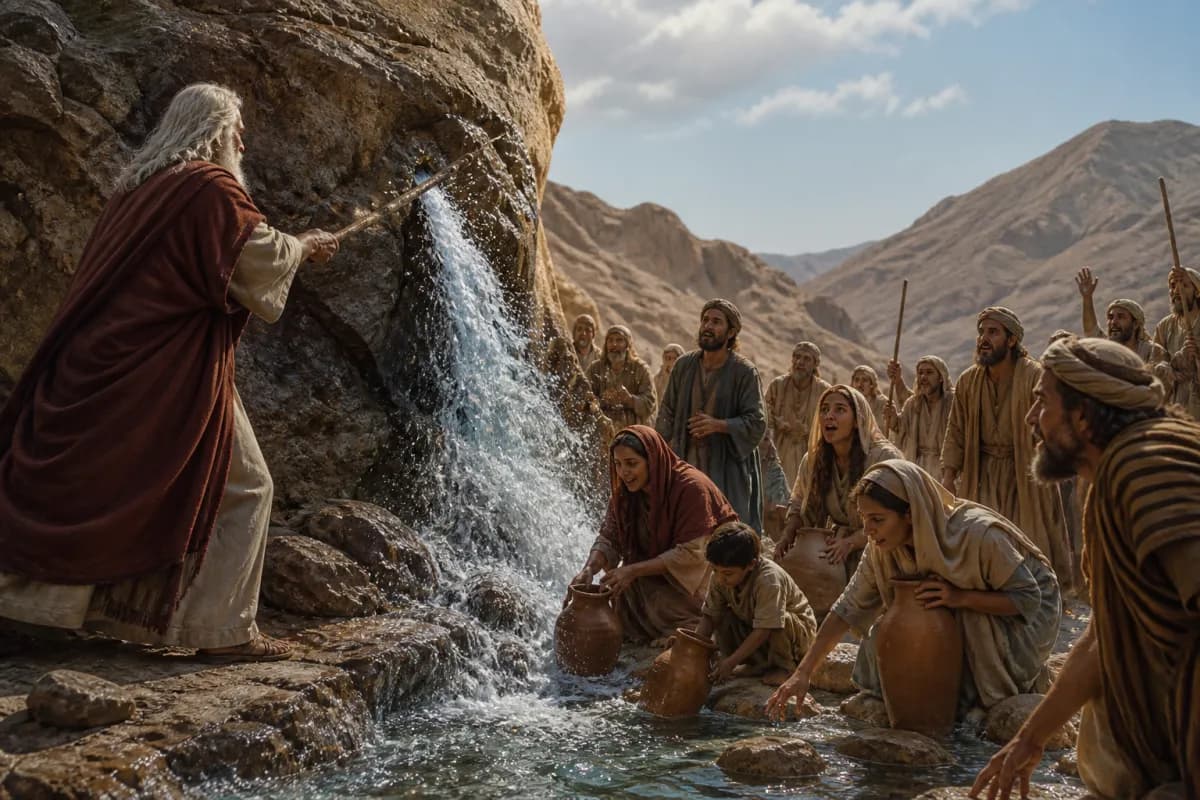
Exodus 17:1–7 shows Israel again thirsting in the wilderness, quarreling with Moses, and testing the Lord’s presence. God commands Moses to strike the rock at Horeb and provides water, exposing unbelief while sustaining the people He has redeemed.
- In this study
- 7 verses · 5 movements
Exodus 17
17:1All the congregation of the children of Israel traveled from the wilderness of Sin, starting according to the LORD’s commandment, and encamped in Rephidim; but there was no water for the people to drink.
17:2Therefore the people quarreled with Moses, and said, “Give us water to drink.” Moses said to them, “Why do you quarrel with me? Why do you test the LORD?”
17:3The people were thirsty for water there; so the people murmured against Moses, and said, “Why have you brought us up out of Egypt, to kill us, our children, and our livestock with thirst?”
17:4Moses cried to the LORD, saying, “What shall I do with these people? They are almost ready to stone me.”
17:5The LORD said to Moses, “Walk on before the people, and take the elders of Israel with you, and take the rod in your hand with which you struck the Nile, and go.
17:6Behold, I will stand before you there on the rock in Horeb. You shall strike the rock, and water will come out of it, that the people may drink.” Moses did so in the sight of the elders of Israel.
17:7He called the name of the place Massah, and Meribah, because the children of Israel quarreled, and because they tested the LORD, saying, “Is the LORD among us, or not?”
CONTEXTUAL OVERVIEW
The manna chapter has not made Israel immune to fear. At Rephidim the lack of water becomes a confrontation: the people quarrel with Moses and ask, “Is the Lord among us or not?” Their question cuts to the covenant’s center, because the exodus was meant to bring them into the Lord’s presence.
Moses is caught between a desperate community and a God whose mercy the community doubts. The passage records a dangerous escalation—Moses fears being stoned—yet the Lord supplies water before the people have corrected their hearts. Grace does not pretend their testing is harmless; it sustains them while naming the failure truthfully.
HISTORICAL AND LITERARY CONTEXT
Rephidim comes just before Sinai in Exodus’s journey. The location is tied to Horeb, the mountain associated with God’s revelation to Moses, so the provision of water stands close to the place where Israel will hear covenant instruction.
Massah means testing and Meribah means quarreling. Later biblical writers return to these names as warnings, not because asking God for help is wrong, but because Israel’s demand assumes that God must prove Himself on terms set by distrust. The narrative distinguishes honest need from an accusatory posture toward the God who has already delivered them.
SECTION-BY-SECTION ANALYSIS
- The question of presence · Exodus 17:7Israel’s deepest crisis is not simply thirst but whether it will trust that the Lord remains among His people.
- The staff · Exodus 17:1The instrument connected to Egypt’s judgment now accompanies provision in the wilderness.
- Massah and Meribah · Exodus 17:5The names keep God’s mercy and Israel’s unbelief together in the community’s memory.
CHRIST IN THIS PASSAGE
Paul says that Israel drank from a spiritual rock and identifies that rock with Christ in 1 Corinthians 10. His point is not that Jesus was physically present as a stone or that every feature of Exodus becomes allegory. He warns the church that privileged experience does not replace persevering faith.
The broader connection is strong: Jesus is the giver of living water, and His saving mission answers humanity’s deepest thirst for life with God. At the cross He bears judgment and opens access to the Spirit, so those who come to Him receive life that cannot be secured by demanding signs on their own terms.
REFLECTION
Need can become a test of God when we turn prayer into a demand that He immediately remove discomfort. Exodus calls us to bring thirst honestly while remembering the decisive evidence of His faithfulness. The question is not whether we may ask; it is whether we will interpret delay as proof that Jesus has left us.
Christ welcomes thirsty people and gives His Spirit. Bring your real need to Him, refuse the habit of accusing God in fear, and help another believer remember the ways He has already provided. This is how a church carries living water into a skeptical world: with humility, truth, and confidence in Jesus’ presence.
Original Hebrew Word Study
Exodus 17:7
נָסָה
nasah · H5254
Usually translated: to test or put to the proof
Nasah means to test. Israel names the place Massah because they put the Lord to the test by demanding proof of His presence after He had already rescued and supplied them.
Follow the Scripture trail
Water from the Rock at Rephidim in the larger story
The connection: God gives water from the rock even as Israel doubts His presence. Jesus gives living water through His saving mission, satisfying the thirst for reconciliation with God and forming a people who trust His presence in the wilderness.
Respond to the passage
Tell Jesus where need has made you question His presence. Ask for the Spirit’s help to pray honestly without accusation, then remind one other person of a concrete mercy God has shown.
- Why is Israel’s question about the Lord’s presence more serious than a request for water?
- What does the place-name Massah and Meribah preserve for later readers?
- How does Paul use this scene as both comfort and warning?
Prayer
Lord Jesus, You know my thirst and my fear. Forgive me for treating hardship as proof that You have abandoned me. Give me Your living water and teach me to trust Your faithful presence. Amen.