Passage Study
The Battle with Amalek and the Lord’s Banner
Exodus 17:8–17:16
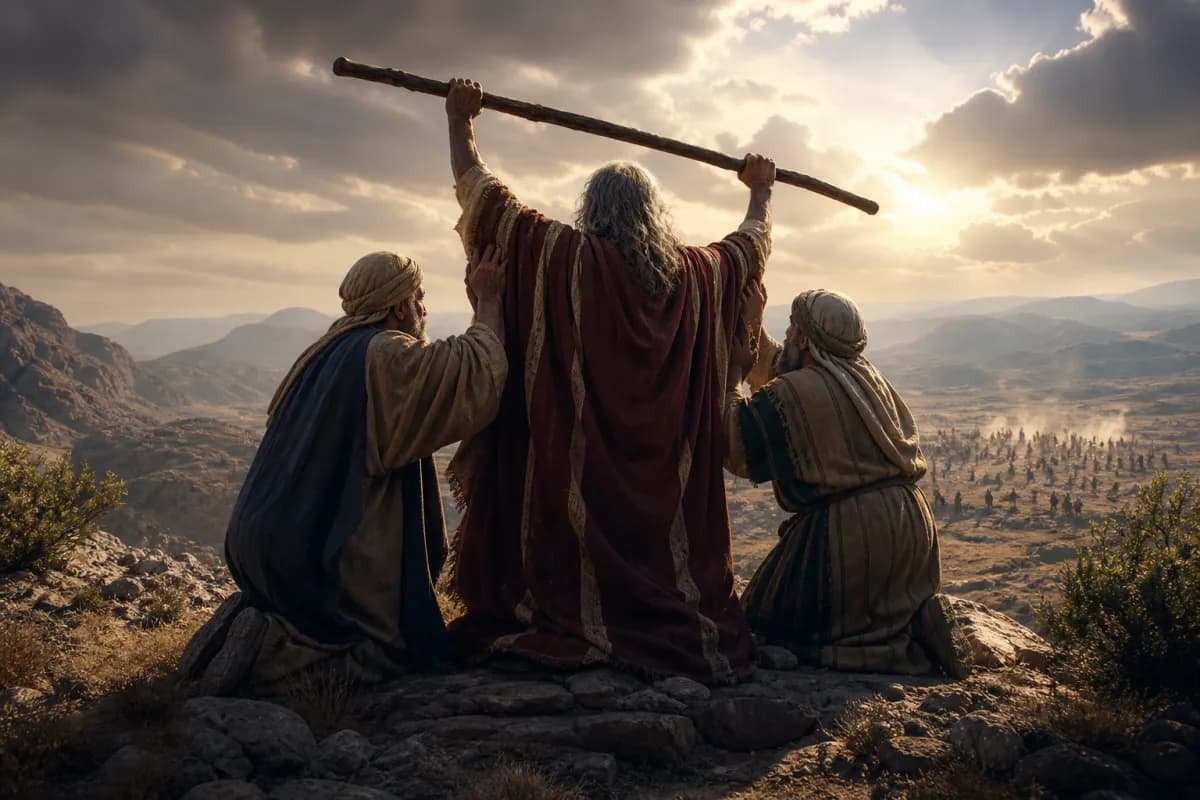
Exodus 17:8–16 recounts Amalek’s attack on Israel and the victory given as Moses stands on the hill with God’s staff raised. Joshua fights, Aaron and Hur support Moses’ weary hands, and an altar named “The Lord is my banner” declares that Israel’s safety rests on God’s help, not military pride.
- In this study
- 9 verses · 5 movements
Exodus 17
17:8Then Amalek came and fought with Israel in Rephidim.
17:9Moses said to Joshua, “Choose men for us, and go out to fight with Amalek. Tomorrow I will stand on the top of the hill with God’s rod in my hand.”
17:10So Joshua did as Moses had told him, and fought with Amalek; and Moses, Aaron, and Hur went up to the top of the hill.
17:11When Moses held up his hand, Israel prevailed. When he let down his hand, Amalek prevailed.
17:12But Moses’ hands were heavy; so they took a stone, and put it under him, and he sat on it. Aaron and Hur held up his hands, the one on the one side, and the other on the other side. His hands were steady until sunset.
17:13Joshua defeated Amalek and his people with the edge of the sword.
17:14The LORD said to Moses, “Write this for a memorial in a book, and rehearse it in the ears of Joshua: that I will utterly blot out the memory of Amalek from under the sky.”
17:15Moses built an altar, and called its name “The LORD our Banner”.
17:16He said, “The LORD has sworn: ‘The LORD will have war with Amalek from generation to generation.’”
CONTEXTUAL OVERVIEW
Immediately after water is provided, Israel faces an enemy it cannot avoid. Joshua appears for the first time as a leader of fighters, while Moses ascends a hill with the staff through which God has previously displayed His power. The scene carefully joins real human action to unmistakable dependence on the Lord.
Moses’ raised hands become the visible sign of dependence. When they lower through weariness, Amalek gains ground; when Aaron and Hur hold them up, Israel prevails. The narrative does not celebrate Moses as a solitary hero. It shows the people’s leaders needing one another under the God whose power decides the outcome.
HISTORICAL AND LITERARY CONTEXT
Exodus gives a compressed account of the attack, while Deuteronomy later remembers Amalek’s assault on the weak and straggling Israelites. The conflict becomes a recurring biblical memory of hostile violence against a vulnerable people on the way from Egypt to God’s promised rest.
The altar name, “The Lord is my banner,” uses military imagery without making Israel’s army ultimate. A banner identifies the force under which people gather. Israel is being taught that it fights under the Lord’s claim and must never confuse successful action with self-sufficient strength.
SECTION-BY-SECTION ANALYSIS
- Joshua in the valley · Exodus 17:9Israel takes responsible action against an actual attack.
- Moses on the hill · Exodus 17:10The raised staff shows that Israel’s victory depends on God rather than human force.
- Aaron and Hur · Exodus 17:12Leadership is sustained through faithful shared support rather than heroic isolation.
CHRIST IN THIS PASSAGE
This passage should not turn every present conflict into Amalek or treat Christians as authorized to wield coercive violence in Jesus’ name. Jesus teaches His followers to love enemies and entrust final judgment to God. The altar’s confession directs confidence upward, away from self-glorifying power.
Christ is the King who defeats the deeper enemies of sin, death, and the devil through His self-giving cross and resurrection. His mission gathers a people who pray, serve, endure, and bear witness under His name. The church’s weapons are not the weapons of domination but truth, prayer, love, and the gospel.
REFLECTION
Some callings require courageous action; dependence on God is never an excuse for abandoning responsibility. Joshua goes to the field, and Moses receives help when his strength fails. The scene invites believers to take their assigned work seriously while refusing the lie that the outcome finally rests on their stamina.
Do not fight alone. Ask for the Aaron-and-Hur kind of support when a burden exceeds your strength, and become that support for someone else. Under Jesus’ banner, endurance becomes a witness to His strength, and even real opposition cannot cancel His saving purpose.
Original Hebrew Word Study
Exodus 17:15
נֵס
nes · H5251
Usually translated: banner or signal
Nes is a banner raised as a signal. Moses names the altar “The Lord is my banner,” locating Israel’s victory in the Lord’s presence and purpose rather than in military strength.
Follow the Scripture trail
The Battle with Amalek and the Lord’s Banner in the larger story
The connection: Israel learns that its defense comes from the Lord’s power and is sustained through shared faithfulness. Jesus wins the decisive victory over sin and death and sends His people to serve, pray, and bear witness under His saving reign.
Respond to the passage
Identify one responsibility that has made you feel alone. Bring it to Jesus, ask one trusted person for specific support, and offer the same steady help to someone whose hands are weary.
- Why does the narrative give attention to both Joshua’s action and Moses’ raised hands?
- What does Aaron and Hur’s support teach about leadership?
- How does Jesus reshape the way Christians speak of enemies and victory?
Prayer
Lord Jesus, keep me from trusting my own strength or treating people as enemies You have called me to hate. Make me courageous in my work, humble in my need, and faithful in prayer under Your saving reign. Amen.