Passage Study
Jethro Advises Moses: Shared Leadership Under God
Exodus 18:13–18:27
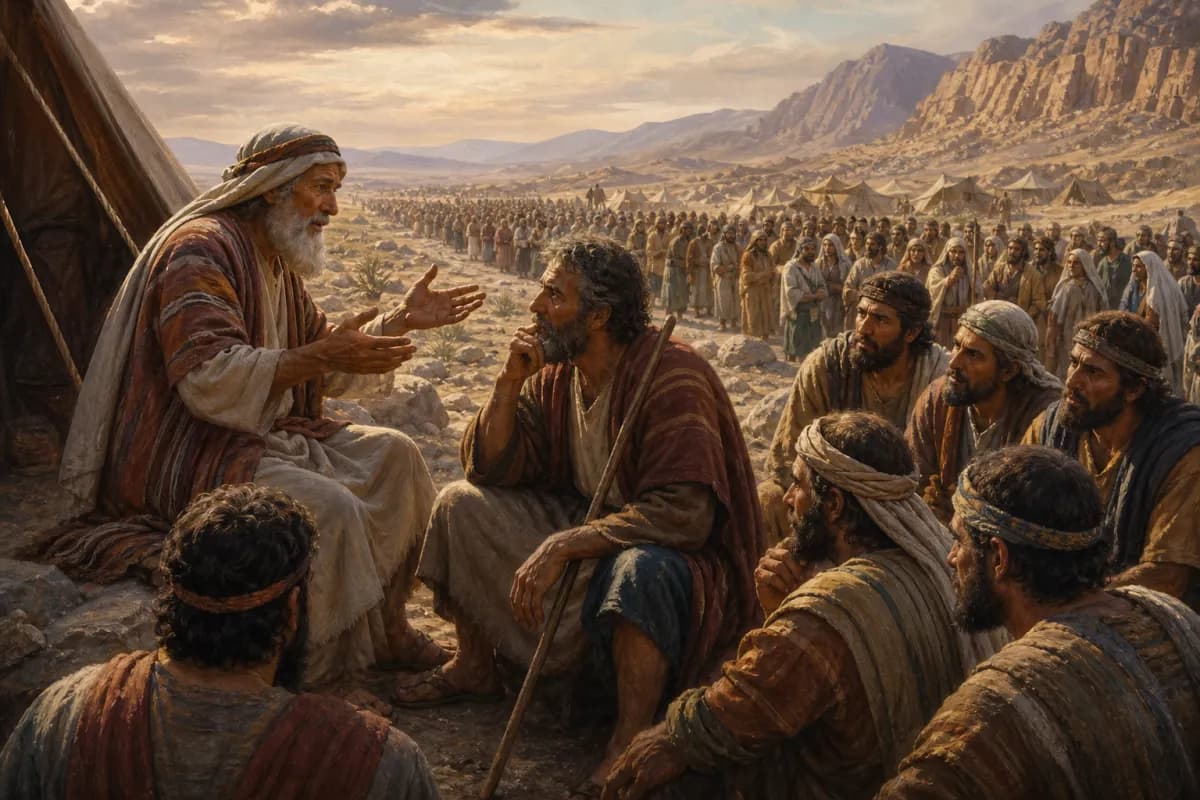
Exodus 18:13–27 shows Jethro watching Moses judge every dispute alone and urging him to appoint capable, God-fearing leaders over smaller groups. The passage joins spiritual dependence with practical wisdom: Moses must teach God’s statutes, intercede, and share the burdens of judgment. Jesus is the wise Shepherd who forms a serving body rather than leaving His people to carry ministry alone.
- In this study
- 15 verses · 5 movements
Exodus 18
18:13On the next day, Moses sat to judge the people, and the people stood around Moses from the morning to the evening.
18:14When Moses’ father-in-law saw all that he did to the people, he said, “What is this thing that you do for the people? Why do you sit alone, and all the people stand around you from morning to evening?”
18:15Moses said to his father-in-law, “Because the people come to me to inquire of God.
18:16When they have a matter, they come to me, and I judge between a man and his neighbor, and I make them know the statutes of God, and his laws.”
18:17Moses’ father-in-law said to him, “The thing that you do is not good.
18:18You will surely wear away, both you, and this people that is with you; for the thing is too heavy for you. You are not able to perform it yourself alone.
18:19Listen now to my voice. I will give you counsel, and God be with you. You represent the people before God, and bring the causes to God.
18:20You shall teach them the statutes and the laws, and shall show them the way in which they must walk, and the work that they must do.
18:21Moreover you shall provide out of all the people able men which fear God: men of truth, hating unjust gain; and place such over them, to be rulers of thousands, rulers of hundreds, rulers of fifties, and rulers of tens.
18:22Let them judge the people at all times. It shall be that every great matter they shall bring to you, but every small matter they shall judge themselves. So shall it be easier for you, and they shall share the load with you.
18:23If you will do this thing, and God commands you so, then you will be able to endure, and all these people also will go to their place in peace.”
18:24So Moses listened to the voice of his father-in-law, and did all that he had said.
18:25Moses chose able men out of all Israel, and made them heads over the people, rulers of thousands, rulers of hundreds, rulers of fifties, and rulers of tens.
18:26They judged the people at all times. They brought the hard cases to Moses, but every small matter they judged themselves.
18:27Moses let his father-in-law depart, and he went his way into his own land.
CONTEXTUAL OVERVIEW
Israel has been delivered from Egypt and has just seen the Lord provide victory and water in the wilderness. Now a quieter problem emerges: Moses sits from morning until evening while the people stand around him waiting for judgment. Jethro sees that the arrangement is exhausting Moses and failing the community it is meant to serve.
His counsel is not to replace Moses’ spiritual calling with administration. Moses must still represent the people before God, bring their cases to Him, and teach the statutes. The change is that smaller disputes are entrusted to tested leaders, so the whole people receive more faithful care under God’s instruction.
HISTORICAL AND LITERARY CONTEXT
This scene occurs before the Sinai covenant is formally given in Exodus 19–24, yet Moses already speaks of making known God’s statutes and instructions. The text may assume prior commands and divine guidance; it does not require readers to imagine a complete later legal code already written down. Its emphasis is that Israel’s communal life is being ordered under the God who has redeemed it.
Jethro is Moses’ Midianite father-in-law and has just confessed that the LORD is greater than all gods. His observation comes from outside Moses’ daily burden, which gives the scene a useful humility: wise counsel can be received without surrendering God-given responsibility. Moses hears, tests the wisdom by his calling, and acts.
SECTION-BY-SECTION ANALYSIS
- Represent before God · Exodus 18:19Moses remains responsible to bring the people and hard cases before the Lord rather than simply becoming a manager.
- Teach the way · Exodus 18:20Leaders need God’s statutes and instructions, because delegation without moral formation merely distributes confusion.
- Tested leaders · Exodus 18:21The requested qualities—capable, God-fearing, trustworthy, and resistant to dishonest gain—protect justice from favoritism and corruption.
CHRIST IN THIS PASSAGE
Moses’ role as teacher and representative points to a need that reaches its fullness in Christ, though Jethro’s administrative plan is not a blueprint for every church structure. Jesus is the unique mediator who brings His people to the Father. At the same time, He does not create a ministry of isolated heroes; He gives gifts to His body so believers serve one another under His word.
Christ’s mission therefore corrects both control and passivity. Leaders are called to pray, teach, and guard the flock; the whole church is called to bear burdens and use gifts faithfully. Sharing responsibility becomes gospel-shaped when it serves people, protects justice, and makes room for the saving message of Jesus to be heard clearly.
REFLECTION
Some people carry every decision because they care deeply; others let responsibilities drop because they fear the weight. Exodus 18 offers a better way. Godly leadership names what only a person’s calling requires and then entrusts appropriate work to people of tested character.
Ask Jesus whether you are hoarding responsibility or avoiding it. Identify one task you should share, one person you should equip, or one burden you should willingly carry. In a church, home, or workplace, choose a practical way to make care and justice more accessible rather than leaving people waiting at the edge of someone else’s exhaustion.
Original Hebrew Word Study
Exodus 18:18
נָבֵל
navel · H5034
Usually translated: to wear out, wither, or fade
Navel pictures something withering or wearing away. Jethro sees that Moses’ solitary pattern will exhaust both Moses and the people, so wise shared responsibility becomes part of faithful leadership.
Follow the Scripture trail
Jethro Advises Moses: Shared Leadership Under God in the larger story
The connection: Jethro’s counsel helps Israel receive just, teachable care instead of depending on Moses’ exhaustion. Jesus remains the one Mediator while forming a gifted people who share service, bear burdens, and make His mission visible.
Respond to the passage
Ask Christ whether you are carrying work He intends you to share or neglecting work He has entrusted to you. Take one concrete step to equip, ask for help from, or serve another person.
- What does Moses keep doing after leadership is shared?
- Why do character and freedom from dishonest gain matter for delegated judgment?
- How does Christ’s unique mediation shape shared ministry without diminishing Him?
Prayer
Lord Jesus, wise Shepherd of Your people, free me from anxious control and careless withdrawal. Give me humble counsel, trustworthy partners, and a willingness to serve so that people are cared for and Your gospel is not obscured by needless burden. Amen.