Passage Study
Moses Is Rescued Through the Waters
Exodus 2:1–2:10
Exodus 2:1–10 tells how a Levite mother hides her son, places him in a carefully prepared basket among the reeds, and watches Pharaoh’s daughter draw him from the Nile. God’s deliverance works through ordinary courage, family care, and an unexpected act of compassion, preserving the child who will later lead Israel out of Egypt.
- In this study
- 10 verses · 5 movements
Exodus 2
2:1A man of the house of Levi went and took a daughter of Levi as his wife.
2:2The woman conceived and bore a son. When she saw that he was a fine child, she hid him three months.
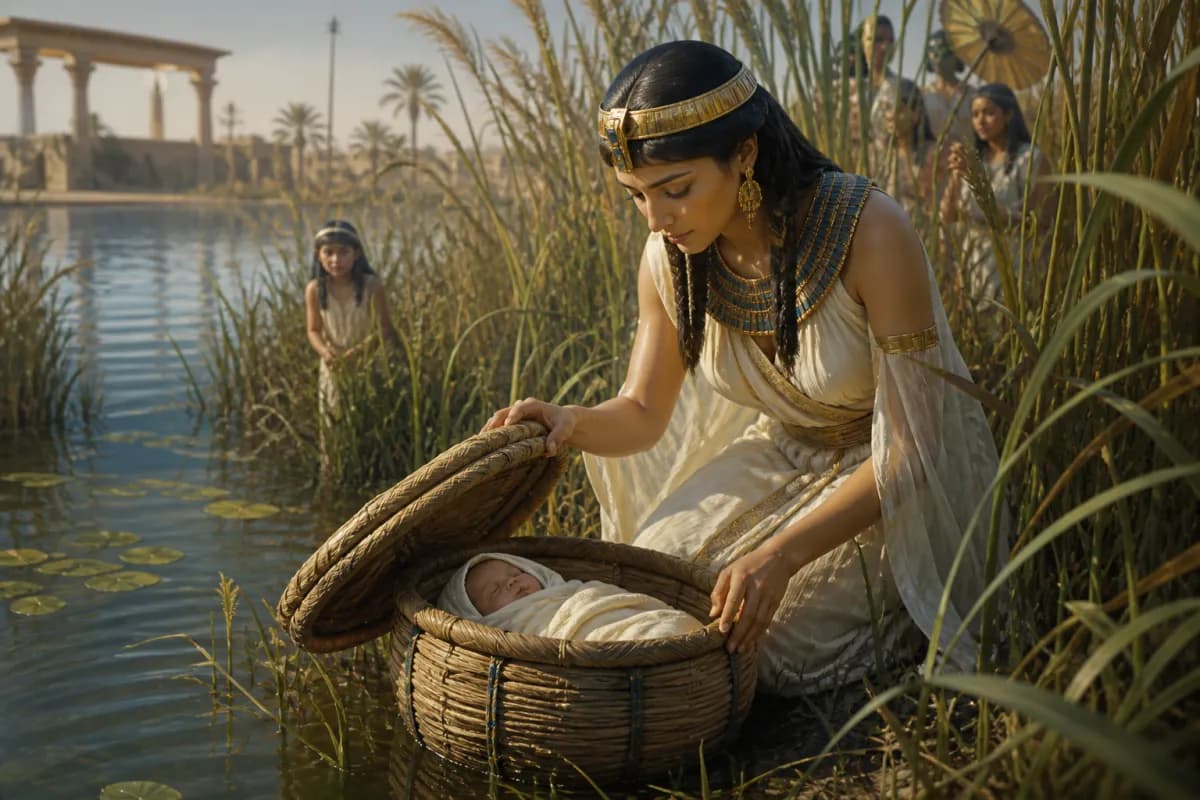
2:3When she could no longer hide him, she took a papyrus basket for him, and coated it with tar and with pitch. She put the child in it, and laid it in the reeds by the river’s bank.
2:4His sister stood far off, to see what would be done to him.
2:5Pharaoh’s daughter came down to bathe at the river. Her maidens walked along by the riverside. She saw the basket among the reeds, and sent her servant to get it.
2:6She opened it, and saw the child, and behold, the baby cried. She had compassion on him, and said, “This is one of the Hebrews’ children.”
2:7Then his sister said to Pharaoh’s daughter, “Should I go and call a nurse for you from the Hebrew women, that she may nurse the child for you?”
2:8Pharaoh’s daughter said to her, “Go.” The young woman went and called the child’s mother.
2:9Pharaoh’s daughter said to her, “Take this child away, and nurse him for me, and I will give you your wages.” The woman took the child, and nursed him.
2:10The child grew, and she brought him to Pharaoh’s daughter, and he became her son. She named him Moses, and said, “Because I drew him out of the water.”
CONTEXTUAL OVERVIEW
The command to cast Hebrew boys into the Nile hangs over every line of this passage. A Levite woman sees that her son is beautiful and hides him for three months. When hiding him is no longer possible, she places him in the river Pharaoh has turned into an instrument of death.
The rescue is full of reversals. The basket is coated to keep out water, the sister watches from a distance, and Pharaoh’s own daughter finds the crying child. The household of the oppressor becomes the place where the future deliverer is nourished and named.
HISTORICAL AND LITERARY CONTEXT
Exodus identifies Moses’ parents as Levites without yet telling the reader why that family line will matter. The detail prepares for Moses and Aaron’s later role in Israel’s worship while first presenting them simply as a family trying to keep a child alive under a brutal decree.
The basket is called a tevah, the uncommon Hebrew word also used for Noah’s ark. That verbal connection is a careful literary echo: both vessels carry life through dangerous waters by God’s preserving mercy. It is an echo, not a claim that every feature of Moses’ basket repeats Noah’s story.
Did you know?
Caring for a royal child could bring extraordinary honor in Egypt. Senetnay, a royal wet nurse, received a tomb in the Valley of the Kings; stone burial vessels preserving her name survive today.
Why it matters: Her burial shows the social importance that nursing a child could carry within the Egyptian royal household.
Jar inscribed for royal nurse Senetnay — The Metropolitan Museum of Art
SECTION-BY-SECTION ANALYSIS
- A vessel of preservation · Exodus 2:5The waterproof basket places Moses beyond human control but not beyond God’s care in the very river Pharaoh had weaponized.
- Unexpected compassion · Exodus 2:6Pharaoh’s daughter recognizes the child’s identity and chooses pity, exposing the limits of her father’s murderous policy.
- A rescued deliverer · Exodus 2:10Moses is first drawn from the water before God later uses him to lead Israel through the sea.
CHRIST IN THIS PASSAGE
Moses’ rescue is a providential preparation for his role in the exodus, not a direct prediction that identifies every detail with Jesus. Yet the canon later places Moses and Christ in meaningful relation: Moses faithfully serves in God’s house, while Jesus is the Son over God’s house. The greater deliverer comes from within Israel’s story and fulfills the rescue toward which it points.
Jesus too enters a world where a ruler’s fear puts children at risk, and He lives to accomplish a greater exodus from sin and death. Moses is drawn out of water so that he may lead a people through it. Jesus passes through death itself and rises, bringing all who trust Him into reconciliation with the Father and the hope of new life.
REFLECTION
The mother’s basket is not a sentimental picture of control. It is a costly act of entrusting a beloved child to God amid danger. The passage gives dignity to faithful care that uses every wise means available and still must release the outcome to the Lord.
For those who feel their story has begun under threat, Moses’ rescue offers real hope without easy promises. Jesus knows what it is to enter a violent world and to be carried by the Father’s purpose through danger and death. His resurrection assures His people that the powers that threaten life do not have the final word.
Original Hebrew Word Study
Exodus 2:3
תֵּבָה
tevah · H8392
Usually translated: basket or ark
Tevah is the same unusual word used for Noah’s ark. Moses is placed in a small vessel of rescue, quietly linking his preservation to God’s earlier deliverance through the waters.
Follow the Scripture trail
Moses Is Rescued Through the Waters in the larger story
The connection: God draws Moses from the water in order to preserve the deliverer of Israel. That rescue pattern reaches its fullness in Jesus, the greater Son who passes through death and rises to bring sinners into life with God.
Respond to the passage
Bring to Jesus the person or future you most want to protect. Faithful care may require deliberate action and painful trust at the same time. Ask Him to make you wise, compassionate, and steady when you cannot control the outcome.
- What careful actions does Moses’ mother take before she places the basket among the reeds?
- How does Pharaoh’s daughter’s compassion overturn her father’s purpose in this scene?
- Why is it important to distinguish a meaningful rescue pattern from forcing every detail of Moses’ story into a prediction of Jesus?
Prayer
Father, You see the dangers that make me afraid for those I love. Give me wisdom to act faithfully and grace to entrust what I cannot control to You. Thank You for Jesus, who conquered death and holds His people in Your care. Amen.