Passage Study
Moses Flees: A Deliverer Formed in Exile
Exodus 2:11–2:22
Exodus 2:11–25 follows Moses from identification with his oppressed people, through the killing of an Egyptian and flight from Pharaoh, to a new life in Midian while Israel groans in Egypt. The passage refuses both self-salvation and despair: God hears the enslaved and prepares His servant in hidden years. Jesus is the greater Deliverer, who saves by obedient self-giving rather than violence and brings outsiders near to God.
- In this study
- 12 verses · 5 movements
Exodus 2
2:11In those days, when Moses had grown up, he went out to his brothers and saw their burdens. He saw an Egyptian striking a Hebrew, one of his brothers.
2:12He looked this way and that way, and when he saw that there was no one, he killed the Egyptian, and hid him in the sand.
2:13He went out the second day, and behold, two men of the Hebrews were fighting with each other. He said to him who did the wrong, “Why do you strike your fellow?”
2:14He said, “Who made you a prince and a judge over us? Do you plan to kill me, as you killed the Egyptian?” Moses was afraid, and said, “Surely this thing is known.”
2:15Now when Pharaoh heard this thing, he sought to kill Moses. But Moses fled from the face of Pharaoh, and lived in the land of Midian, and he sat down by a well.
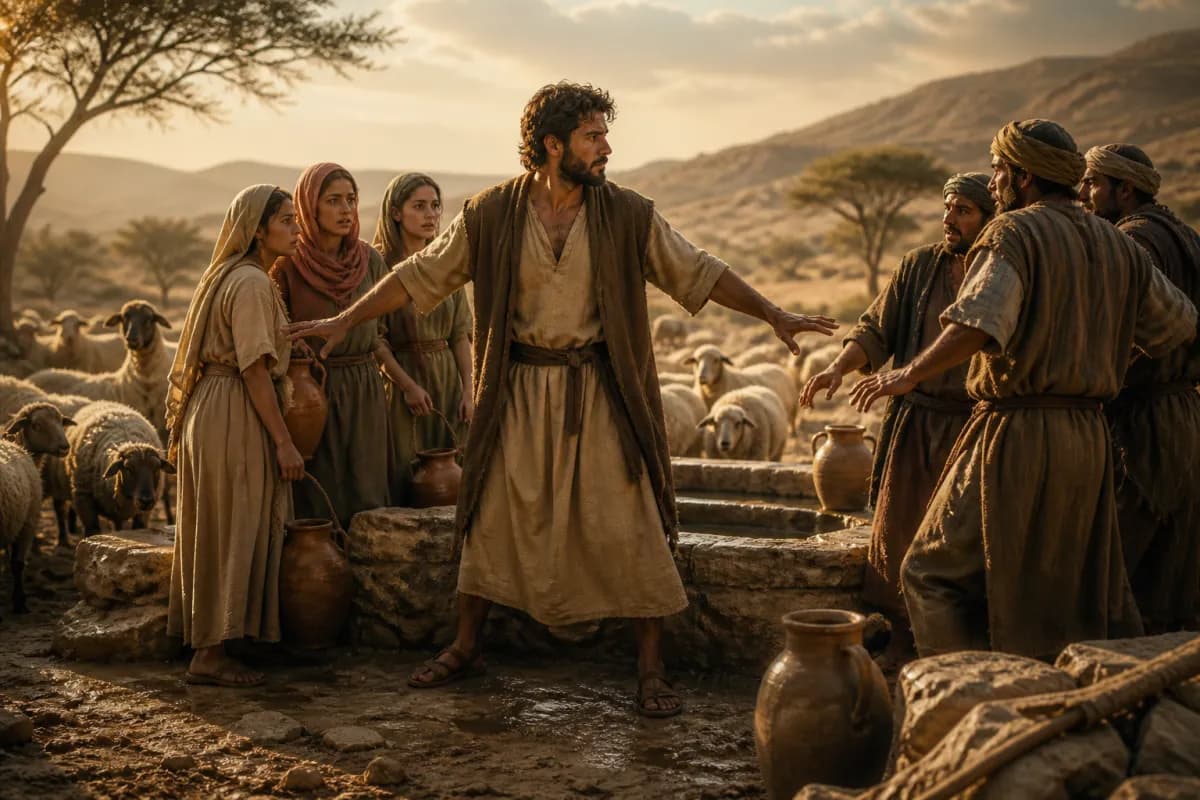
2:16Now the priest of Midian had seven daughters. They came and drew water, and filled the troughs to water their father’s flock.
2:17The shepherds came and drove them away; but Moses stood up and helped them, and watered their flock.
2:18When they came to Reuel, their father, he said, “How is it that you have returned so early today?”
2:19They said, “An Egyptian delivered us out of the hand of the shepherds, and moreover he drew water for us, and watered the flock.”
2:20He said to his daughters, “Where is he? Why is it that you have left the man? Call him, that he may eat bread.”
2:21Moses was content to dwell with the man. He gave Moses Zipporah, his daughter.
2:22She bore a son, and he named him Gershom, for he said, “I have lived as a foreigner in a foreign land.”
CONTEXTUAL OVERVIEW
The child rescued from the Nile now sees the suffering of his own people. Moses’ response shows that he does not regard Israel’s slavery as somebody else’s problem, but Exodus also makes clear that his first intervention cannot become the deliverance Israel needs. An Egyptian lies buried in the sand, Moses is exposed, and Pharaoh seeks his life.
The narrative then carries Moses away from Egypt to Midian. At a well he defends the daughters of Reuel from aggressive shepherds, is welcomed into their household, and names his son Gershom because he is a resident alien. The long paragraph ends not with Moses’ plan but with Israel’s groaning and God’s covenant attention.
HISTORICAL AND LITERARY CONTEXT
Exodus 2 stands between Moses’ birth and his call at Horeb. Its scenes explain why the future leader is absent from Egypt when God later appears to him: he has become a fugitive under Pharaoh’s sentence. The text neither praises the killing as Israel’s rescue nor pauses to give a modern legal ruling about every aspect of the event; it shows the insufficiency and cost of Moses’ attempt to act by his own hand.
The well scene recalls earlier biblical meetings in which a journey leads to family formation, yet its immediate function is concrete. Moses, though displaced, protects vulnerable women and receives shelter among Midianites. His marriage and shepherding make his exile real; God’s future work will involve a man who has known both palace life and life without a homeland.
Did you know?
Ancient Egyptians told another famous story of flight from Egypt: the Tale of Sinuhe. Its frightened courtier finds refuge abroad, marries a local ruler’s daughter, and builds a new life far from the royal household he once served.
Why it matters: The comparison shows that exile and life among foreigners were familiar concerns in Egyptian storytelling as well as in Moses’ journey.
Tale of Sanehat (Sinuhe), translation — University College London
SECTION-BY-SECTION ANALYSIS
- Moses’ failed rescue · Exodus 2:11His concern for the Hebrew is real, but hidden violence and self-appointed authority cannot free Israel.
- Gershom · Exodus 2:22The child’s name keeps Moses’ exile in view and prepares readers to see him as a man shaped outside Egypt.
- God remembers · Exodus 2:14God’s remembrance is His faithful commitment to act on the covenant He made with Abraham, Isaac, and Jacob.
CHRIST IN THIS PASSAGE
Moses’ concern for his people anticipates his later mediating role, but this episode also exposes why Israel needs a better Deliverer. Jesus enters our violence and bondage without sinning or using evil means to secure His kingdom. He gives His life willingly, bears judgment rather than hiding it, and frees His people from sin and death by His own sacrificial obedience.
The exile theme also fits Christ’s mission with appropriate care. Moses is a displaced fugitive; Jesus comes as the Son sent into a hostile world and gathers those who were far off into the Father’s household. The connection is not that every detail of Midian predicts Jesus, but that God’s rescue story reaches its faithful center in the Savior who brings true reconciliation.
REFLECTION
Anger at oppression can be morally alert and still become destructive when we seize God’s work by sinful means. Moses’ first act asks us to examine not only whether we care about wrong, but how we seek to address it. God is not indifferent to the cry of the afflicted, and He does not need our concealed violence to accomplish His justice.
Bring to Jesus one place where frustration has tempted you to control the outcome. Confess any sinful response, take one honest step toward protection or repair, and pray for patience in hidden seasons. A faithful conversation, practical support for someone burdened, or refusal to spread harm can become a small witness to Christ’s reconciling way.
Original Hebrew Word Study
Exodus 2:22
גֵּר
ger · H1616
Usually translated: sojourner or resident foreigner
Ger names a person living away from his own land and security. Moses’ name for his son keeps his exile before the reader: the future deliverer knows what it is to live as an outsider.
Follow the Scripture trail
Moses Flees: A Deliverer Formed in Exile in the larger story
The connection: Moses cannot deliver Israel through hidden violence, yet God hears the slaves and forms him during exile. Jesus is the sinless Deliverer whose sacrificial death accomplishes the rescue and reconciliation human force cannot achieve.
Respond to the passage
Ask Christ to show you where anger has become control or avoidance. Make one repair, protective action, or truthful confession that reflects His way of justice and mercy.
- What does Moses’ failure reveal about the kind of deliverance Israel needs?
- Why does the narrative linger over Gershom’s name and Moses’ life in Midian?
- How do God’s hearing, remembering, seeing, and knowing shape prayer in suffering?
Prayer
Lord Jesus, You see the burdens I cannot fix by force or concealment. Forgive my harmful responses to injustice, give me courage to protect the vulnerable, and teach me to trust Your righteous and reconciling work. Amen.