Passage Study
God Hears Israel’s Cry and Remembers His Covenant
Exodus 2:23–2:25
Exodus 2:23–25 turns from Moses’ exile to Israel’s continuing bondage. Their groaning rises to God, and the narrative answers with four covenant verbs: God hears, remembers, sees, and knows. The coming exodus begins in God’s faithful attention to a suffering people and in His commitment to the promises He made to Abraham, Isaac, and Jacob.
- In this study
- 3 verses · 5 movements
Exodus 2
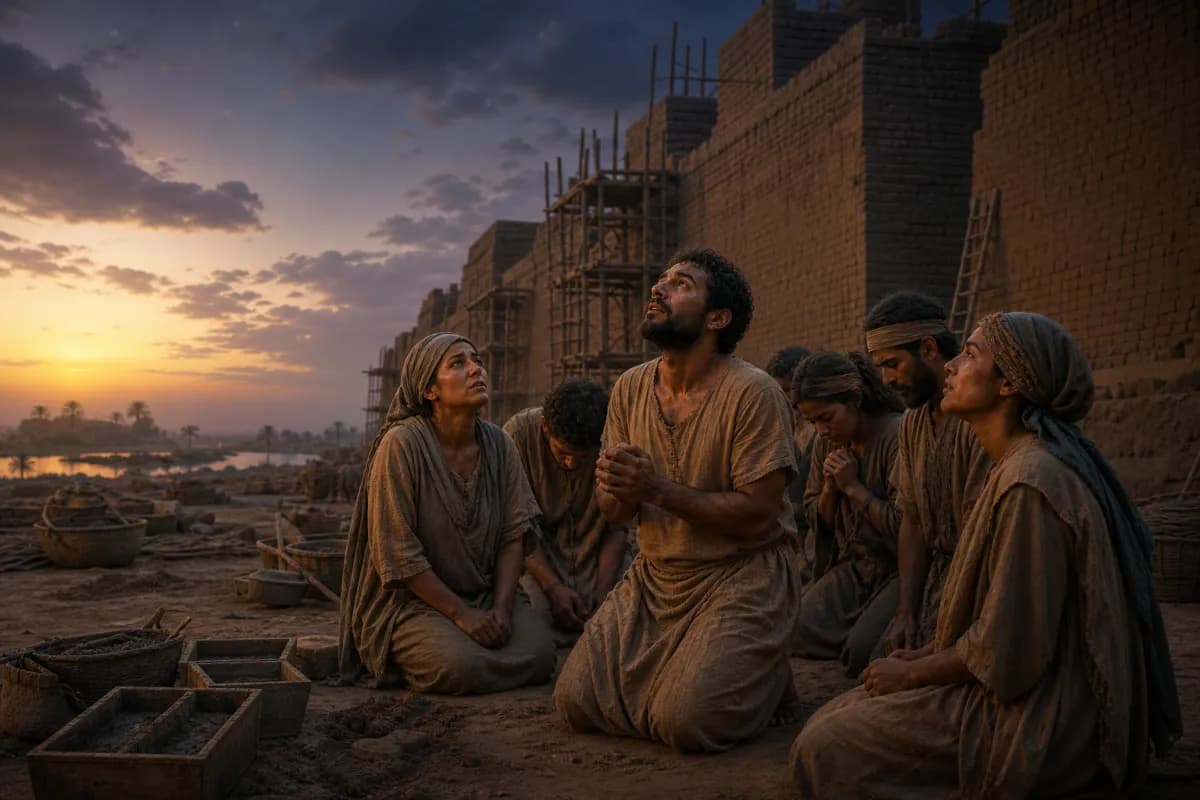
2:23In the course of those many days, the king of Egypt died, and the children of Israel sighed because of the bondage, and they cried, and their cry came up to God because of the bondage.
2:24God heard their groaning, and God remembered his covenant with Abraham, with Isaac, and with Jacob.
2:25God saw the children of Israel, and God understood.
CONTEXTUAL OVERVIEW
Moses is living in Midian, far from Egypt, while Israel remains under bondage. The death of the king does not end their misery. Their groaning and cry show that time passing has not made slavery normal or harmless in God’s sight.
The passage’s center is not Israel’s strategy but God’s response. Four short statements slow the narrative: God heard their groaning; God remembered His covenant; God saw the Israelites; God knew. The words assure readers that the Lord’s rescue will arise from His faithful character, not from a people who have earned it.
HISTORICAL AND LITERARY CONTEXT
These verses close the first major movement of Exodus. The next scene begins with Moses tending a flock at Horeb, where God will identify Himself as the God of Abraham, Isaac, and Jacob and send Moses back to Egypt. The repeated covenant names make the transition deliberate.
When Scripture says God remembers, it does not mean He had forgotten information and recovered it. In this covenant setting, remembrance means that God acts in faithfulness to the relationship and promise He has established. His seeing and knowing likewise express personal, active attention rather than distant awareness.
Did you know?
Egyptian worshippers sometimes left stone ears in temples. Other monuments were covered with carved ears—one had 376—to express the hope of being heard by a deity. A surviving example names a man called Ramessumerysutekh.
Why it matters: These objects make the ancient longing for a hearing God tangible beside Exodus’s assurance that Israel’s cry reached Him.
Model Ear of Ramessumerysutekh — The Metropolitan Museum of Art
SECTION-BY-SECTION ANALYSIS
- God hears · Exodus 2:23The enslaved people’s cry reaches the Lord; their suffering is never mere background in the story.
- God remembers · Exodus 2:24The coming rescue rests on God’s covenant commitment to Abraham, Isaac, and Jacob.
- God knows · Exodus 2:25God’s knowledge is personal and active, preparing the reader for His decisive intervention.
CHRIST IN THIS PASSAGE
God’s covenant attention in Exodus is fulfilled and enlarged in Jesus, through whom God acts decisively to save His people from sin and death. The passage does not say that every sufferer will receive the same temporal outcome as Israel, but it establishes that suffering is seen by the God who keeps His promises. In Christ, God has drawn near to human grief and borne the curse at the cross.
Jesus’ saving mission rests on the Father’s covenant faithfulness, not on human deserving. He hears the cries of those who come to Him, intercedes for His people, and will finally make all things right. The exodus therefore gives believers language for prayer: lament can be honest because the Lord knows, remembers, and acts in steadfast love.
REFLECTION
These verses give permission to groan before God. Biblical faith does not require pretending that oppression, illness, grief, or prolonged uncertainty are small. Israel’s cry is not polished, and the narrator does not criticize it. It rises to the God who sees the people no one else has rescued.
The gospel adds a sure foundation for that prayer. Jesus is the crucified and risen Lord who has entered suffering and opened access to the Father. His people can bring their pain to Him, accompany others without empty explanations, and bear witness to the coming kingdom where bondage and death will be no more.
Original Hebrew Word Study
Exodus 2:23
שַׁוְעָה
shavah · H7775
Usually translated: cry for help
Shavah is an urgent cry from distress. The passage does not present Israel’s pain as background noise; their cry rises before the God who remembers His covenant.
Follow the Scripture trail
God Hears Israel’s Cry and Remembers His Covenant in the larger story
The connection: Israel’s cry rises to the covenant-keeping God, who begins the exodus because He has heard, remembered, seen, and known. Jesus completes the saving mission toward which that rescue points: He draws near to sinners, bears their bondage, and brings them to the Father with lasting hope.
Respond to the passage
Do not hide the groan you have carried too long. Bring it to Jesus in plain words, trusting that He knows your need before you can explain it fully. Then let His mercy make you attentive to another person whose cry may be easy for others to miss.
- What do the four verbs—heard, remembered, saw, and knew—add to your understanding of God’s response?
- Why does the death of Pharaoh not immediately end Israel’s suffering, and how does that shape faithful lament?
- How does Jesus’ sympathetic priesthood give you a concrete way to pray when no quick resolution is visible?
Prayer
Covenant-keeping God, You hear the cries I cannot put into polished words. Thank You for seeing and knowing Your people, and for sending Jesus to bring us near through His cross and resurrection. Teach me to lament honestly, wait faithfully, and notice those who need mercy today. Amen.