Passage Study
Blood, Promise, and a Meal Before God
Exodus 24:1–24:11
Exodus 24:1–11 confirms Israel’s covenant with the Lord through spoken commitment, the reading of the covenant book, sacrificial blood, and a meal in God’s presence. The scene makes clear that access to the holy God is given through His appointed covenant mercy. Jesus establishes the new covenant in His blood and brings forgiven people near to God.
- In this study
- 11 verses · 5 movements
Exodus 24
24:1He said to Moses, “Come up to the LORD, you, and Aaron, Nadab, and Abihu, and seventy of the elders of Israel; and worship from a distance.
24:2Moses alone shall come near to the LORD, but they shall not come near. The people shall not go up with him.”
24:3Moses came and told the people all the LORD’s words, and all the ordinances; and all the people answered with one voice, and said, “All the words which the LORD has spoken will we do.”
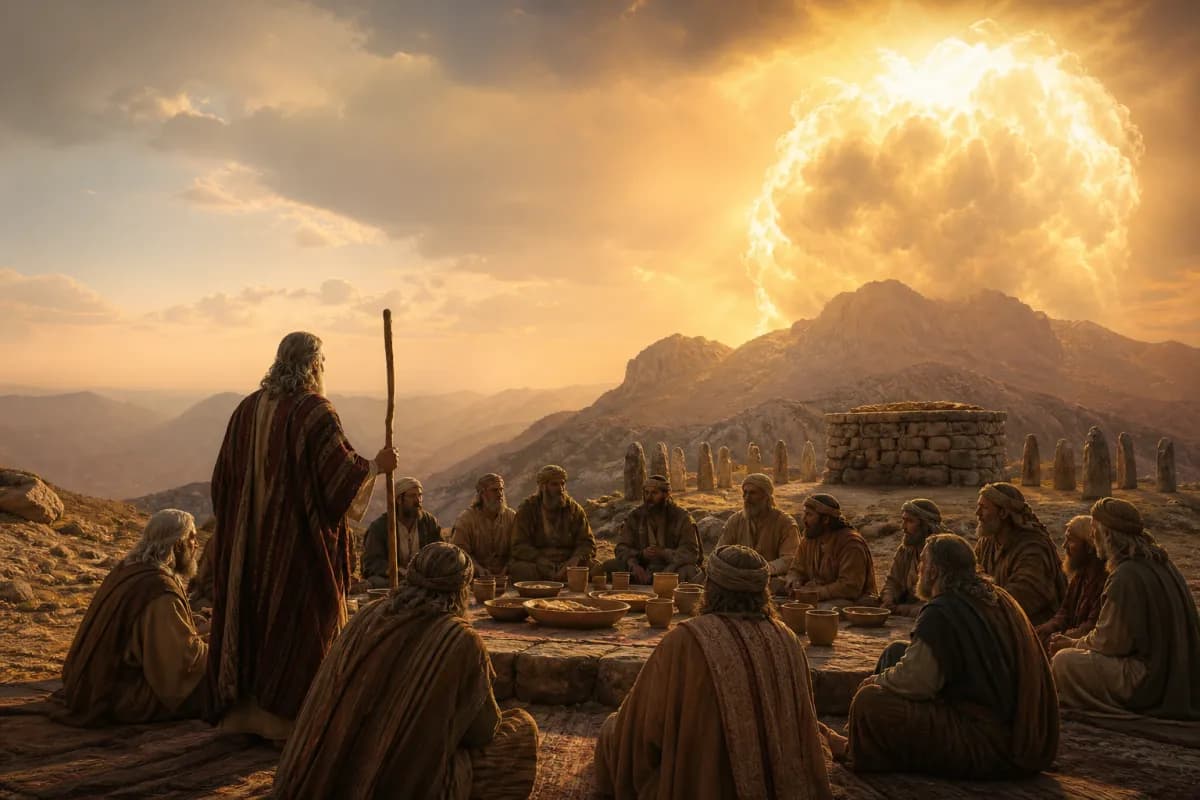
24:4Moses wrote all the LORD’s words, then rose up early in the morning and built an altar at the base of the mountain, with twelve pillars for the twelve tribes of Israel.
24:5He sent young men of the children of Israel, who offered burnt offerings and sacrificed peace offerings of cattle to the LORD.
24:6Moses took half of the blood and put it in basins, and half of the blood he sprinkled on the altar.
24:7He took the book of the covenant and read it in the hearing of the people, and they said, “We will do all that the LORD has said, and be obedient.”
24:8Moses took the blood, and sprinkled it on the people, and said, “Look, this is the blood of the covenant, which the LORD has made with you concerning all these words.”
24:9Then Moses, Aaron, Nadab, Abihu, and seventy of the elders of Israel went up.
24:10They saw the God of Israel. Under his feet was like a paved work of sapphire stone, like the skies for clearness.
24:11He didn’t lay his hand on the nobles of the children of Israel. They saw God, and ate and drank.
CONTEXTUAL OVERVIEW
Exodus 24 stands at a hinge in the Sinai story. The Lord has spoken His commands, and Israel now publicly enters the covenant those commands express. The people answer, “All the words that the Lord has spoken we will do,” but the narrative does not rest covenant relationship on verbal resolve alone. It includes altar, sacrifice, blood, written words, and God-given access.
The closing meal is startling. Moses, Aaron, Nadab, Abihu, and seventy elders see a manifestation associated with the God of Israel and yet are not destroyed; they eat and drink. Exodus gives no full description of God’s form, and it protects His transcendence even as it records real fellowship. The holy God makes a way for a people He has redeemed to draw near.
HISTORICAL AND LITERARY CONTEXT
Covenants in the ancient world often involved declared terms, witnesses, and solemn rites. Exodus uses this recognizable covenant form but grounds it in the Lord’s prior grace: He has already brought Israel out of Egypt. The twelve pillars correspond to the twelve tribes, making the ceremony representative of the whole nation rather than a private spiritual experience for Moses alone.
The blood is divided between altar and people after Moses reads the book of the covenant. Blood represents life given in sacrifice and marks the seriousness of belonging to the God whose commands are being received. The later failure of Israel does not make the rite empty; it shows why covenant mercy must reach deeper than human promise-making.
SECTION-BY-SECTION ANALYSIS
- Covenant words · Exodus 24:8Israel hears and receives God’s commands before it claims covenant fellowship.
- Covenant blood · Exodus 24:6Sacrificial blood marks the gravity of access to God and the life-for-life seriousness of sin.
- Covenant meal · Exodus 24:7The leaders’ meal portrays fellowship granted by God rather than casually assumed by people.
CHRIST IN THIS PASSAGE
Jesus deliberately echoes Exodus 24 at the Last Supper when He speaks of the new covenant in His blood. The connection is explicit: His death is not merely a moving example of love but the covenant sacrifice through which forgiveness is secured and a people is brought to God.
Hebrews also explains that the Sinai blood points forward while remaining incomplete. Christ enters once for all by His own blood and opens lasting access to God. The meal before God in Exodus is therefore a real covenant gift and a forward-looking pattern: through Jesus, forgiven sinners receive fellowship with the Father and are sent to proclaim His reconciling mercy.
REFLECTION
Many people approach God by rehearsing what they intend to do better. Exodus 24 takes obedience seriously, but it refuses to make human resolve the foundation of access. Come to God through the blood of Jesus, confessing sin honestly and receiving the mercy that makes faithful obedience possible.
The covenant meal also corrects isolated faith. Jesus gathers people into a reconciled community around His table and mission. Receive worship as shared fellowship, seek peace with fellow believers where possible, and let the grace you have received make you ready to speak of Christ to those who remain far from God.
Original Hebrew Word Study
Exodus 24:3
מִשְׁפָּטִים
mishpatim · H4941
Usually translated: ordinances, judgments, or regulations
Mishpatim means concrete judgments or legal decisions—the kind of rulings by which justice is actually carried out. Moses is not merely repeating religious rules; he is placing God’s justice before a covenant people whose worship must shape ordinary life.
Exodus 24:7
נַעֲשֶׂה וְנִשְׁמָע
na’aseh ve-nishma · H6213 / H8085
Usually translated: “we will do and we will hear”
Shema means more than receiving sound. In biblical Hebrew, hearing often carries the sense of listening attentively and responding in obedience. Israel is pledging more than agreement with God’s words; they are receiving His voice as binding on their lives.
Follow the Scripture trail
Blood, Promise, and a Meal Before God in the larger story
The connection: At Sinai, God confirms His covenant through word, blood, and a meal before His presence. Jesus establishes the new covenant through His own blood, forgives sin, gathers a people into fellowship with God, and sends them out to announce His reconciliation.
Respond to the passage
Approach God today on the basis of Jesus’ blood rather than your record. If a relationship within Christ’s people needs truthful repair, take one humble step toward peace and pray for an opportunity to share the gospel’s reconciling grace.
- Why are both God’s written words and covenant blood central to this ceremony?
- What does the meal before God reveal about access to His holiness?
- How does Jesus’ new-covenant blood fulfill and surpass the Sinai ceremony?
Prayer
Lord Jesus, thank You for establishing the new covenant through Your blood. Keep me from trusting my promises more than Your mercy. Draw me near to the Father, form me into a faithful member of Your people, and make me a witness of Your reconciliation. Amen.