Passage Study
Willing Gifts for the Dwelling of God
Exodus 25:1–25:9
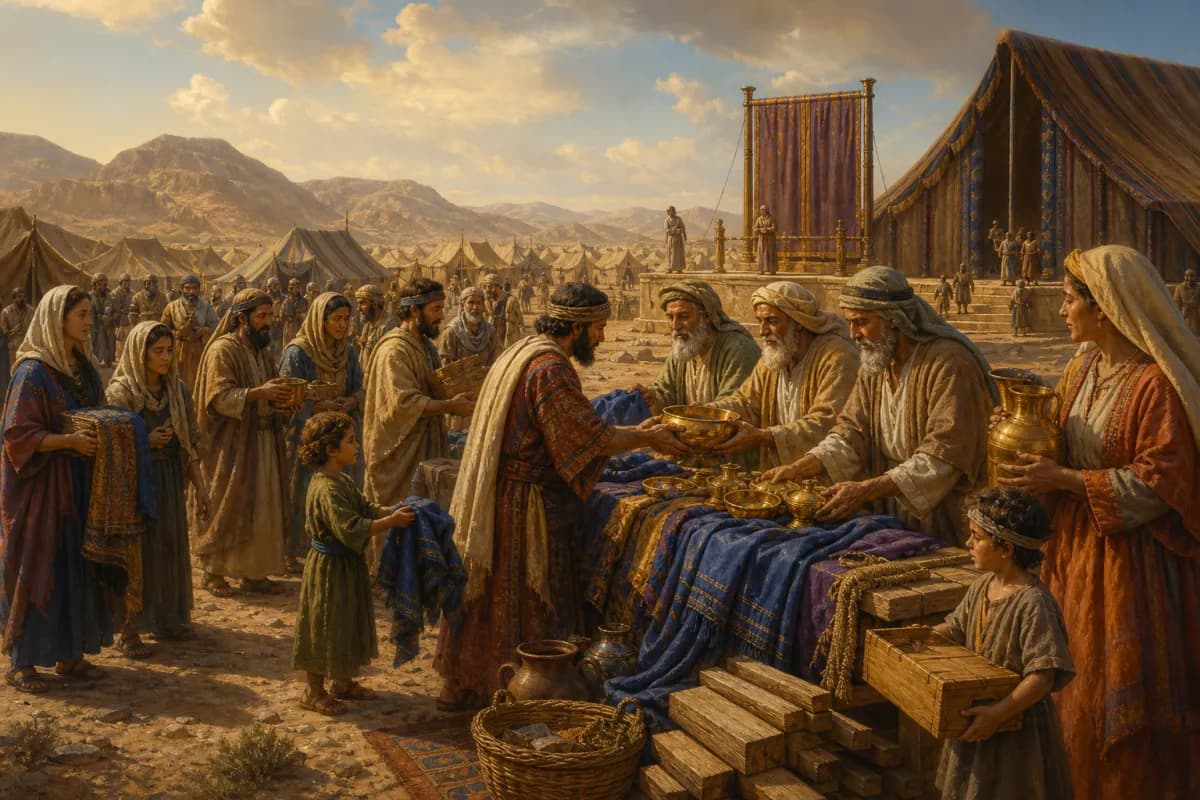
Exodus 25:1–9 opens the tabernacle instructions by calling Israel to bring willing offerings so that the Lord may dwell among them. Gold, fabric, skins, wood, oil, spices, and stones are gathered according to God’s pattern, showing that worship is a grateful response to God’s prior rescue and a holy arrangement for His presence. Jesus is the true dwelling of God with humanity and gathers a people who give themselves freely for His mission.
- In this study
- 9 verses · 5 movements
Exodus 25
25:1The LORD spoke to Moses, saying,
25:2“Speak to the children of Israel, that they take an offering for me. From everyone whose heart makes him willing you shall take my offering.
25:3This is the offering which you shall take from them: gold, silver, bronze,
25:4blue, purple, scarlet, fine linen, goats’ hair,
25:5rams’ skins dyed red, sea cow hides, acacia wood,
25:6oil for the light, spices for the anointing oil and for the sweet incense,
25:7onyx stones, and stones to be set for the ephod and for the breastplate.
25:8Let them make me a sanctuary, that I may dwell among them.
25:9According to all that I show you, the pattern of the tabernacle, and the pattern of all of its furniture, even so you shall make it.
CONTEXTUAL OVERVIEW
Exodus 25 begins the detailed instructions for the tabernacle just after covenant confirmation. The first word is an invitation to bring, not a demand to earn rescue. Israel gives because the Lord has already delivered it from Egypt and bound Himself to it by covenant mercy. The sanctuary will make visible the astonishing purpose of the exodus: God intends to dwell among His people.
The list of materials is concrete—precious metals, colored yarn, linen, skins, wood, oil, spices, and stones. Worship is not vague feeling detached from created things. God directs a communal offering and a physical dwelling according to His pattern, teaching Israel that His presence is a gift to receive reverently, not a project to design according to taste.
HISTORICAL AND LITERARY CONTEXT
Many of the materials recall the plunder Israel received from Egypt before departing. What once belonged to the house of bondage is now freely offered for the dwelling of the Redeemer. Exodus does not describe God as needy; the Creator owns all things. The offering reveals the hearts of a people learning to return His gifts in worship.
Ancient temples commonly represented a god’s presence in a city, but Israel’s tabernacle differs decisively from an idol-house. The Lord cannot be contained or manipulated, and no image of Him is made. The pattern comes from God on the mountain because Israel’s worship must be shaped by the God who speaks, not by a visible object it can control.
SECTION-BY-SECTION ANALYSIS
- Willing hearts · Exodus 25:2The sanctuary begins with grateful generosity, not a transaction by which Israel purchases God’s favor.
- A dwelling among the people · Exodus 25:8The goal is covenant presence: the God who rescued Israel chooses to live in its midst.
- The revealed pattern · Exodus 25:9God’s design protects worship from becoming an attempt to contain, image, or manipulate Him.
CHRIST IN THIS PASSAGE
The tabernacle is a strong biblical pattern of God dwelling with His people, and John deliberately says that the Word became flesh and made His dwelling among us. Jesus is not merely another sacred structure; He is God the Son come near in human flesh, the place where God’s holiness and mercy meet sinners.
His death and resurrection open the way for a people to become God’s dwelling by the Spirit. That does not turn buildings or offerings into guarantees of God’s favor. Jesus’ saving mission creates willing worship: people redeemed by grace offer resources, work, and themselves so that the good news of His presence can reach others.
REFLECTION
Giving can reveal whether we see resources as a fortress for self or as gifts from God for His purposes. Exodus does not make every Christian gift identical to tabernacle materials, but it does ask a searching question: has grace made your heart more willing to offer what you have for the worship and mission of God?
Bring your specific resources before Jesus—money, skill, time, hospitality, and influence. Ask where they can serve His people and make His gospel clearer to those who do not yet know Him. Generosity becomes worship when it flows from the presence we have received in Christ rather than from pressure or a desire to be seen.
Original Hebrew Word Study
Exodus 25:2
תְּרוּמָה
terumah · H8641
Usually translated: contribution or offering set apart
Terumah is a contribution set apart for a sacred purpose. The sanctuary begins with willing gifts, teaching that God’s dwelling among His people is received as grace and answered with freely given devotion.
Follow the Scripture trail
Willing Gifts for the Dwelling of God in the larger story
The connection: God calls redeemed Israel to bring willing gifts so that His holy presence may dwell among them according to His revealed pattern. In Jesus, God has dwelt with humanity decisively, and His saving grace forms a Spirit-filled people who offer themselves and their resources for His mission.
Respond to the passage
Ask Jesus to identify one resource you treat as only your own. Give it a concrete place in His work this week—through generosity, hospitality, skilled service, or support for gospel witness—and do so freely rather than for recognition.
- Why does the call to a sanctuary offering begin with willing hearts?
- How do the materials and the revealed pattern protect Israel from treating worship as self-expression?
- How does Jesus as God dwelling among us reshape Christian generosity and mission?
Prayer
Lord Jesus, You have come near to me by grace and made Your people Your dwelling by the Spirit. Free me from possessiveness and the need to be noticed. Make my time, resources, and abilities willing offerings that serve Your church and make Your saving mission known. Amen.