Passage Study
The Ark: God’s Covenant Word at the Center
Exodus 25:10–25:22
Exodus 25:10–22 gives Israel the ark, the mercy seat, and the cherubim as the innermost furniture of the sanctuary. The ark holds the testimony; above it God promises to meet and speak. Holy fellowship therefore begins with God’s covenant word and His provided mercy. Jesus fulfills this pattern by bringing God’s word and reconciliation to sinners, opening access to the Father through His saving sacrifice.
- In this study
- 13 verses · 5 movements
Exodus 25
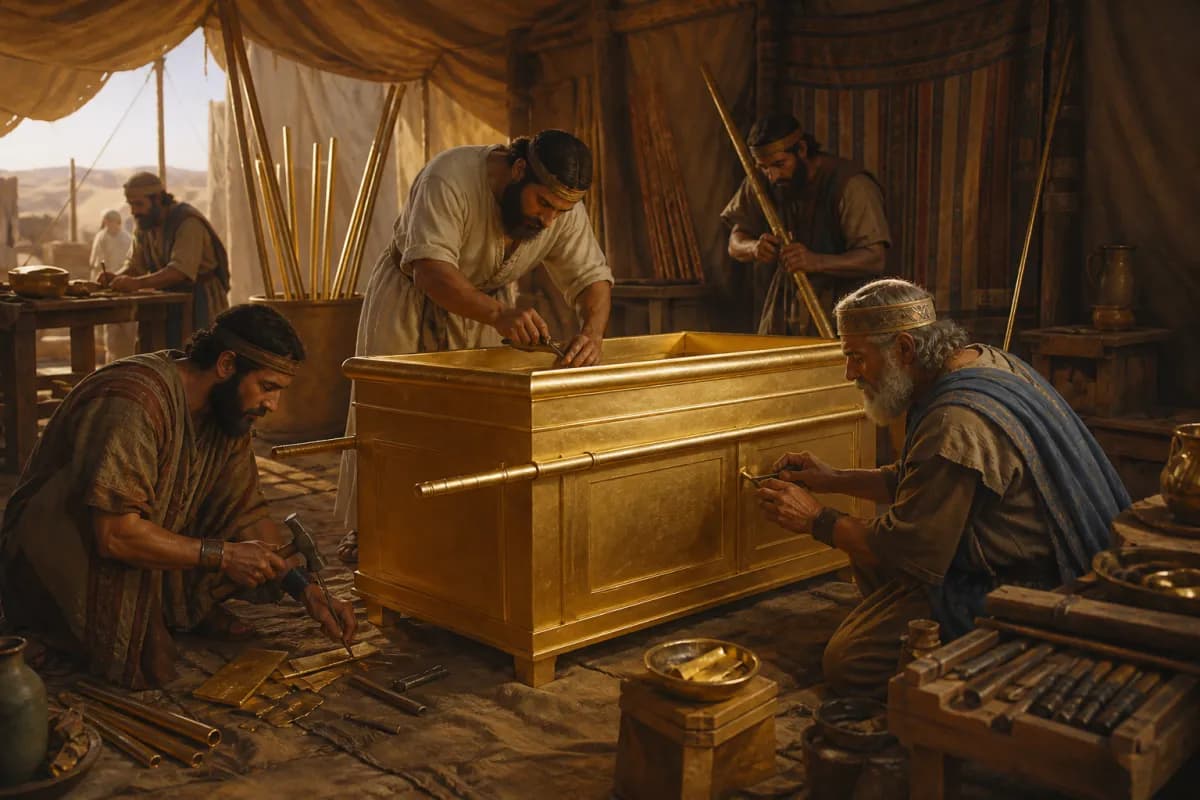
25:10“They shall make an ark of acacia wood. Its length shall be two and a half cubits, its width a cubit and a half, and a cubit and a half its height.
25:11You shall overlay it with pure gold. You shall overlay it inside and outside, and you shall make a gold molding around it.
25:12You shall cast four rings of gold for it, and put them in its four feet. Two rings shall be on the one side of it, and two rings on the other side of it.
25:13You shall make poles of acacia wood, and overlay them with gold.
25:14You shall put the poles into the rings on the sides of the ark to carry the ark.
25:15The poles shall be in the rings of the ark. They shall not be taken from it.
25:16You shall put the covenant which I shall give you into the ark.
25:17You shall make a mercy seat of pure gold. Two and a half cubits shall be its length, and a cubit and a half its width.
25:18You shall make two cherubim of hammered gold. You shall make them at the two ends of the mercy seat.
25:19Make one cherub at the one end, and one cherub at the other end. You shall make the cherubim on its two ends of one piece with the mercy seat.
25:20The cherubim shall spread out their wings upward, covering the mercy seat with their wings, with their faces toward one another. The faces of the cherubim shall be toward the mercy seat.
25:21You shall put the mercy seat on top of the ark, and in the ark you shall put the covenant that I will give you.
25:22There I will meet with you, and I will tell you from above the mercy seat, from between the two cherubim which are on the ark of the covenant, all that I command you for the children of Israel.
CONTEXTUAL OVERVIEW
The first object described for the sanctuary is not an ornament but a chest for the testimony—the covenant tablets that communicate God’s will for His redeemed people. Israel’s worship is therefore ordered around a word it receives, not religious feeling it invents.
The ark’s cover becomes the place from which God promises to meet Moses and give commands for Israel. The covenant word inside the ark and the mercy above it belong together: the God who speaks holy commands also provides a way for His people to remain in relationship with Him.
HISTORICAL AND LITERARY CONTEXT
Ancient temples could contain images of deities, but Exodus does not put an image of Israel’s God in the ark. The cherubim are heavenly throne-guardians, not a replacement for the Lord. This distinction fits the command against making an image to control or represent God.
The poles remain in the rings of the ark. Israel’s God chooses to dwell among a pilgrim people, but His holiness cannot be treated as portable magic. Later narratives underscore the danger of handling the ark outside God’s instruction; Exodus begins by specifying careful, reverent transport.
SECTION-BY-SECTION ANALYSIS
- The testimony · Exodus 25:22God’s covenant instruction is placed at the center of Israel’s worship and life.
- The mercy seat · Exodus 25:21God promises a meeting place above the ark, where mercy and holiness are not separated.
- The carrying poles · Exodus 25:13Even travel is governed by reverence; God’s presence is a gift, never a possession.
CHRIST IN THIS PASSAGE
The ark does not directly describe Jesus in every detail, but it establishes a lasting covenant pattern: sinful people need God to provide both His word and a merciful meeting place. The New Testament presents Christ as God’s definitive self-revelation and as the sacrifice through whom sins are dealt with rather than ignored.
Paul uses the Greek term often translated “place of atonement” when speaking of Christ’s death, and Hebrews connects the sanctuary’s mercy seat with Christ’s priestly work. Jesus brings people to God not by making sacred objects controllable, but by His once-for-all sacrifice and risen presence. His mission sends forgiven people to live under His word and announce His mercy.
REFLECTION
It is easy to want God’s comfort without His testimony—presence without a word that corrects, commands, and remakes us. Exodus holds them together. Receive Scripture as the speech of the God who desires fellowship with His people, including where it exposes what needs repentance.
Come to God through Jesus rather than through religious familiarity or performance. His mercy is not permission to be casual with sin; it is the costly gift that makes honest confession and renewed obedience possible. Let that mercy shape the way you speak of Christ to those who feel far from God.
Original Hebrew Word Study
Exodus 25:10
אָרוֹן
aron · H727
Usually translated: chest or ark
Aron is a chest. This ark is the covenant chest that holds the testimony, so it keeps God’s word at the center of Israel’s worship rather than functioning as a religious good-luck object.
Follow the Scripture trail
The Ark: God’s Covenant Word at the Center in the larger story
The connection: The ark gathers God’s testimony and His promised meeting into the heart of Israel’s sanctuary. Jesus fulfills this covenant need by revealing the Father and making atonement, bringing sinners near and sending them with the message of His mercy.
Respond to the passage
Bring one place where you have wanted God’s help while resisting His word into prayer. Confess it to Jesus, receive His mercy, and take one concrete step of obedience that shows His authority is welcome there.
- Why is the testimony placed inside the ark rather than treated as an optional addition to worship?
- What does the promise to meet and speak above the mercy seat reveal about God’s initiative?
- How does Christ’s sacrifice keep mercy from becoming casualness about sin?
Prayer
Lord Jesus, thank You for bringing me near to the Father through Your costly mercy. Put Your word at the center of my life, expose my resistance, and make me a faithful witness to the reconciliation You provide. Amen.