Passage Study
Bread Before the Presence of God
Exodus 25:23–25:30
Exodus 25:23–30 directs Israel to make a table for the bread of the Presence, set continually before the Lord. The table declares that the tribes live by God’s provision and before His face. Jesus is the bread of life who gives Himself for the world, gathering His people into grateful dependence and shared fellowship for His saving mission.
- In this study
- 8 verses · 5 movements
Exodus 25
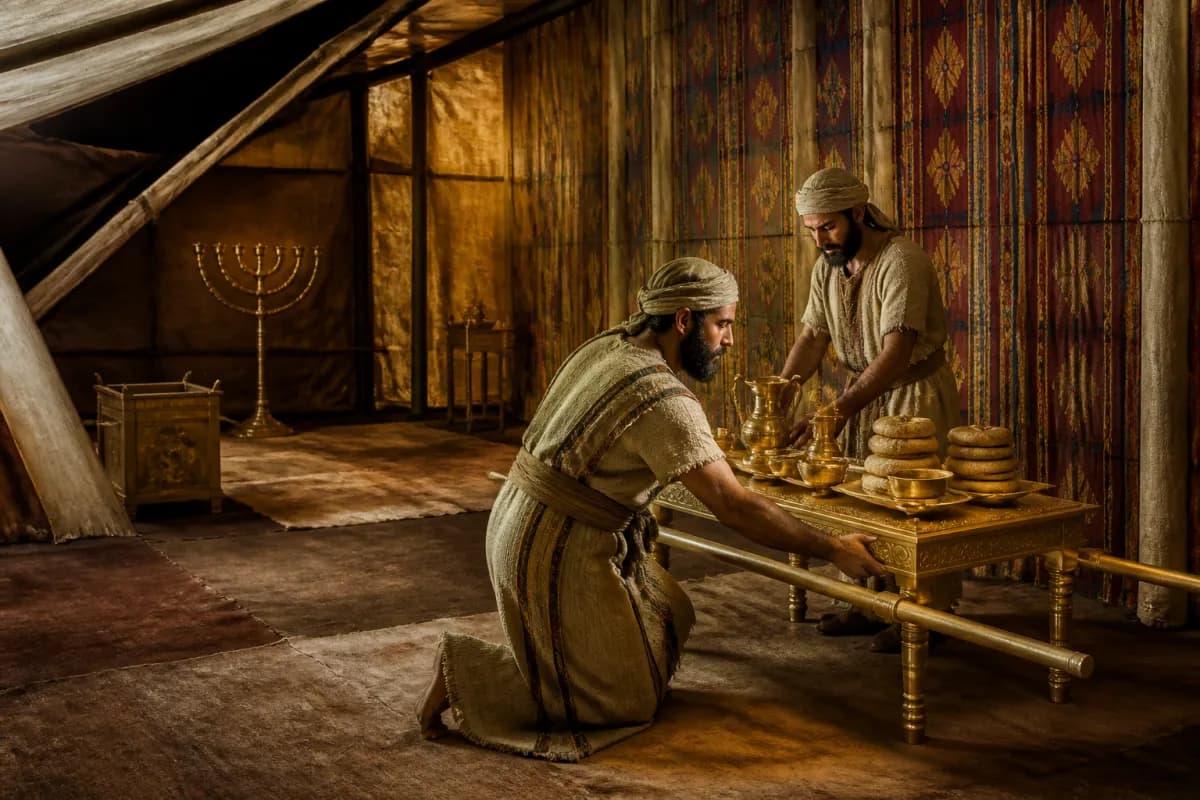
25:23“You shall make a table of acacia wood. Its length shall be two cubits, and its width a cubit, and its height one and a half cubits.
25:24You shall overlay it with pure gold, and make a gold molding around it.
25:25You shall make a rim of a hand width around it. You shall make a golden molding on its rim around it.
25:26You shall make four rings of gold for it, and put the rings in the four corners that are on its four feet.
25:27The rings shall be close to the rim, for places for the poles to carry the table.
25:28You shall make the poles of acacia wood, and overlay them with gold, that the table may be carried with them.
25:29You shall make its dishes, its spoons, its ladles, and its bowls with which to pour out offerings. You shall make them of pure gold.
25:30You shall set bread of the presence on the table before me always.
CONTEXTUAL OVERVIEW
Immediately after the ark, Exodus describes a table. God’s holy dwelling is not represented as a distant abstraction; it includes a continual sign of His provision for the covenant people. The bread is before the Lord, reminding Israel that ordinary sustenance comes from Him and is to be received in His presence.
The table is deliberately portable, with rings and poles like the ark. Israel will carry this ordered worship through the wilderness. Its future in the promised land must never erase its dependence on the God who fed it before it owned fields or harvests.
HISTORICAL AND LITERARY CONTEXT
The “bread of the Presence” is literally bread of the face or presence. Leviticus later specifies twelve loaves, corresponding to Israel’s tribes, set before the Lord on each Sabbath. The bread is not food God requires; it is a covenant sign that the whole people is remembered before Him.
The table has utensils for arranging and presenting the bread. Its details resist the idea that access to God is private or improvised. Israel’s life before the Lord has a given form, and its shared food becomes a fitting sign of dependence, fellowship, and ordered worship.
SECTION-BY-SECTION ANALYSIS
- Bread before God · Exodus 25:30The continual bread represents the covenant people living under God’s care and gaze.
- Twelve tribes remembered · Exodus 25:23Leviticus’s later twelve loaves show that no tribe is absent from the sign of God’s provision.
- Portable provision · Exodus 25:27The table travels with Israel, teaching dependence before abundance has arrived.
CHRIST IN THIS PASSAGE
The passage itself does not call the table a prediction of the incarnation, but the Bible’s bread theme finds a strong fulfillment in Jesus. He calls Himself the bread of life and gives His flesh for the life of the world. Israel’s continual bread prepares readers to see that life comes from God and is ultimately sustained by His saving gift in Christ.
Jesus also feeds crowds, shares table fellowship with sinners, and gives His disciples a meal that remembers His death. His mission creates a people who know their deepest hunger is not met by abundance alone. They receive Him by faith and share what God gives so that others may hear and see the gospel.
REFLECTION
Daily provision can become invisible precisely because it is daily. Give thanks by naming particular food, work, people, and strength you have received from God. Gratitude interrupts the illusion that your life is self-supplied.
Jesus calls His church to more than private spiritual consumption. Open a table, share a meal, or meet a practical need in a way that points to the generous Savior. The bread before God invites us to live openly before Him and generously toward neighbors.
Original Hebrew Word Study
Exodus 25:30
פָּנִים
panim · H6440
Usually translated: face or presence
Panim literally means face or presence. The bread placed continually before the Lord signifies an ordered life lived before Him; Israel’s daily provision and fellowship are held in His presence.
Follow the Scripture trail
Bread Before the Presence of God in the larger story
The connection: The bread of the Presence keeps Israel’s daily life before the giving God. Jesus gives the reality to which this provision points: He is the bread of life, gathering a grateful people whose shared life displays His saving generosity to the world.
Respond to the passage
Thank God for one ordinary provision you have begun to overlook, then share a concrete provision with someone else this week in Jesus’ name.
- Why is the bread kept continually before the Lord?
- How does the portable table speak to Israel’s wilderness dependence?
- How does Jesus as the bread of life reshape Christian gratitude and generosity?
Prayer
Lord Jesus, You are the bread of life. Forgive my forgetful self-reliance, teach me to receive daily provision with thanks, and make my table and resources a witness to Your generous saving grace. Amen.