Passage Study
Woven Curtains for God’s Dwelling
Exodus 26:1–26:14
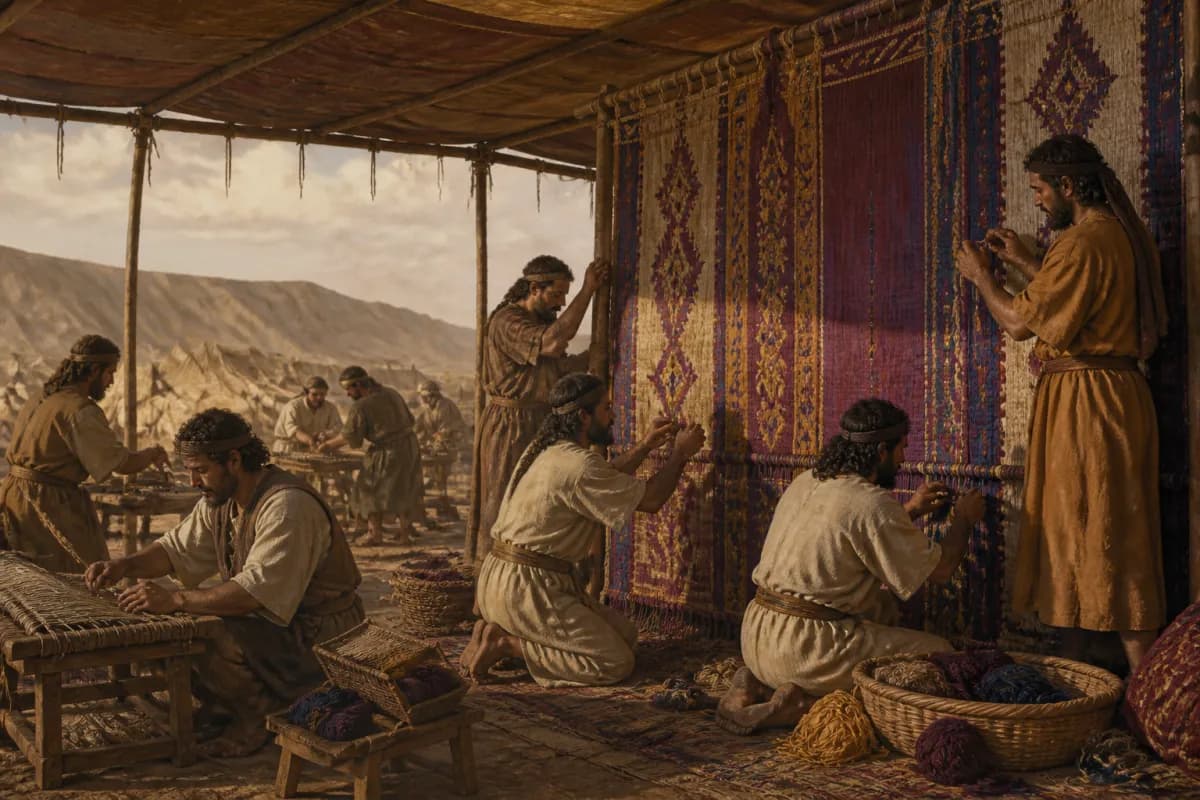
Exodus 26:1–14 gives exact instructions for the linen curtains, loops, clasps, and protective coverings of the tabernacle. Their unity, beauty, and layers serve one purpose: the holy God chooses to dwell among a redeemed people by His own gracious provision. Jesus is God dwelling with us and opens a new way into God’s presence through His saving death.
- In this study
- 14 verses · 5 movements
Exodus 26
26:1“Moreover you shall make the tabernacle with ten curtains of fine twined linen, and blue, and purple, and scarlet, with cherubim. You shall make them with the work of a skillful workman.
26:2The length of each curtain shall be twenty-eight cubits, and the width of each curtain four cubits: all the curtains shall have one measure.
26:3Five curtains shall be coupled together to one another, and the other five curtains shall be coupled to one another.
26:4You shall make loops of blue on the edge of the one curtain from the edge in the coupling, and you shall do likewise on the edge of the curtain that is outermost in the second coupling.
26:5You shall make fifty loops in the one curtain, and you shall make fifty loops in the edge of the curtain that is in the second coupling. The loops shall be opposite one another.
26:6You shall make fifty clasps of gold, and couple the curtains to one another with the clasps. The tabernacle shall be a unit.
26:7“You shall make curtains of goats’ hair for a covering over the tabernacle. You shall make eleven curtains.
26:8The length of each curtain shall be thirty cubits, and the width of each curtain four cubits: the eleven curtains shall have one measure.
26:9You shall couple five curtains by themselves, and six curtains by themselves, and shall double over the sixth curtain in the forefront of the tent.
26:10You shall make fifty loops on the edge of the one curtain that is outermost in the coupling, and fifty loops on the edge of the curtain which is outermost in the second coupling.
26:11You shall make fifty clasps of bronze, and put the clasps into the loops, and couple the tent together, that it may be one.
26:12The overhanging part that remains of the curtains of the tent—the half curtain that remains—shall hang over the back of the tabernacle.
26:13The cubit on the one side and the cubit on the other side, of that which remains in the length of the curtains of the tent, shall hang over the sides of the tabernacle on this side and on that side, to cover it.
26:14You shall make a covering for the tent of rams’ skins dyed red, and a covering of sea cow hides above.
CONTEXTUAL OVERVIEW
The detailed curtain instructions can feel remote until their purpose is remembered: Israel’s God is making a dwelling in the center of a redeemed camp. The curtains form both a beautiful inner sanctuary and weather-resistant outer layers. Nearness to God is not vague spirituality; it comes through the concrete provision He gives.
The woven cherubim echo the guardians at Eden’s entrance, yet the tabernacle makes a remarkable change. The holy God still sets boundaries, but He is also making a way to dwell with His people. Exodus holds distance and grace together rather than treating either as optional.
HISTORICAL AND LITERARY CONTEXT
A portable sanctuary fits Israel’s wilderness journey. Linen, goat hair, skins, loops, and clasps create a structure that can be assembled, carried, and protected. The text’s care with materials conveys that God’s dwelling belongs in the real conditions of a traveling people, not only in a permanent city.
The exact identification of the final outer covering is debated in translation, especially the animal term often rendered fine leather or porpoise skins. The passage’s clear point does not depend on solving that question: the dwelling is covered and protected according to God’s instruction.
SECTION-BY-SECTION ANALYSIS
- Joined as one · Exodus 26:6Loops and clasps make many panels one tabernacle, serving one dwelling place for the Lord.
- Cherubim woven in · Exodus 26:1The guardians recall holy boundaries while the tabernacle announces God’s willingness to dwell with His people.
- Covered and protected · Exodus 26:2Outer layers preserve the sanctuary in the wilderness and show that God’s provision includes durable care.
CHRIST IN THIS PASSAGE
The tabernacle is a strong canonical pattern of God choosing to dwell among His people. John says that the Word became flesh and “dwelt” among us, using language that evokes the tabernacle. Jesus is not merely another sacred space; He is God the Son come near in human flesh.
Hebrews connects the sanctuary’s ordered access with Christ’s saving death and priestly mediation. The curtain materials do not individually predict events in Jesus’ life, but the entire dwelling system creates longing for lasting access to God. Jesus fulfills that longing by bringing forgiven people into the Father’s presence and sending them to announce this welcome.
REFLECTION
God’s detailed provision shows that He cares about drawing near to His people. If you feel spiritually displaced or worn by a long journey, remember that Jesus meets people in the wilderness of real life. His presence is not reserved for a polished version of you.
The joined curtains also offer a modest picture of shared life. God forms one dwelling, not a collection of isolated panels. Pursue a practical act of unity in Christ’s church—repair a strained relationship, carry a burden, or make room for someone who feels outside—and let it point to the God who comes near.
Original Hebrew Word Study
Exodus 26:1
מִשְׁכָּן
mishkan · H4908
Usually translated: dwelling place or tabernacle
Mishkan means dwelling place. The detailed curtains belong to God’s decision to dwell in the midst of Israel, making every boundary and beauty of the sanctuary serve His holy nearness.
Follow the Scripture trail
Woven Curtains for God’s Dwelling in the larger story
The connection: The tabernacle curtains make a protected dwelling where the holy God comes near to Israel. Jesus brings that purpose to its fullness as God with us, opening lasting access to the Father and forming one people for His mission.
Respond to the passage
Tell Jesus where you feel far from God or from His people. Receive His welcome, then take one specific step toward embodied fellowship with a believer who needs encouragement.
- How do the curtains hold together beauty, protection, and holiness?
- Why should readers avoid assigning meanings to every material when Exodus does not explain them?
- How does Jesus fulfill the tabernacle’s purpose of God dwelling among His people?
Prayer
Lord Jesus, You came near in our humanity and opened the way to the Father. Meet me in my weariness, make me grateful for Your presence, and form me into a faithful part of Your people for the sake of Your mission. Amen.