Passage Study
Frames and Bases: A Stable Dwelling in the Wilderness
Exodus 26:15–26:30
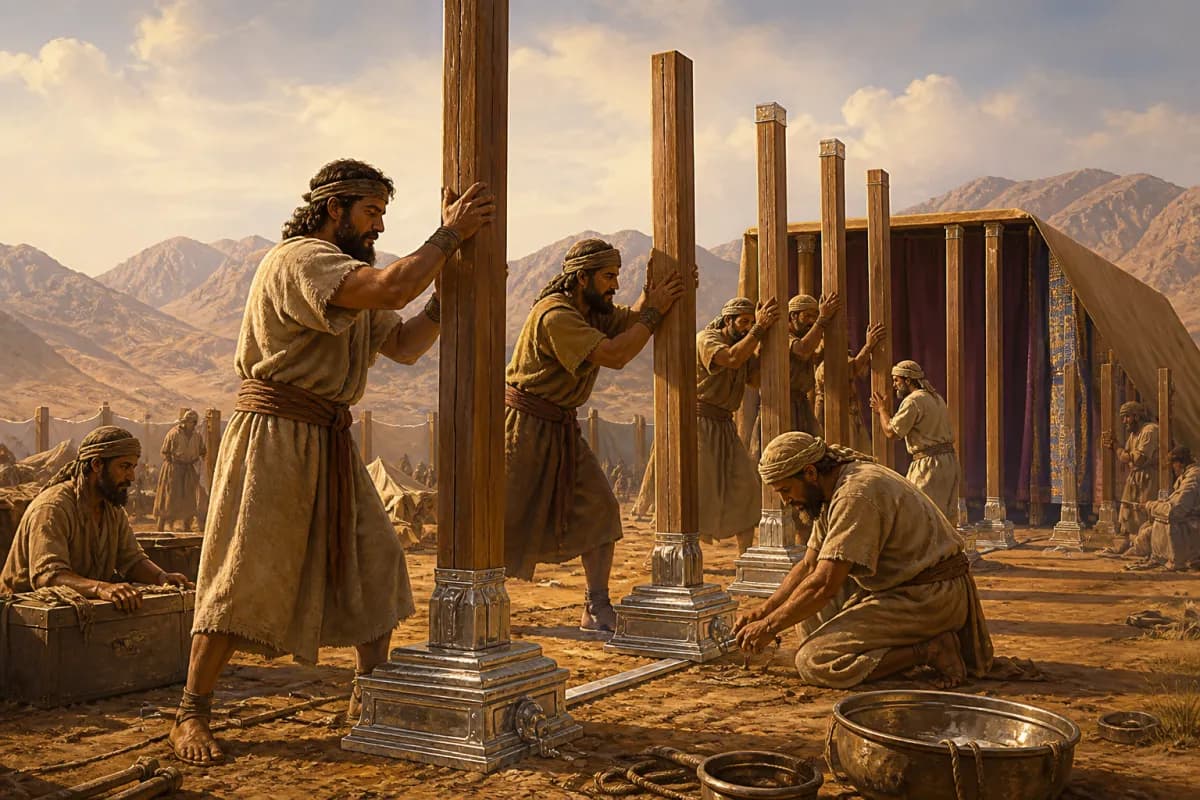
Exodus 26:15–30 specifies the upright acacia frames, silver bases, bars, and corner construction that give the tabernacle its stable form. These details show that God’s dwelling among Israel is ordered and durable even in a wilderness journey. Jesus makes His people a holy dwelling by the Spirit, building them together for faithful worship and mission.
- In this study
- 16 verses · 5 movements
Exodus 26
26:15“You shall make the boards for the tabernacle of acacia wood, standing upright.
26:16Ten cubits shall be the length of a board, and one and a half cubits the width of each board.
26:17There shall be two tenons in each board, joined to one another: thus you shall make for all the boards of the tabernacle.
26:18You shall make twenty boards for the tabernacle, for the south side southward.
26:19You shall make forty sockets of silver under the twenty boards; two sockets under one board for its two tenons, and two sockets under another board for its two tenons.
26:20For the second side of the tabernacle, on the north side, twenty boards,
26:21and their forty sockets of silver; two sockets under one board, and two sockets under another board.
26:22For the far side of the tabernacle westward you shall make six boards.
26:23You shall make two boards for the corners of the tabernacle in the far side.
26:24They shall be double beneath, and in the same way they shall be whole to its top to one ring: thus shall it be for them both; they shall be for the two corners.
26:25There shall be eight boards, and their sockets of silver, sixteen sockets; two sockets under one board, and two sockets under another board.
26:26“You shall make bars of acacia wood: five for the boards of the one side of the tabernacle,
26:27and five bars for the boards of the other side of the tabernacle, and five bars for the boards of the side of the tabernacle, for the far side westward.
26:28The middle bar in the middle of the boards shall pass through from end to end.
26:29You shall overlay the boards with gold, and make their rings of gold for places for the bars. You shall overlay the bars with gold.
26:30You shall set up the tabernacle according to the way that it was shown to you on the mountain.
CONTEXTUAL OVERVIEW
After the curtains, Exodus turns to the upright framework that holds the dwelling in place. The frames are not decorative trivia. A sanctuary that travels through wilderness needs a stable, ordered structure so that the God-given place of meeting can stand in the midst of the camp.
The passage keeps repeating dimensions, bases, and connections. God’s presence is a gift, but His people cannot create or rearrange its terms by preference. What seems ordinary—wood, sockets, and measurements—serves the extraordinary reality that the Lord dwells among a redeemed people.
HISTORICAL AND LITERARY CONTEXT
The frames are made of acacia wood, the same durable wilderness wood used for other sanctuary furnishings, and stand in silver bases. Their repeated shape allows the tabernacle to be assembled and taken down as Israel travels. The text therefore fits the mobile setting of Exodus rather than assuming a fixed temple building.
The back corners receive special attention so that the structure is properly joined. Ancient construction details can be difficult to reconstruct precisely, but the literary emphasis is clear: the dwelling is securely fitted together according to God’s disclosed pattern. Israel’s worship rests on God’s provision, not improvisation.
SECTION-BY-SECTION ANALYSIS
- Upright frames · Exodus 26:15The boards give the tabernacle a stable form suited to worship in the wilderness.
- Joined corners · Exodus 26:17Careful connections keep the dwelling one coherent structure rather than scattered pieces.
- Pattern from the mountain · Exodus 26:30The repeated command grounds Israel’s worship in revelation rather than preference.
CHRIST IN THIS PASSAGE
These frames are not a direct allegory of individual Christians, and Exodus does not make that claim. Their place in the tabernacle nevertheless serves a strong biblical theme: God provides an ordered dwelling for His presence among His people.
Through Christ’s reconciling death, the New Testament describes Jews and Gentiles being built together into a dwelling place for God by the Spirit. Jesus Himself is the cornerstone, not a frame within a self-built religious structure. His saving mission creates a stable people whose unity rests on Him and whose life becomes a witness to the Father’s welcome.
REFLECTION
Faith can feel fragile when life moves quickly, but God does not ask His people to invent their own foundation. Return to what He has given: Christ’s finished work, His word, prayer, and the faithful fellowship of His church. Stability grows through received grace and practiced obedience.
Notice the places where connections need strengthening: a neglected friendship, a church responsibility, a shared burden no one has named. In Christ, unity is not uniformity or mere efficiency. It is a Spirit-created life in which people are joined together to display God’s dwelling mercy to the world.
Original Hebrew Word Study
Exodus 26:15
קֶרֶשׁ
qeresh · H7175
Usually translated: frame or board
Qeresh is an upright frame or board. These are not decorative details: the frames and bases give the dwelling its stable structure, showing that the Lord provides an ordered way for His holy presence among Israel.
Follow the Scripture trail
Frames and Bases: A Stable Dwelling in the Wilderness in the larger story
The connection: The tabernacle’s frames give God’s wilderness dwelling a stable, joined form. In Jesus, God builds a reconciled people into His Spirit-filled dwelling, sending them to proclaim the mercy that brought them from darkness into light.
Respond to the passage
Identify one connection in Christ’s church that needs faithful attention. Take a concrete step to strengthen it this week, trusting that Jesus is building His people on a foundation you do not have to manufacture.
- Why does Exodus give so much attention to frames, bases, and corners?
- What does the repeated mountain pattern teach about worship?
- How does Ephesians use building language without turning each tabernacle detail into an allegory?
Prayer
Lord Jesus, You are the sure cornerstone. Establish me in Your grace, strengthen the bonds of Your church, and make us a faithful dwelling where Your mercy is seen and Your saving mission is proclaimed. Amen.