Passage Study
The Veil: Holy Presence and a Given Way In
Exodus 26:31–26:37
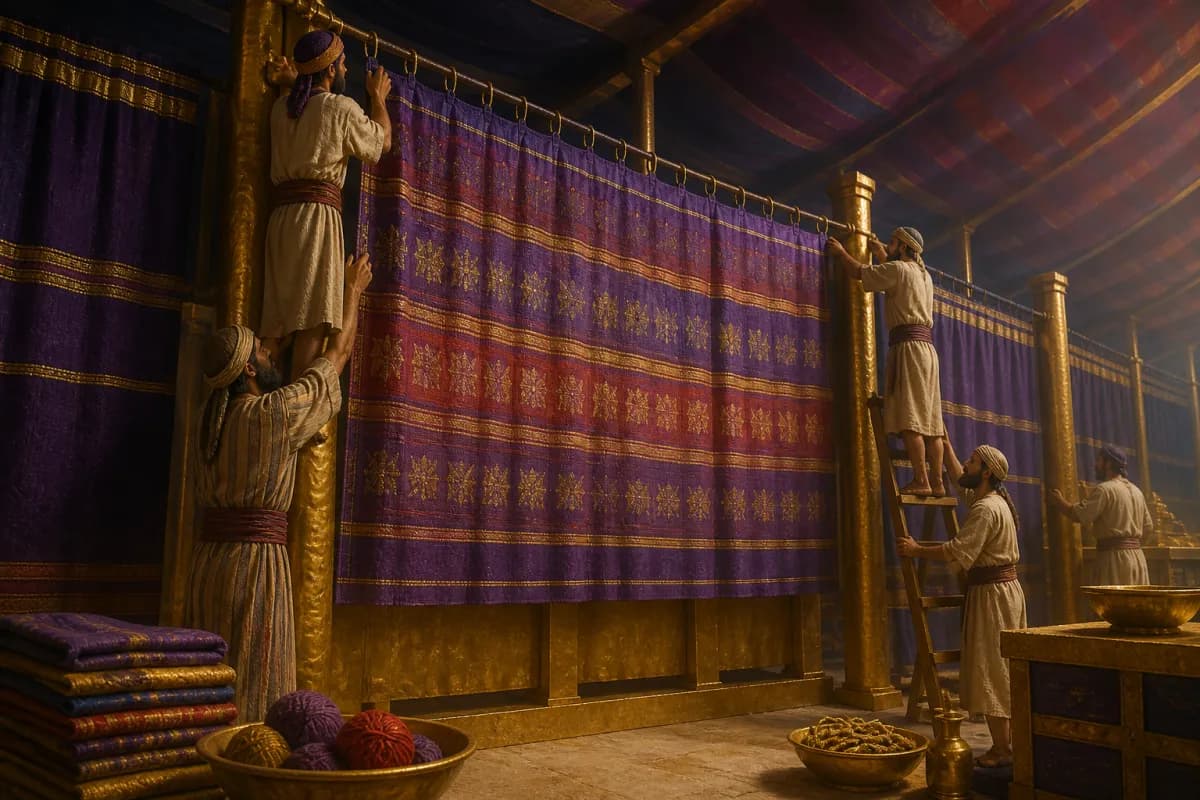
Exodus 26:31–37 commands a woven veil between the Holy Place and the Most Holy Place, then a screen for the tent entrance. The barriers make a double truth visible: the Lord truly dwells among Israel, yet sinful people cannot walk into His holiness on their own terms. Jesus fulfills this sanctuary pattern by giving His life to bring repentant sinners near to the Father.
- In this study
- 7 verses · 5 movements
Exodus 26
26:31“You shall make a veil of blue, and purple, and scarlet, and fine twined linen, with cherubim. It shall be the work of a skillful workman.
26:32You shall hang it on four pillars of acacia overlaid with gold; their hooks shall be of gold, on four sockets of silver.
26:33You shall hang up the veil under the clasps, and shall bring the ark of the covenant in there within the veil. The veil shall separate the holy place from the most holy for you.
26:34You shall put the mercy seat on the ark of the covenant in the most holy place.
26:35You shall set the table outside the veil, and the lamp stand opposite the table on the side of the tabernacle toward the south. You shall put the table on the north side.
26:36“You shall make a screen for the door of the Tent, of blue, and purple, and scarlet, and fine twined linen, the work of the embroiderer.
26:37You shall make for the screen five pillars of acacia, and overlay them with gold. Their hooks shall be of gold. You shall cast five sockets of bronze for them.
CONTEXTUAL OVERVIEW
The tabernacle’s curtains and frames have prepared a dwelling place; these verses now regulate movement within it. The inner veil separates the ark and mercy seat from the Holy Place. Israel is being taught that the God who chose to live in its camp is not available for casual access.
Yet the text describes a screen at the entrance as well as a veil within. The sanctuary is neither an empty exclusion nor an open room. God provides a real place and a real way to draw near, while guarding the holiness that sin cannot survive without atonement.
HISTORICAL AND LITERARY CONTEXT
The veil bears cherubim, recalling the cherubim who guard the way to the tree of life after Eden. Exodus does not say that the tabernacle simply recreates Eden, but the shared guardians appropriately remind readers that God’s life-giving presence is holy and human rebellion has consequences.
Leviticus later restricts entry behind this veil to the high priest, and only on the Day of Atonement with sacrificial blood. That later instruction explains why the division matters. The veil is not an arbitrary sacred decoration; it belongs to a worship system that takes sin, mediation, and God’s mercy seriously.
SECTION-BY-SECTION ANALYSIS
- Cherubim on the veil · Exodus 26:31The woven guardians make the holiness of God’s inner dwelling visible.
- The ark behind it · Exodus 26:34God’s testimony and mercy occupy the place most carefully guarded.
- An entrance screen · Exodus 26:36God provides a real, ordered way of approach rather than abandoning His people outside.
CHRIST IN THIS PASSAGE
The veil does not predict each detail of Jesus’ death, but it establishes the problem His saving work addresses: sinners need God Himself to provide a way into His holy presence. The Gospels report the temple curtain tearing at Jesus’ death, and Hebrews interprets Christ’s sacrifice as opening confident access to God.
Jesus does not make holiness less holy. He bears sin and serves as the true mediator so that those who trust Him may draw near with cleansed consciences. His mission also sends those brought near to invite others to the Father, never by religious control but by announcing the mercy Christ has secured.
REFLECTION
Some people treat God as distant because they know their guilt; others treat Him casually because they have forgotten His holiness. The veil corrects both errors. Bring sin into honest confession, and receive the welcome Jesus has won instead of trying to manage shame through performance.
When you speak of Christ, do not offer vague spirituality or a technique for self-improvement. Tell the truer news: the holy God has made a costly way for sinners to come home. That message gives courage to pray and kindness toward people who believe they are beyond welcome.
Original Hebrew Word Study
Exodus 26:31
פָּרֹכֶת
parokhet · H6532
Usually translated: veil or curtain
Parokhet is the veil that separates the Most Holy Place. It teaches that God truly dwells near His people while access to His holy presence remains guarded and must be received on His terms.
Follow the Scripture trail
The Veil: Holy Presence and a Given Way In in the larger story
The connection: The veil makes Israel feel both the gift and the danger of God’s nearness. Jesus fulfills the sanctuary’s hope by bearing sin, opening access to the Father, and sending a reconciled people to announce that welcome.
Respond to the passage
Name one place where guilt has made you hide from God or where familiarity has made you careless. Bring it to Jesus in confession, then thank Him aloud for the access His sacrifice provides.
- Why does Exodus give both an entrance screen and an inner veil?
- What do the cherubim communicate without turning the veil into a secret code?
- How does Jesus open access to God while preserving the seriousness of holiness?
Prayer
Lord Jesus, You gave Yourself to bring sinners near to the Father. Replace my hiding and my presumption with reverent confidence, and make me a truthful witness to the mercy You have secured. Amen.