Passage Study
The Bronze Altar: Approach Through Sacrifice
Exodus 27:1–27:8
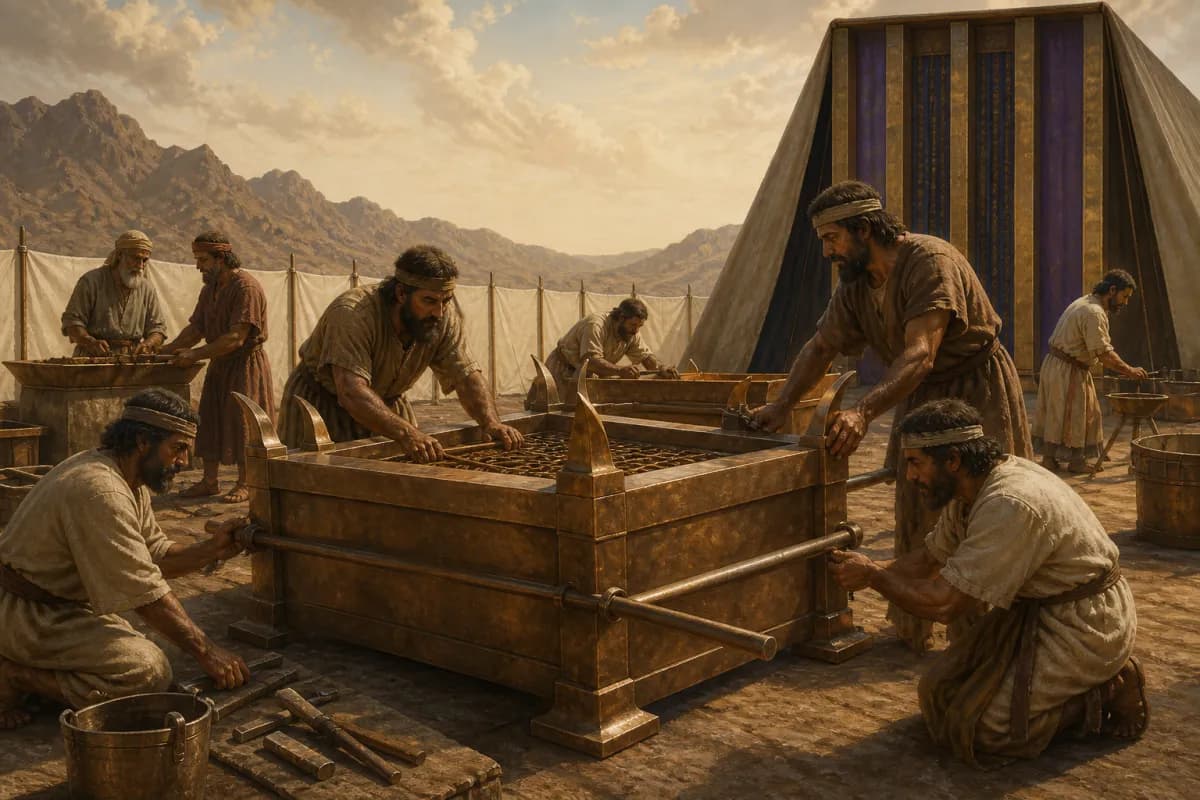
Exodus 27:1–8 describes the bronze altar standing at the entrance of the tabernacle court. Before Israel reaches the dwelling itself, sacrifice is placed at the center of approach. The altar teaches that reconciliation with the holy God requires the provision He appoints, and it prepares the way for Jesus, whose self-giving death deals decisively with sin.
- In this study
- 8 verses · 5 movements
Exodus 27
27:1“You shall make the altar of acacia wood, five cubits long, and five cubits wide. The altar shall be square. Its height shall be three cubits.
27:2You shall make its horns on its four corners. Its horns shall be of one piece with it. You shall overlay it with bronze.
27:3You shall make its pots to take away its ashes; and its shovels, its basins, its meat hooks, and its fire pans. You shall make all its vessels of bronze.
27:4You shall make a grating for it of network of bronze. On the net you shall make four bronze rings in its four corners.
27:5You shall put it under the ledge around the altar beneath, that the net may reach halfway up the altar.
27:6You shall make poles for the altar, poles of acacia wood, and overlay them with bronze.
27:7Its poles shall be put into the rings, and the poles shall be on the two sides of the altar when carrying it.
27:8You shall make it hollow with planks. They shall make it as it has been shown you on the mountain.
CONTEXTUAL OVERVIEW
The first major object encountered in the court is an altar, not a platform for human achievement. Israel comes near to God through a place where offerings are presented according to His command. The location makes the theological order visible: holy fellowship cannot be built on denial of sin.
This passage gives construction instructions, while Leviticus explains many sacrificial uses. Reading Exodus on its own, we should notice its emphasis on the altar’s durable, portable design. The God who travels with a wilderness people also provides a concrete place where their approach to Him is ordered by mercy.
HISTORICAL AND LITERARY CONTEXT
Altars were common in the ancient world, but Exodus defines Israel’s altar by the Lord’s revelation rather than by a generic religious impulse. Its horns, bronze overlay, grating, utensils, and carrying poles all serve worship in a mobile sanctuary. Israel may not improvise an approach to its God from surrounding practice.
The altar stands outside the inner dwelling, which preserves a crucial sequence. Sacrifice does not erase God’s holiness or make everyone a priest; it is God’s appointed means by which a sinful people can remain in covenant relationship and later receive fuller priestly ministry.
SECTION-BY-SECTION ANALYSIS
- At the entrance · Exodus 27:1Sacrifice stands before further sanctuary approach, naming the reality of sin.
- Bronze and fire tools · Exodus 27:3The materials serve an altar used in public, costly worship rather than decorative religion.
- Carrying poles · Exodus 27:7God’s appointed provision travels with His pilgrim people.
CHRIST IN THIS PASSAGE
Exodus does not identify the altar itself as Jesus, but the altar belongs to the sacrificial system whose purpose the New Testament says Christ fulfills. Jesus gives Himself willingly for sins; His cross is not an example of divine indifference to evil but God’s costly act of reconciliation.
Christ’s sacrifice is once for all, so Christians do not repeat Israel’s altar offerings. Yet the altar continues to train our imagination: forgiveness is grace, not denial, and coming to God rests on what He has provided. Those reconciled through Jesus are sent to tell others that peace with God is offered through Him.
REFLECTION
We can minimize sin by calling it a mistake, an appetite, or a private choice. The altar gives sin moral weight without leaving sinners hopeless. Let its cost move you to honest repentance and deeper gratitude for Christ rather than to self-condemnation or contempt for others.
A gospel conversation can begin with the human desire to make things right after harming someone. Explain that God has not ignored the rupture between Himself and us: Jesus gave Himself to reconcile those who trust Him. Offer that news with humility, remembering you stand by mercy too.
Original Hebrew Word Study
Exodus 27:1
מִזְבֵּחַ
mizbeach · H4196
Usually translated: altar
Mizbeach is an altar, the appointed place for sacrifice. The first major object of approach is therefore not a throne for Israel but a place where sin, cleansing, and restored fellowship are reckoned with before God.
Follow the Scripture trail
The Bronze Altar: Approach Through Sacrifice in the larger story
The connection: The altar meets Israel at the threshold with God’s appointed sacrifice. Jesus brings the sacrificial purpose to completion through His self-giving death, reconciling sinners to God and sending them with the message of peace.
Respond to the passage
Confess one sin you have been explaining away, and thank Jesus specifically that His mercy deals with real guilt. Then consider whom you could approach with a word of reconciliation or the gospel of peace.
- Why is the altar placed at the entrance of the court?
- What do the tools and grating contribute to the passage’s view of sacrifice?
- How does Christ’s once-for-all sacrifice shape repentance without requiring repeated offerings?
Prayer
Lord Jesus, thank You for giving Yourself to reconcile me to God. Keep me honest about sin, confident in Your mercy, and ready to speak of the peace You offer to people far from You. Amen.